Student PGs vs Working Professional PGs in Tricity: Operational Differences, Turnover Rates & Margin Comparison (2026)

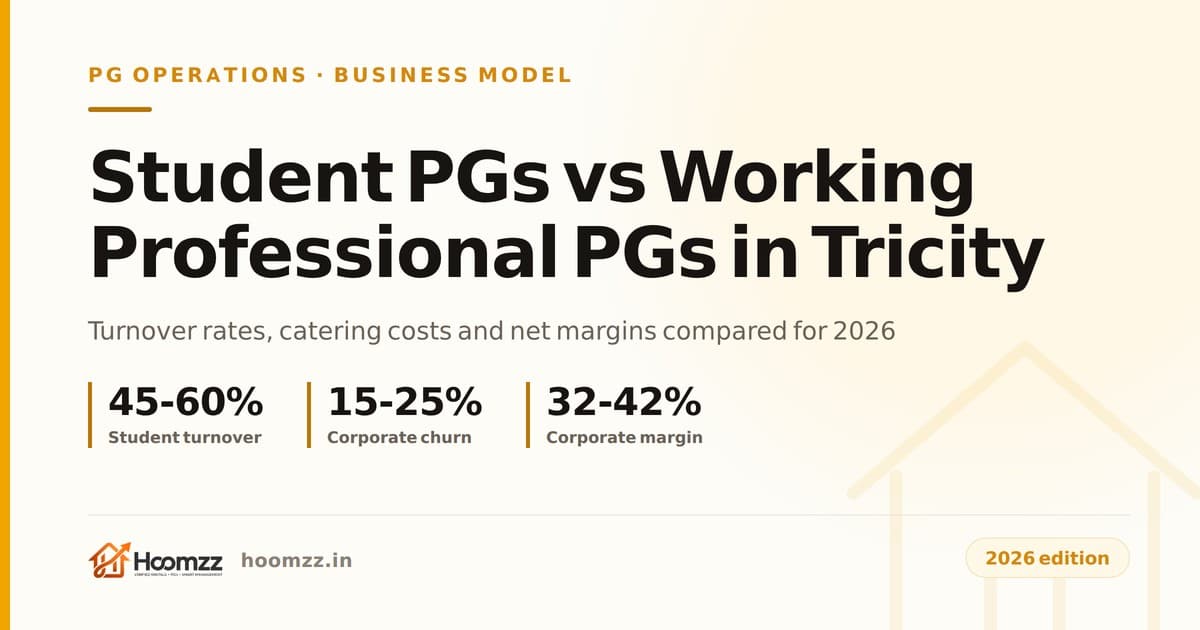
Comparing student and corporate PG business models in Chandigarh, Mohali, and Kharar. Learn how turnover rates, catering overhead, and seasonal vacancies impact net operating margins.
Short answer: In the Tricity rental market, student PGs generate higher bed density but suffer from 45% to 60% annual tenant turnover and a painful 60-day summer vacancy, producing net annual profit margins of 28% to 35% on leased properties. In contrast, corporate PGs catering to IT professionals in Mohali IT City and Sector 82 deliver stable year-round occupancy with turnover below 20%, lower catering overhead, and net margins of 32% to 42%. Hoomzz lists physically verified rentals across Chandigarh, Mohali, Panchkula and Zirakpur, allowing operators to bypass the standard 15-day broker commission on every bed turnover by publishing verified room and bed vacancies directly.
- 45–60%Student turnoverannual churn across Kharar & Sector 34
- 15–25%Corporate turnoverannual churn in Mohali IT corridor
- 32–42%Corporate net marginstable 12-month operational yield
- ₹0Broker commissiondirect bed listings on Hoomzz
Every commercial paying guest operator in the Tricity eventually faces a fundamental business choice: do you configure your property for high-density student housing, or do you tailor it for corporate working professionals? While both rental models convert residential square footage into recurring bed revenue, their underlying operational mechanics, tenant retention dynamics, and cash flow predictability could not be more different.
Local real estate Instagram pages and creators are an active source of listings and area info for Tricity renters today, yet short video reels never show the operational reality behind the scenes. They skip the frantic May room turnover when university semesters conclude, the daily friction of managing raw grocery inventories for fifty hostelers, the midnight disputes over air-conditioner electricity bills, and the 15-day broker commissions that eat away at net margins. Choosing between a student and a working professional tenant base is not just an aesthetic decision; it dictates your daily staff headcount, your capital expenditure cycle, and your net return on investment.
The Tricity accommodation market is geographically divided by tenant intent. Student housing clusters around institutional epicenters: Kharar along the Chandigarh University bus routes, Sunny Enclave and Landran near CGC, Chandigarh Sector 15 and 37 near Panjab University and DAV College, and Sector 34 catering to civil services and competitive exam coaching institutes. Meanwhile, corporate co-living concentrates heavily across the Mohali IT corridor—specifically Sector 82, Sector 83 JLPL Industrial Area, Phase 8B Industrial Focal Point near Bestech Business Tower, and Aerocity—alongside pockets near Chandigarh IT Park and Panchkula Industrial Area.
Bed Density, Room Configurations, and Pricing Power
The initial trade-off between the two models lies in space utilisation. Student PGs maximise bed density to offer accessible monthly price points, whereas corporate accommodations prioritise personal space, privacy, and quiet work environments.
1. Student Accommodations: High Density, Modest Ticket Size
In student hubs like Kharar, Landran, and Chandigarh Sector 15, operators typically convert standard bedrooms into triple-sharing or quad-sharing layouts. A 14x16 foot master bedroom often accommodates three single iron beds or two bunk beds, each paired with a compact steel almirah and a small study desk.
- Observed Bed Rents: Multi-sharing beds in student PGs rent for an observed range of ₹4,000 to ₹7,500 per month, which almost universally includes three daily mess meals. Private single rooms for students range between ₹8,500 and ₹12,000 per month, though they represent less than 15% of total student inventory.
- Revenue Density: By placing 3 beds in a 200 sq ft room at ₹6,000 per bed, an operator generates ₹18,000 in gross room revenue. However, after deducting food costs and high utility usage, the net room contribution compresses significantly.
2. Working Professional Accommodations: Lower Density, Premium Rates
Working professionals employed at software firms in Mohali Phase 8B, data centers in Sector 82, or consultancies near Chandigarh IT Park actively avoid high-density living. They look for private single rooms or spacious twin-sharing setups with attached washrooms, ergonomic chairs, and dedicated workstation desks.
- Observed Bed Rents: Twin-sharing beds in corporate PGs in Mohali Sector 82 and Aerocity rent for an observed range of ₹7,500 to ₹11,000 per month. Fully furnished single-occupancy rooms command ₹12,000 to ₹18,000 per month, with premium studio-style setups in newly built kothis reaching ₹20,000+.
- Meal Modality: Unlike student hostels, corporate accommodations rarely bundle three full meals. Most offer a breakfast-and-dinner package, or operate on a room-only basis with a shared pantry equipped with a microwave, refrigerator, and induction cooktop, leaving tenants to handle lunch at office cafeterias or via food delivery.
The Seasonality Trap: Turnover Rates & Summer Vacancy
The single greatest operational divide between student and professional PGs is the seasonality of occupancy. For student housing operators, the calendar year is defined by an abrupt academic cliff.
1. Student Turnover and the 60-Day Summer Slump
Student PGs in Chandigarh and Kharar face an annual tenant churn rate of 45% to 60%. Every year between mid-May and late July, university examinations end, graduating batches vacate permanently, and continuing students return to their home states for summer break. During these 60 to 75 days, occupancy in student facilities routinely drops to 50% to 65%.
This seasonal collapse creates extreme cash flow strain. If you lease the underlying building from a property owner, your fixed lease rent (typically ₹70,000 to ₹1,50,000 per month for an independent commercial kothi) remains due in full. Staff salaries for cooks, sweepers, and wardens must still be paid to prevent them from leaving for rival hostels. Water tariffs, commercial power fixed charges, and property taxes do not pause for summer vacations. An operator who generates healthy surpluses from August to April can watch their entire annual profit disappear across May, June, and July if summer reserves are not managed aggressively.
2. Working Professional PGs: Predictable 12-Month Stability
In contrast, corporate PGs in Mohali and Chandigarh experience an annual turnover rate of only 15% to 25%. Tech employees, healthcare staff, and corporate analysts work on year-round employment contracts rather than semester calendars. Vacancies occur randomly throughout the year due to job switches, remote work transitions, or marriage, rather than in a single catastrophic wave.
With standard 30-day notice periods enforced in rental agreements, corporate operators maintain steady 85% to 92% average annual occupancy. Predictable monthly cash inflows allow operators to service bank loans, pay building lease rents on time, and reinvest in property upgrades without the seasonal panic that grips student corridors every summer. Understanding these occupancy dynamics is critical when reviewing tenant vetting and rental yield models in Chandigarh and Mohali.
Mess and Kitchen Operations: The Silent Margin Killer
Many first-time PG operators assume that providing in-house food is a reliable profit center. In practice, running a commercial kitchen inside a residential property is an operational nightmare that frequently destroys net margins.
1. The Student Mess Operational Burden
Providing food is mandatory to attract students. Young college students rarely cook, and parents insist on three daily hot meals before paying an admission token. However, managing a 30-to-50 bed student mess involves severe operational friction:
- Wholesale Procurement & Inflation: Procuring fresh vegetables, dairy, cooking oil, and commercial LPG cylinders at volatile market rates requires daily cash tracking. Rising food prices directly compress margins because raising student mess fees mid-academic session is practically impossible.
- Labor Headaches: Full-time cooks and kitchen helpers are notoriously prone to sudden absenteeism. When a cook fails to report for the 7:00 AM breakfast shift before morning lectures, the operator faces immediate student revolts.
- Food Wastage: Weekend meal attendance drops unpredictably as students visit local cafes or travel home, leading to cooked food wastage that burns operating capital.
- Expense Share: Raw groceries, cooking fuel, kitchen maintenance, and cook salaries consume 25% to 32% of gross rental receipts in a standard student PG. Review our detailed breakdown on PG mess and food operations in Tricity for cost containment protocols.
2. The Corporate PG Streamlined Approach
Working professionals maintain irregular work shifts, frequently eat lunch at tech park cafeterias around Mohali Phase 8B and Bestech Business Tower, and socialize over dinners on weekends. Consequently, corporate PGs rarely provide three meals:
- Breakfast & Dinner Model: Preparing light breakfast (poha, parathas, eggs) and a standard dinner eliminates daytime kitchen staffing. Food outgo drops to 12% to 18% of gross revenue.
- Self-Catering Pantry: Many boutique co-living spaces in Sector 82 and Aerocity provide zero cooked meals. Instead, they provide a hygienic shared pantry with an RO water dispenser, microwave, induction plate, refrigerator, and modular storage. Tenants prepare quick breakfasts or order meals independently via food delivery apps.
- Operational Peace: Eliminating a full mess operation removes grease trap blockages, commercial LPG hazards, pest control emergencies, and 80% of daily tenant complaints.
The single largest unforced error made by Tricity PG operators is relying on offline brokers for room turnovers. Paying a broker 15 days of rent (₹4,000 to ₹7,000) every time a bed empties siphons off ₹60,000 to ₹1,20,000 in annual net profit for a 30-bed property. Direct verified listings eliminate this recurring drain entirely.
Utility Consumption, Sub-Meters, and Infrastructure Wear
How tenants use your physical property during the day determines your utility overhead and periodic maintenance bills.
1. High Daytime Load in Student Facilities
College timetables leave students with substantial free daytime hours. Between canceled lectures, exam preparatory leaves, and weekend study groups, student rooms remain occupied throughout the day. In summer months, desert coolers and air conditioners run 16 to 20 hours daily. Geysers in shared washrooms are left switched on continuously during winter.
Without individual sub-meters, electricity bills explode. A 30-bed student facility in Kharar can easily generate summer electricity bills exceeding ₹45,000 per month. Savvy operators install calibrated digital sub-meters for each room and charge electricity separately at local commercial or domestic slab rates (typically ₹8 to ₹10 per unit). In addition, student properties suffer higher physical wear and tear—scuffed walls, broken bed slats, clogged drain pipes, and damaged door locks—requiring annual repainting and hardware repairs.
2. Low Daytime Footprint in Corporate Accommodations
Working professionals typically leave for their offices by 9:00 AM and return after 7:00 PM. During peak daytime tariff hours, the building remains virtually empty, keeping baseline electricity and water consumption minimal. Fixtures and furniture experience far gentler handling.
However, professional tenants demand uncompromising infrastructure reliability. While a student might tolerate an hour of internet downtime or an uncooled lobby, a software engineer working remotely on a production deployment will not. Corporate PGs require:
- Dual High-Speed Fiber Connections: Two independent internet service providers (e.g., Airtel and JioFiber) configured on a load-balancing router to guarantee zero downtime.
- 100% Power Backup: A dedicated diesel generator (DG) or heavy-duty inverter system capable of running Wi-Fi routers, workstation laptop chargers, and room lighting during grid outages.
- Silent Climate Control: Split air conditioners rather than noisy window units or water coolers, paired with individual sub-meters. Learn more about co-living property standards in our guide to co-living rules and society guidelines for IT professionals in Mohali.
Financial Head-to-Head: 30-Bed P&L Model (2026 Projections)
To understand how these operational factors translate into bottom-line earnings, let us analyze a realistic annual profit and loss comparison for a 30-bed commercial property in the Tricity operating under a lease-and-manage model (where the operator leases the property from the building owner and manages the PG business).
| Financial & Operational Metric | 30-Bed Student PG (Kharar / Chd Sec 34) | 30-Bed Corporate PG (Mohali Sector 82 / IT City) |
|---|---|---|
| Room & Bed Configuration | 10 rooms (Triple sharing, 30 beds total) | 15 rooms (Twin sharing, 30 beds total) |
| Average Monthly Rent per Bed (Observed) | ₹6,500 (Includes 3 mess meals) | ₹9,500 (Includes breakfast & dinner) |
| Average Annual Occupancy Rate | 78% (Reflects May–July summer slump) | 88% (Year-round corporate stability) |
| Total Gross Annual Rent Collected | ₹18,25,200 | ₹30,09,600 |
| Building Lease Rent Paid to Landlord | ₹7,20,000 (₹60,000/month) | ₹10,80,000 (₹90,000/month) |
| Catering, Groceries & Kitchen Fuel | ₹5,10,000 (28% of gross revenue) | ₹4,20,000 (14% of gross revenue) |
| Housekeeping, Cook & Warden Salaries | ₹2,40,000 (Cook + helper + sweeper) | ₹2,16,000 (Cook/cleaner + sweeper) |
| Net Utility Costs (Power shortfall, water, Wi-Fi) | ₹90,000 (After sub-meter recoveries) | ₹1,10,000 (Dual fiber + DG fuel + water) |
| Maintenance, Hardware Wear & Upkeep | ₹60,000 (High room/furniture wear) | ₹45,000 (Lower physical wear) |
| Middleman Brokerage Churn (Offline model) | ₹72,000 (16 bed turnovers @ ₹4,500 cut) | ₹28,500 (6 bed turnovers @ ₹4,750 cut) |
| Total Annual Operating Expenses | ₹16,92,000 | ₹18,99,500 |
| Net Annual Operating Profit (EBITDA) | ₹1,33,200 | ₹11,10,100 |
| Net Operational Margin % (Leased Property) | 7.3% (Highly vulnerable to churn) | 36.9% (Predictable healthy return) |
| Net Operational Margin % (If Property Owned) | 46.7% (₹8,53,200 net yield) | 72.8% (₹21,90,100 net yield) |
The financial model illustrates an essential commercial truth: on a leased property, a student PG operates on razor-thin net margins. A prolonged summer vacancy or sudden food inflation can push a leased student facility into net operational losses. Conversely, if you own the underlying freehold property, both models generate strong cash flows, but the corporate model delivers more than double the net annual profit with significantly lower operational friction.
When to Choose the Student PG Model
- Your property is located within 2 km of major campuses (Chandigarh University, CGC Landran, Panjab University, or Sector 34 coaching centers).
- You own the freehold building outright and do not have monthly building lease obligations.
- You already operate an established in-house commercial kitchen or catering service.
- The room dimensions permit comfortable triple-sharing layouts to maximize bed volume.
- You have trusted on-site management capable of active gate discipline and curfew oversight.
When to Choose the Corporate PG Model
- Your property is situated in Mohali (Phase 8B, Sector 82, Aerocity), Chandigarh IT Park, or Panchkula.
- You operate under a master lease and require steady, 12-month cash flows to pay property rent reliably.
- You want to eliminate full-time mess operations and avoid high food inventory wastage.
- Your property features modern construction, attached bathrooms, and dedicated workstation desks.
- You prefer low-friction tenant interactions with self-disciplined working professionals.
Regulatory Mandates, Safety Norms, and Legal Realities
Regardless of whether you cater to college freshers or corporate software developers, operating a paying guest facility in the Tricity requires strict adherence to local administrative and police guidelines.
1. Mandatory Police Tenant Verification
Both Chandigarh and SAS Nagar (Mohali) districts operate under standing District Magistrate preventive orders making tenant police verification mandatory. Failing to submit tenant details to local police stations is a punishable offense under Section 223 of the Bharatiya Nyaya Sanhita (BNS). In Chandigarh, operators must submit Form B details online via e-Jan Sampark or at the jurisdictional police station. In Mohali and Kharar, verification is processed through Punjab Police Saanjh Kendras. Corporate tenants are generally quick to provide employer verification letters and corporate email IDs, simplifying compliance audits.
2. Biometric Access and CCTV Retention Rules
Local administrations require commercial PGs to deploy continuous electronic surveillance. Network Video Recorders (NVR) must maintain a minimum of 30 days of continuous footage covering main access gates, stairwells, and shared corridors. Cameras inside private bedrooms or washrooms are strictly prohibited by law. In girls' accommodations across Punjab and Chandigarh, appointing an on-site, 24/7 resident female warden is an explicit administrative requirement. For a complete audit checklist on hardware costs and fail-safe installations, read our guide on PG safety, biometric access and warden rules in Tricity.
3. Rent Control Acts & The Deposit Cap Reality
Property operators must understand the governing tenancy statutes across jurisdictions. Chandigarh remains governed by the East Punjab Urban Rent Restriction Act, 1949; the Chandigarh Administration notification applying the Assam Tenancy Act, 2021 was stayed and held in abeyance by the Punjab & Haryana High Court on 29 May 2026. Mohali, Kharar, and Zirakpur operate under the Punjab Rent Act, 1995, while Panchkula falls under the Haryana Urban (Control of Rent and Eviction) Act, 1973.
Crucially, there is no statutory two-month security deposit cap in force anywhere in the Tricity. In practice, operators mutually agree on security deposits with incoming occupants. For student PGs, operators commonly collect one month of rent as a refundable security deposit alongside an advance month of rent. For corporate PGs, market practice ranges between one and two months of deposit to protect against furniture and electronics damage.
Eliminating Middleman Commissions with Direct Listings on Hoomzz
Every time a student graduates or a corporate employee relocates, traditional offline property brokers take a 15-day rent cut to supply a replacement tenant. For a 30-bed property with typical student turnover, an operator loses upwards of ₹70,000 every single year purely in broker commissions.
Hoomzz fundamentally changes this dynamic. Instead of handing over hard-earned rental yield to middlemen, property owners and operators can list their verified PG rooms and beds on Hoomzz. Hoomzz lists physically verified rentals across Chandigarh, Mohali, Panchkula and Zirakpur, sending field representatives to inspect property conditions, room dimensions, security installations, and meal arrangements.
Verified badges instill immediate trust in searching tenants and concerned parents browsing PGs in Tricity. Direct tenant-to-operator messaging enables operators to fill vacant beds weeks before semester turnover begins—all with zero brokerage commissions. Operators can also project their property economics, simulate vacancy buffers, and evaluate lease yields using dedicated Tricity rental calculators.
Frequently Asked Questions
What is the average profit margin of a PG in Tricity?
Commercial PG accommodations in Chandigarh, Mohali, and Kharar typically operate at an average net profit margin of 28% to 42% of gross rental receipts when running at 85% or higher occupancy. Net margins depend heavily on property ownership structure: operators who own the underlying freehold kothi retain upwards of 45% net yield, whereas lease-and-operate managers paying fixed property rent to landlords see margins compressed to 20% to 30% after deducting catering, electricity, and staff salaries.
How does listing rooms and beds on Hoomzz reduce middleman commission?
Listing directly on Hoomzz connects PG operators directly with verified students and working professionals without paying the standard 15-day rent cut charged by local brokers on every bed turnover. Hoomzz physically verifies property credentials, room layouts, and safety features on-site, allowing owners to showcase their security infrastructure and attract quality tenants directly at zero brokerage.
What are the key security and safety installations required by local authorities?
Local administrations across Chandigarh and SAS Nagar district require commercial PGs to maintain an NVR-backed CCTV system with at least 30 days of continuous footage retention covering entry gates, common staircases, and corridors. Operators must also install functional ABC dry chemical fire extinguishers, ensure fail-safe openable emergency terrace exits, maintain Form B resident registers for police verification, and deploy a full-time resident female warden in all girls’ accommodations.
How do seasonal university cycles affect PG cash flow?
Tricity PGs face significant cash flow contractions during the annual May to July academic transition, when outgoing university students vacate rooms ahead of new admissions, often dropping occupancy to 50% to 65%. Well-managed operators offset this seasonal dip by securing advance booking tokens from incoming semester students via direct listing platforms, staggering corporate tenant leases, and maintaining summer internship short-stay packages.
Should PG operators install individual electricity sub-meters for student rooms?
Yes, installing calibrated digital sub-meters for individual rooms is essential to prevent high utility overhead and tenant disputes over air conditioner or geyser usage. Operators typically bundle a baseline electricity allowance into the monthly bed rent and charge any surplus consumption at actual domestic or commercial unit rates.
What is the standard security deposit collected for PGs in Chandigarh and Mohali?
Market practice across the Tricity typically ranges from one to two months of rent as a refundable security deposit, subject to mutual agreement between the operator and tenant. There is currently no statutory security deposit cap in force under regional tenancy acts, making clear written agreement clauses regarding notice periods and refund timelines vital.
Sources, and what here is judgement rather than data
Factual & Administrative Sources:
- Chandigarh Administration Estate Office Paying Guest Guidelines and building bye-laws documented by the Chandigarh Administration Official Portal and Chandigarh Housing Board.
- Public safety standing orders and online tenant verification procedures administered by Chandigarh Police e-Jan Sampark.
- Citizen security and tenant registration protocols managed by the Punjab Police Citizen Portal for SAS Nagar, Kharar, and Zirakpur.
- Reporting on local paying guest safety drives, fire department inspection notices, and the Punjab & Haryana High Court stay on the tenancy notification published by The Tribune India.
Editorial Judgement & Market Estimates:
- Observed monthly bed rents (₹4,000–₹7,500 for student beds; ₹7,500–₹18,000 for corporate rooms) reflect prevailing listings and market surveys across Kharar, Chandigarh Sectors 15/34, and Mohali Sector 82 in 2026.
- Turnover rates (45%–60% for students vs 15%–25% for professionals) and net operating margin models represent operational estimates from managed accommodations, not guaranteed investment yields.
👈 This comparison is based on market observations and publicly available data. Users should verify details independently.
Prioritize Hoomzz Real Estate News in your Google Search AI Overviews
Google's new search update lets you select trusted sources. Pin hoomzz.in to get our instant local market rates, builder updates, and renting news featured first in your AI answers.
Find Verified PGs & Hostels
Safe, hygienic AC/Non-AC PG accommodations with meals, Wi-Fi & zero broker markups in Tricity.