Renting to Bachelors vs Families in Chandigarh & Mohali: Legal Facts, Society Rules, Rent Yields & Tenant Safety (2026)

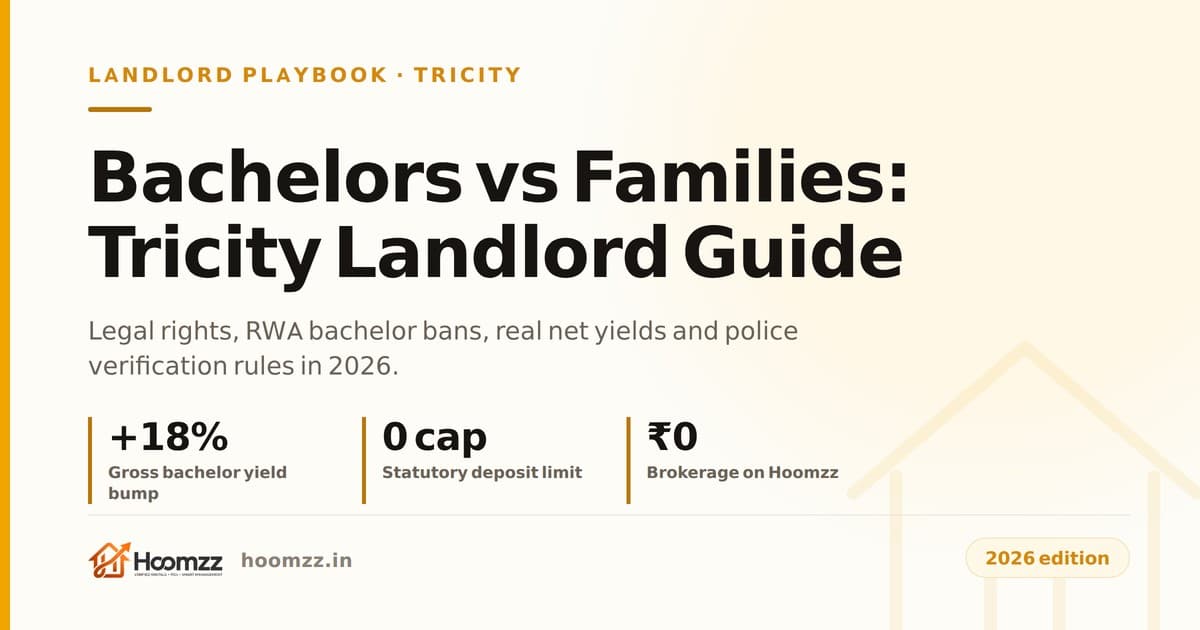
Renting to bachelors delivers 15% to 25% higher gross rent in Chandigarh and Mohali, but higher turnover often equalises net yields. Here is the legal reality on RWA bachelor bans, mandatory police verification, and real net rental returns in 2026.
Short answer: Renting to bachelors in Chandigarh and Mohali delivers an observed 15% to 25% higher gross rent compared to nuclear families, with shared 2BHK flats commanding ₹20,000–₹26,000 per month versus ₹16,000–₹21,000 for families. However, shorter tenancies (11–14 months) and higher turnover refurbishment costs trim net rental yields closer to parity (3.2% net for bachelors versus 3.4% net for long-term families). Legally, Resident Welfare Associations (RWAs) cannot enforce blanket bans on bachelors under Article 19(1)(e) of the Indian Constitution and property ownership statutes. Tenant police verification remains mandatory across Chandigarh and SAS Nagar under standing District Magistrate orders. Hoomzz lists physically verified rentals across Chandigarh, Mohali, Panchkula and Zirakpur, connecting landlords directly with vetted tenants at zero brokerage.
- +18%Gross bachelor rent bumpobserved across shared 2BHKs
- 11–14mAverage bachelor tenurevs 24–36 months for families
- 0 capStatutory deposit limitHigh Court abeyance in force
- ₹0Brokerage on Hoomzzsaving 15–30 days gross rent
Every Tricity landlord faces the same choice when a flat falls vacant: lease to a settled family for three years, or rent to young professionals and students paying a per-room premium? In major employment hubs like Sector 34 Chandigarh, Phase 8B Mohali, IT Park, and the Kharar bypass near Chandigarh University, bachelor groups represent the fastest-growing tenant segment.
Local real estate Instagram pages and creators are an active source of listings and area info for Tricity renters today, yet sorting through broker claims often obscures the legal and financial reality. Middlemen frequently claim bachelors ruin properties while pushing them to collect fresh 15-day commissions on annual turnovers, quoting conflicting rents and demanding advance token fees.
The Yield Reality: Gross Rent Premium vs Hidden Turnover Friction
Room pooling drives the bachelor rental bump: three IT professionals sharing a Mohali Sector 82 or Kharar 2BHK pay ₹7,000–₹8,500 each, generating ₹21,000 to ₹25,500 monthly gross compared to ₹16,000 to ₹21,000 from a family—an observed 15% to 25% gross bump. Near Chandigarh University or Sector 15, gross yields reach 4.8% to 5.2%.
However, three operational deductions reduce net returns:
- Turnover Vacancy: Bachelor tenancies average 11–14 months versus 24–36 months for families. A 45-day vacancy drains 12.5% of annual gross rent (each vacant month costs 8.3%), erasing the gross premium.
- Refurbishment: Multiple occupants increase daily wear, costing ₹18,000 to ₹32,000 per turnover in repainting and hardware repairs.
- Broker Churn: Traditional brokers charge 15–30 days rent per placement, taking 4.2% to 8.3% of annual revenue. Landlords can test these trade-offs on dedicated Tricity rental yield calculators.
Financial & Operational Comparison: Bachelors vs Families
Consider this three-year comparison for a ₹65 lakh 2BHK apartment in Mohali or Zirakpur:
| Metric / Factor | Bachelor & Student Roommates | Nuclear & Working Families | Net Landlord Impact |
|---|---|---|---|
| Observed Gross Rent (2BHK) | ₹20,000–₹26,000 / month | ₹16,000–₹21,000 / month | Bachelors yield 15%–25% higher gross rent |
| Average Tenancy Duration | 11–14 months | 24–36 months | Families provide 2× longer tenancy stability |
| Annual Vacancy Friction | 30–45 days per turnover cycle | 15–20 days every 2–3 years | Bachelor turnover risks 8.3%–12.5% annual rent loss |
| Refurbishment Outgo | ₹18,000–₹32,000 per exit | ₹10,000–₹18,000 every 2–3 years | Higher wear-and-tear consumes bachelor rent bump |
| Brokerage Cost Churn | 15–30 days rent every 12 months | 15–30 days rent every 24–36 months | Traditional brokers drain 4%–8% annual yield on bachelors |
| Estimated True Net Yield | 3.0%–3.3% net | 3.2%–3.5% net | Net yields converge after accounting for friction |
| RWA / Society Friction | Moderate to high (late entries, gate checks) | Low (society acceptance, easy approvals) | Bachelors require proactive landlord boundary-setting |
| Tenant Verification Process | Mandatory (individual forms per occupant) | Mandatory (primary earner + family particulars) | Equal legal duty under District Magistrate orders |
The 18% gross bachelor premium is mostly consumed by frequent vacancy, repainting, and broker fees. Capturing real profit requires eliminating intermediary deductions and setting structured lease rules.
The Legal Position: Can RWAs Ban Bachelors in Punjab & Chandigarh?
A frequent hurdle in the Tricity is pushback from Resident Welfare Associations. In several societies across Sector 68 Mohali, Sector 20 Panchkula, and VIP Road Zirakpur, committees attempt to bar single tenants or fine landlords. The legal position is unambiguous: RWAs have no statutory power to ban bachelors, single women, or students from renting apartments.
Under Article 300A and the Transfer of Property Act, 1882, property owners possess the absolute right to lease private property to any adult citizen, while Article 19(1)(e) guarantees citizens the right to reside anywhere in India. RWAs registered under the Societies Registration Act, 1860, or the Punjab Apartment Ownership Act, 1995, manage common amenities; they do not own private flats. Indian courts consistently hold that society bylaws cannot override constitutional rights. Any resolution banning bachelors is legally void (ultra vires).
An RWA cannot impose maintenance penalties on bachelor tenancies, deny gate entry, disconnect utilities, or demand moral character certificates. RWAs can enforce uniform community rules: quiet hours past 10:00 PM, assigned parking, visitor logging, and police verification slips. Landlords managing tech leases can consult our breakdown of co-living rules and society guidelines for IT professionals in Mohali Phase 8B and Sector 82, while those hosting female professionals should review our guide on female flatmate discovery and safety protocols in Chandigarh Sector 34 and 35.
Tenancy Statutes and the Security Deposit Myth in Tricity
Rumors in mid-2026 claimed a statutory two-month deposit cap had become mandatory across Chandigarh. That claim is legally inaccurate.
Here is the exact legal position: There is no statutory security-deposit cap anywhere in the Tricity.
The misconception originated when the Ministry of Home Affairs issued a notification on 6 May 2026 extending the Assam Tenancy Act, 2021 to Chandigarh, which included a two-month residential deposit limit. However, following legal petitions, the Punjab & Haryana High Court placed the notification in abeyance on 29 May 2026. Because that notification remains stayed, the East Punjab Urban Rent Restriction Act, 1949 continues to govern Chandigarh tenancies.
Similarly, Mohali, Kharar, and Zirakpur operate under the Punjab Rent Act, 1995, while Panchkula is governed by the Haryana Urban (Control of Rent and Eviction) Act, 1973. Neither statute caps security deposits; amounts remain strictly contractual.
Contractual Deposit Norms in Tricity: Because no statutory deposit ceiling applies, market practice standardises on 1 to 2 months of rent for unfurnished or semi-furnished flats. For fully furnished units with air conditioners, LED TVs, and modular appliances, landlords routinely collect 2 to 3 months of rent to secure against property damage. For tax implications on rent receipts, review our guide on taxation on rental income in Punjab and Chandigarh.
Tenant Safety & Mandatory Police Verification Across Tricity
While an RWA cannot ban bachelors, landlords carry a strict legal duty: tenant police verification is legally mandatory across Chandigarh UT and SAS Nagar district (Mohali, Kharar, and Zirakpur).
Enforced through standing District Magistrate preventive orders, failing to submit tenant particulars is a criminal offense under Section 223 of the Bharatiya Nyaya Sanhita (BNS, 2023) (formerly Section 188 IPC). Local police routinely file FIRs against defaulting landlords during security audits.
The verification process is digital:
- Chandigarh UT: Landlords submit details online via the Chandigarh Police e-Saathi portal or the e-Sampark network with photo ID, address proof, employer or college credentials, and rent agreement copy. The service is free and takes 10 to 15 days under Right to Service standards.
- SAS Nagar (Mohali): Administered via the Punjab Police Saanjh portal or local Saanjh Kendras (Phase 1 or Phase 8 Mohali). A nominal fee of approximately ₹200 applies, with verification completing in 5 to 10 working days.
Landlords must verify every adult occupant in a shared flat, not just the primary signatory. Both owners and tenants must also guard against advance listing fraud; review our guide on rental scams in Chandigarh Tricity and the five-minute listing verification checklist.
Which Tenant Profile Fits Your Property Strategy?
Choosing between bachelor tenants and nuclear families depends on your property layout, location, and management style. Neither tenant category is universally superior; each serves distinct landlord objectives.
Bachelor Tenants Work Best If:
- Your property is near IT clusters (Phase 8B, Sector 82) or education centers (Sector 34, CU Kharar).
- You want to maximize monthly cash flow and capture the 15%–25% gross rental premium.
- The apartment is furnished or fitted with durable, low-maintenance hardware.
- You are prepared to manage annual lease renewals and 11–14 month turnover cycles.
- You list directly without middleman brokerage cuts eating into your turnover margin.
Family Tenants Work Best If:
- Your property is located in quiet residential sectors (Sector 68–70 Mohali, Panchkula 20–21).
- You prioritize multi-year stability (2–3 years) with minimal vacancy interruption.
- You prefer passive management and want tenants who handle minor household maintenance.
- You own an unfurnished or semi-furnished floor and want tenants with their own furniture.
- You prefer avoiding unnecessary debates with conservative society management committees.
Landlord Playbook: 5 Steps to Safe, High-Yield Tenancy
Experienced property owners who consistently earn superior rental returns implement a systematic five-step onboarding framework, regardless of tenant profile:
- Execute an Individual-Named Lease DeedDraft an 11-month rent agreement naming every adult bachelor roommate individually with joint-and-several financial liability, barring unauthorized sub-letting.
- Complete Mandatory Police Verification PromptlySubmit verification forms through the Chandigarh Police portal or Punjab Police Saanjh within seven days of lease execution to comply with District Magistrate orders.
- Establish Constructive Alignment with the RWASubmit lease copies and police verification receipts to the society office early, establishing firm compliance while rejecting unauthorized bachelor bans or penalties.
- Conduct a Documented Move-In Condition InventoryInspect the property together with incoming tenants, taking dated photographs of paint and appliances to ensure a transparent security deposit settlement at move-out.
- List Directly on Verified ChannelsAvoid losing 15 to 30 days of rent to brokers on every turnover. Property owners can list their verified property directly on Hoomzz to reach qualified tenants with zero brokerage.
Hoomzz lists physically verified rentals across Chandigarh, Mohali, Panchkula and Zirakpur. Field teams verify layouts and ownership on-site. By removing broker commissions, owners protect net yields, while renters searching to rent properties in Tricity connect directly with verified landlords without deceptive markups.
Frequently Asked Questions
What are the mandatory legal requirements for landlords in Tricity?
Landlords in Chandigarh and SAS Nagar must complete tenant police verification under standing District Magistrate orders punishable under Section 223 BNS. Owners must also execute a written lease specifying rent, deposits, and notice terms. RWA approval is not a statutory requirement.
How does listing directly on Hoomzz protect landlord interests?
Listing directly on Hoomzz connects property owners with physically verified tenants across Chandigarh, Mohali, and Panchkula with zero brokerage. On-site verification confirms genuine ownership, preventing brokers from quoting inflated rents or collecting unauthorized token fees.
What is the standard dispute resolution process under local rent acts?
Tenancy disputes regarding rent arrears or eviction proceed before the local Rent Controller in the district courts. Chandigarh falls under the East Punjab Urban Rent Restriction Act, 1949, Mohali under the Punjab Rent Act, 1995, and Panchkula under the Haryana 1973 Act, with appeals heard by the Appellate Authority.
How can owners calculate their true net rental yield?
Landlords deduct annual property taxes, maintenance outgo, vacancy losses, and broker onboarding fees from gross rent, dividing the net sum by total property cost. While bachelors yield 4.5% to 5.2% gross, turnover friction brings net yields to 3.0% to 3.4%.
Can an RWA legally ban bachelors or single women from renting in Chandigarh or Mohali?
No, Resident Welfare Associations lack legal power to ban unmarried individuals from renting private flats. Under Article 19(1)(e) of the Indian Constitution and property laws, owners have the absolute right to lease to any adult citizen. Blanket society bans are legally void.
Is there a statutory two-month limit on tenant security deposits in Chandigarh or Punjab?
No statutory security deposit cap exists anywhere in the Tricity. While a May 2026 Chandigarh notification proposed a two-month limit, the High Court stayed it on 29 May 2026, keeping the 1949 Act in force. Security deposits remain contractually agreed, usually settling at 1 to 2 months rent.
Sources, and what here is judgement rather than data
Factual & Administrative Sources:
- Tenant verification in Chandigarh UT is governed by the Chandigarh Police Official Portal and Chandigarh Administration e-Sampark.
- Tenant background checks in SAS Nagar are administered via the Punjab Police Official Portal.
- Reporting on the High Court order of 29 May 2026 keeping the Chandigarh tenancy notification in abeyance is documented by The Tribune India.
- Constitutional property leasing protections rest on Articles 14, 19(1)(e), and 300A of the Constitution of India and the Transfer of Property Act, 1882.
Editorial Judgement & Market Estimates:
- Observed market rental ranges (such as ₹16,000–₹21,000 for family leases versus ₹20,000–₹26,000 for bachelor shares) reflect typical asking rates in direct Tricity listings in 2026 and require independent verification for specific sectors.
- Net rental yield estimates (3.0% to 3.5%) are modelled financial projections based on average tenancy durations of 11–14 months for bachelors versus 24–36 months for families, factoring in vacancy periods and customary refurbishment costs.
👈 This comparison is based on market observations and publicly available data. Users should verify details independently.
Prioritize Hoomzz Real Estate News in your Google Search AI Overviews
Google's new search update lets you select trusted sources. Pin hoomzz.in to get our instant local market rates, builder updates, and renting news featured first in your AI answers.
Need an Instant Rental Agreement?
Legally binding e-stamped agreements delivered in 15 mins with digital biometric tenant verification.