Retaining Student PG Tenants in Tricity (2026): Study Lounges, Amenities & Summer Vacancy Tactics

Student PG operators across Chandigarh, Mohali, and Kharar lose significant annual revenue when rooms empty out between May and July. Here is how adding dedicated study lounges, recreational amenities, and a structured summer retainer fee preserves high occupancy across academic years.
Short answer: Student PG operators across Chandigarh, Mohali, and Kharar lose 16% to 25% of annual gross revenue during the May–July summer vacation dip if rooms empty out completely. Operators maintain 75% to 85% year-over-year student retention by establishing dedicated 24/7 quiet study lounges, scheduling monthly community dinners, offering a 25% to 35% summer luggage retainer fee, and listing beds directly on Hoomzz to eliminate broker turnover cuts. All facilities must comply with local municipal bylaws, including the 50 sq. ft. usable floor area per occupant mandate and mandatory police verification.
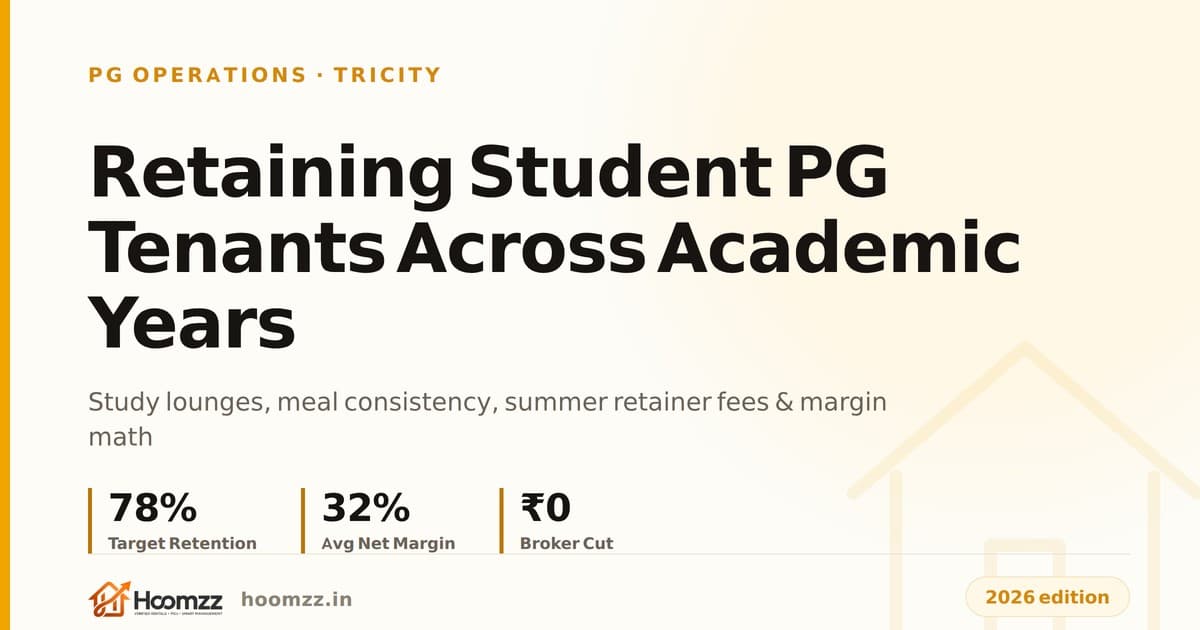
- 16.6%Annual Revenue LostPer 2-month summer vacancy
- 78%Target RetentionAcross academic semesters
- 32%Average Net MarginWell-managed Tricity student PG
- ₹0Broker CommissionDirect bed listings on Hoomzz
Every year in mid-May, student accommodation corridors across the Tricity face a sharp cash-flow drop. Final semester examinations conclude at major institutions, including Chandigarh University (CU) in Gharuan and Kharar, Chandigarh Group of Colleges (CGC) at Landran and Jhanjeri, Panjab University (PU) in Sectors 14 and 25, Punjab Engineering College (PEC) in Sector 12, and coaching centers in Sector 34 Chandigarh. Thousands of outstation scholars pack their bags and head home across Punjab, Haryana, Himachal Pradesh, Jammu & Kashmir, Delhi-NCR, and Uttar Pradesh.
For PG building owners in Kharar, Sunny Enclave, Landran Road, Mohali Phase 7, and Sector 22 Chandigarh, this seasonal departure triggers two to three months of vacant rooms and zero rental income. Refilling those vacated beds in August typically forces operators to pay 15 to 30 days of rent to local street brokers, absorb turnover repainting, and onboard unvetted tenants. While local real estate Instagram pages and creators are an active source of listings and area info for Tricity renters today, running a profitable student accommodation requires operational discipline rather than viral social media clips. Hoomzz lists physically verified rentals across Chandigarh, Mohali, Panchkula and Zirakpur, giving PG operators direct access to students and parents without middleman brokerage cuts.
Student tenant churn is an operational choice. Operators who run their building as a focused academic community retain over three-quarters of their residents into subsequent academic years.
The Real Cost of Annual Student Churn
Many PG owners calculate cash flows on a month-to-month basis. This practice creates an illusion of high profitability during peak occupancy in September and October, hiding the steep revenue leakage between May 15 and July 31.
Consider a standard 30-bed student PG building in Kharar or Mohali charging an observed market rent of ₹8,000 per bed per month, covering meals and broadband:
- Maximum Gross Potential: 30 beds × ₹8,000 × 12 months = ₹28,80,000 annually.
- The Unmanaged Summer Void (60% Vacancy for 2.5 Months): When 18 students vacate in mid-May, lost rent equals 18 × ₹8,000 × 2.5 months = ₹3,60,000 (12.5% of total top-line revenue).
- Offline Brokerage Re-Listing Fees: Sourcing 18 replacement students through street brokers costs between ₹2,500 and ₹4,000 per bed, totaling ₹45,000 to ₹72,000.
- Turnover Repairs: Fixing wall scuffs, deep-cleaning mattresses, and servicing hardware adds roughly ₹1,500 per bed (₹27,000).
- Total Annual Attrition Drain: Between ₹4,32,000 and ₹4,59,000 lost to vacancy, broker commissions, and maintenance churn.
When student turnover is unmanaged, annual net operating margins drop from an achievable 32% down to 16% to 19%. Operators can test their building numbers using Hoomzz rental yield calculators to quantify the financial benefit of summer occupancy retention.
Physical Amenities That Keep Students Enrolled
Students leave PGs for three recurring reasons: noisy environments that disrupt studying, poor food, and interpersonal conflict in crowded rooms. Investing in focused physical amenities eliminates these grievances.
1. The Dedicated 24/7 Quiet Study Lounge
In double and triple sharing PG bedrooms, sleep schedules and study habits clash. An engineering student preparing for morning exams needs quiet, while a roommate working on late-night code needs light and typing space. Cramming study desks beside beds creates constant friction.
Converting a basement space, ground-floor room, or enclosed terrace into a dedicated quiet study lounge resolves this conflict:
- Ergonomic Desks & Power Points: Install wide laminate study stations with dividers, lumbar-support mesh chairs, and dual 6A charging points at every desk.
- Commercial Dual-Band Wi-Fi: Consumer routers crash when twenty students stream video lectures simultaneously. Deploy commercial ceiling access points with traffic prioritization for academic portals.
- Enforced Silence: Maintain a strict zero-talking policy inside the study lounge. Group work belongs in the dining area or terrace.
2. Indoor Recreation and Unwinding Spaces
College life carries intense academic pressure during semester tests and placement drives. If a PG offers only a bedroom and a dining bench, students treat it strictly as a temporary bunk. Adding recreational options builds social bonds:
- Table Tennis & Foosball: Compact, high-durability setups that fit into recreation lounges and allow residents to burn off exam stress.
- Carrom & Chess Tables: Low-noise games that stimulate casual interaction across different academic departments and colleges.
- RO Water & Hot Beverage Station: A clean water cooler and an electric kettle station in the common room encourage clean social gathering.
For buildings focused on women students and interns, structural security and transparent entry protocols are decisive. Operators can consult our operational review on HerSpace PG models across Mohali and Chandigarh for physical safety protocols and floor layouts.
Operational Tactics: Community Dinners & Menu Governance
Food quality is the primary trigger for sudden mid-semester departures. When meals deteriorate, students spend heavily on food delivery, resent paying the mandatory mess fee, and search for independent flats with shared kitchens.
Rotational Weekly Menus and Student Committees
Avoid running an unvarying menu across terms. Form a three-member student food committee rotated every semester to maintain food satisfaction:
- Culinary Variety: Tricity students come from diverse states. Balance North Indian staples (dal makhani, rajma, seasonal sabzi) with curd, fresh salads, and breakfast variation (poha, paranthas, idli) to prevent monotony.
- Direct Feedback Logs: Maintain a physical register or simple group chat where students log meal feedback weekly, addressing complaints before frustration spreads.
- Quality Ingredients: Using AGMARK cooking oils, fresh milk, and whole wheat flour costs less than ₹250 extra per tenant per month, but protects thousands in retained rent.
Monthly Community Dinners and Cultural Celebrations
Organizing a monthly special meal on the first Sunday builds camaraderie. Marking festivals like Diwali, Lohri, Eid, and Holi with celebratory dinners turns an impersonal commercial hostel into a supportive home. When residents establish genuine friendships, they coordinate room renewals together for the following year.
When disagreements regarding visitor registers or late returns arise, clear house rules prevent disputes. Operators should review our guide on managing late-night entry registers and tenant rights in Tricity societies to balance safety with tenant dignity.
The Summer Retainer Model: Securing Cash Flow
Forcing students to pay full rent during June and July when they are home in other states breeds resentment. However, letting them vacate completely leaves the building empty. The summer retainer solves both problems.
- Announce Retainer Terms by Late MarchPublish the summer policy 60 days before semester exams start so residents know their reservation options early.
- Set a Discounted Retainer TariffOffer students the option to lock their exact bed for the next academic session by paying 25% to 35% of monthly rent (typically ₹2,000 to ₹2,800) for June and July.
- Provide Secure Luggage StorageAllow residents to store packed, labeled cartons and academic books inside locked wardrobes or a dedicated CCTV-monitored luggage room.
- Support Summer Trainees Without DisruptionAllow students staying for industrial internships in Mohali Phase 8B, QuarkCity, or IT Park Chandigarh to continue their full stay at regular monthly rates.
A 30-bed property with 20 vacating students collects ₹2,500 × 20 beds × 2 months = ₹1,00,000 in baseline retainer income. Operational expenses drop because mess purchases reduce and geysers remain switched off. In August, the operator welcomes back verified occupants without paying brokerage fees.
If an outstation tenant abruptly leaves without clearing dues or collecting personal items, follow formal legal steps. Read our detailed procedure on handling abandoned tenant belongings under Punjab and Chandigarh laws before clearing rooms.
Comparison Matrix: Traditional PG vs High-Retention Community PG
| Operational Metric | Standard Traditional PG | High-Retention Community PG |
|---|---|---|
| Annual Tenant Turnover | 65% to 80% annual attrition | 15% to 25% annual attrition |
| May–July Summer Occupancy | Plunges to 20%–35% | Maintains 75%–85% via Retainers |
| Brokerage Outlay per Bed | ₹2,500–₹4,000 every August | ₹0 (Direct renewal & Hoomzz discovery) |
| Study Environment | Noisy shared bedrooms, Wi-Fi lag | 24/7 dedicated quiet study lounge |
| Food Quality Control | Fixed tiffin menu, unaddressed complaints | Rotational student menu, monthly feasts |
| Net Annual Operating Margin | 16% to 22% (diluted by vacancy) | 28% to 36% (protected cash flow) |
High-Retention Community Model Works If
- You operate a facility with 15 or more beds near CU, CGC, PU, or PEC.
- You have common space to create a dedicated quiet study area (50+ sq. ft. per guest).
- You want predictable 12-month operational cash flow without seasonal dips.
- You prefer building direct relationships with scholars and parents via Hoomzz.
Traditional Low-Investment Model Fits Only If
- You run a small 2-room home setup with zero common areas.
- You rely solely on short-term coaching students staying for 60 to 90 days.
- You do not want to manage meal quality, Wi-Fi infrastructure, or common spaces.
- You are willing to pay local brokers recurring commissions every single summer.
Statutory Regulations: Chandigarh and Mohali PG Bylaws
Operating a student PG in the Tricity requires adherence to local municipal bylaws and administrative orders. Non-compliance risks show-cause notices, monetary penalties, and building sealing.
1. Space Norms and Chandigarh Estate Office Guidelines
- Minimum Plot Size: PGs in Chandigarh are legally permitted only on residential plots measuring at least 10 Marla (roughly 250 square yards).
- Usable Floor Area: Operators must provide at least 50 square feet of usable floor area per paying guest. Cramming four students into a 120 sq. ft. room violates municipal bylaws.
- Owner Residence Rule: In UT Chandigarh, the house owner, lessee, or an immediate family member must reside on the property. Purely commercial absentee hostels in residential sectors face enforcement sealing.
- Sanitation Standards: The administration requires at least one sanitary water closet (WC) and bathroom for every five occupants.
2. Fire Safety Clearances (NBC & Municipal Norms)
- Fire Extinguishers: Install ISI-marked ABC dry chemical powder and CO2 fire extinguishers on every floor within 15-meter travel distances.
- Clear Escape Corridors: Corridors and staircases must maintain an unobstructed width of at least 1.25 meters. Locking rooftop escape doors or storing scrap furniture on stairwells is strictly prohibited.
- Ban on Flammable Partitions: Temporary internal partitions built from flammable PVC, thin plywood, or fiberboards violate municipal fire codes.
3. Mandatory Police Tenant Verification
In both Chandigarh and SAS Nagar (Mohali) districts, paying guest verification is mandatory under standing preventive orders from the District Magistrate. In Punjab, operators must submit Form 'B' details with Aadhaar copies of residents and domestic staff (cooks, sweepers, security guards) to the local police station or via the Punjab Police Saanjh Kendra. In Chandigarh, registrations are submitted to the sector police station. Failure to comply invites legal prosecution under Section 223 of the Bharatiya Nyaya Sanhita (BNS).
4. Rent Control Statutes and Security Deposits
- Chandigarh: The East Punjab Urban Rent Restriction Act, 1949 remains operational. The May 2026 notification adopting the Assam Tenancy Act was placed in abeyance by the Punjab and Haryana High Court on May 29, 2026. There is no statutory two-month security deposit cap in Chandigarh.
- SAS Nagar (Mohali) & Kharar: Regulated by the Punjab Rent Act, 1995. Security deposits are determined by mutual agreement, typically one to two months of rent.
- Panchkula: Regulated by the Haryana Urban (Control of Rent and Eviction) Act, 1973.
For landlords renting residential flats to working professionals or software engineers, review our guide on renting flats to remote tech workers in Mohali for commercial lease clauses and power backup standards.
Listing Directly on Hoomzz to Protect Your Operating Margin
Eliminating broker dependency expands net operating margins faster than marginal rent increases. Street brokers charge half to one month of rent per bed while providing zero long-term accountability. Brokers thrive on high turnover because student departures generate fresh commissions every August.
Hoomzz replaces this broken cycle. By listing individual beds, private rooms, or full floors on verified PG accommodations in Tricity, operators connect directly with verified students and parents seeking reliable accommodations. Hoomzz field teams physically inspect properties, confirming study spaces, clean water filtration, room dimensions, and Wi-Fi connectivity.
Verified listings receive the Hoomzz Physical Verification badge, reassuring incoming university scholars that property images and tariffs are authentic. Operators can register vacant beds on Hoomzz direct property listing with zero brokerage, maintaining full occupancy through every semester transition.
Frequently Asked Questions
What is the average profit margin of a PG in Tricity?
A well-managed paying guest accommodation in the Tricity typically achieves a net profit margin between 28% and 38% if the property is self-owned, or 18% to 26% if the building is leased from a landlord. Gross margins appear much higher on paper, but grocery inflation for mess meals, commercial utility tariffs, housekeeping wages, and summer vacancy dips compress real net earnings if not strictly controlled.
How does listing rooms and beds on Hoomzz reduce middleman commission?
Listing directly on Hoomzz connects PG operators directly with verified students and working professionals without paying intermediaries 15 to 30 days of rent per occupied bed. Because Hoomzz conducts physical verification of listings across Chandigarh, Mohali, Panchkula, and Zirakpur, prospective tenants trust the listed tariffs and room photos, eliminating offline brokerage commissions entirely.
What are the key security and safety installations required by local authorities?
Local authorities across Chandigarh and SAS Nagar require mandatory police verification of all paying guests and domestic staff under Section 223 BNS. Facilities must also secure a Fire Safety NOC from the municipal corporation, provide functional ISI-marked ABC/CO2 extinguishers, keep 1.25-meter corridors unobstructed, ensure at least 50 sq. ft. of usable floor area per occupant, and prohibit flammable PVC partitions.
How do seasonal university cycles affect PG cash flow?
Tricity universities and colleges operate on an academic calendar where semester exams wrap up in May, leading to sudden student departures until late July. If an operator fails to implement a summer retention strategy or luggage hold fee, building occupancy can collapse below the 65% break-even mark, wiping out two to three months of rental cash flow and severely damaging annual yields.
How does the summer luggage retainer model work for student PGs?
The summer retainer model allows students returning home for vacation to retain their designated bed and store packed personal belongings securely for a fee of 25% to 35% of normal rent. This covers the property's baseline holding costs while saving the student the hassle of moving out and re-hunting in August, ensuring the operator maintains predictable cash flow throughout June and July.
Is there a statutory limit on PG security deposits in Chandigarh and Mohali?
There is no statutory two-month security deposit cap in force across the Tricity. While a notification adopting the Assam Tenancy Act was issued in Chandigarh in May 2026, it was promptly placed in abeyance by the Punjab and Haryana High Court; Chandigarh remains governed by the East Punjab Urban Rent Restriction Act, 1949, while Mohali follows the Punjab Rent Act, 1995. Security deposits remain subject to mutual lease agreement, typically set at one to two months of rent.
Sources, and what here is judgement rather than data
Government and Regulatory Citations:
- Chandigarh Administration Official Portal: Administrative guidelines governing paying guest accommodations in residential premises, minimum plot size requirements (10 Marla), and 50 sq. ft. floor space norms.
- Punjab Police Official Portal: Statutory citizen rules on preventive tenant registration, District Magistrate orders, and legal compliance under Section 223 BNS.
- Punjab Police Saanjh Portal: Official tenant and paying guest verification procedures, Form B documentation, and service protocols in SAS Nagar district.
- Hindustan Times Chandigarh: Municipal Corporation Chandigarh reporting on paying guest fire safety enforcement, staircase width regulations (1.25m), and building bylaw compliance.
- The Tribune India: Judicial reporting on the Punjab and Haryana High Court stay on the UT Chandigarh tenancy notification and the operation of the East Punjab Urban Rent Restriction Act, 1949.
Editorial Judgement vs. Measured Data: Municipal spatial standards (50 sq. ft. per guest, 10 Marla minimum plot size), fire safety requirements (1.25m stairways, Fire NOC), police verification directives under Section 223 BNS, and rent act jurisdictions represent verified legal and regulatory data. Financial figures, including observed market rents (₹8,000 per bed), net operating profit margins (28% to 38%), summer retainer percentages (25% to 35%), and student renewal rates reflect editorial market judgement based on field observations of operational PGs across Kharar, Mohali, and Chandigarh in 2026.
👈 This comparison is based on market observations and publicly available data. Users should verify details independently.
Prioritize Hoomzz Real Estate News in your Google Search AI Overviews
Google's new search update lets you select trusted sources. Pin hoomzz.in to get our instant local market rates, builder updates, and renting news featured first in your AI answers.
Find Verified PGs & Hostels
Safe, hygienic AC/Non-AC PG accommodations with meals, Wi-Fi & zero broker markups in Tricity.