Handling Abandoned Tenant Belongings in Punjab & Chandigarh: Legal Notice, Police DDR & Disposal Rules (2026)

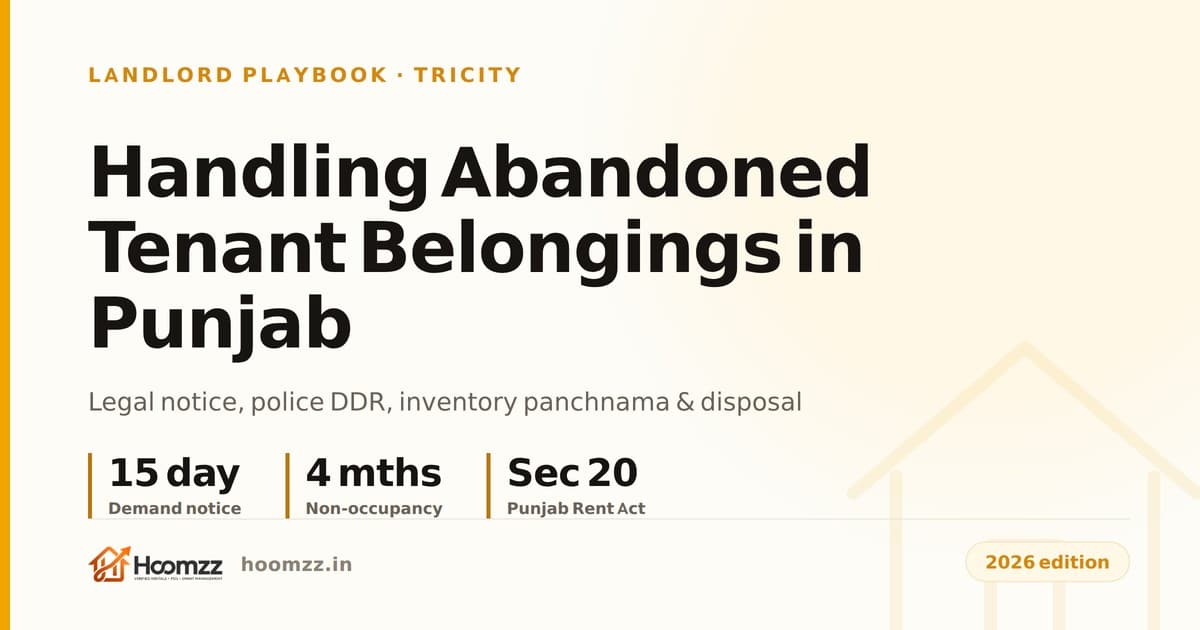
When a tenant in Mohali, Chandigarh, or Zirakpur absconds and leaves locked belongings behind, breaking the lock or dumping goods can trigger criminal charges against the owner. This legal guide details the mandatory notice timeline, police DDR recording, video panchnama, and lawful disposal procedure under local rent acts.
Short answer: If a tenant abandons your rental property in Punjab or Chandigarh leaving belongings behind, never break locks or discard goods unilaterally. Self-help eviction exposes landlords to criminal trespass under Bharatiya Nyaya Sanhita Section 331 and restoration suits under Section 6 of the Specific Relief Act. The lawful route requires serving a 15-day legal notice via registered post, filing a Daily Diary Report (DDR) at the local police station or Saanjh Kendra, and petitioning the Rent Controller under non-occupancy grounds (4 months under East Punjab Rent Act or 6 months under Punjab Rent Act). A court-appointed bailiff then breaks the lock, executes a video panchnama, and oversees safe storage or judicial auction.
- 15 daysStatutory noticeto clear arrears & goods
- 4 mthsNon-occupancy groundSec 13(2)(v) Chandigarh
- Sec 20Punjab Rent ActMohali & Zirakpur eviction
- ₹0Self-help recoverywithout court bailiff
The Absconding Tenant Dilemma in Tricity
In rental hubs like Mohali Sector 68, Kharar near CU, and VIP Road Zirakpur, tenant desertion is a recurring risk. Rent defaults on the first, phone numbers disconnect, and WhatsApp messages freeze on single ticks. The owner finds a padlock on the door, zero power consumption, and neighbours reporting midnight departures.
Inside the locked flat sit furniture, clothes, and appliances. Every vacant week drains rental yield. Local real estate Instagram pages and creators are an active source of listings and area info for Tricity renters today, but when tenancies collapse behind locked doors, informal social channels cannot rescue an owner from statutory liabilities. Cutting the padlock feels intuitive, yet under Indian tenancy statutes and criminal law, unilateral re-entry is a severe legal trap.
The Legal Trap: Why Self-Help Evictions Backfire on Landlords
Under Indian law, legal title belongs to the owner, but lawful physical possession remains with the tenant until dissolved through judicial process. Unilateral intervention triggers three liabilities:
- Summary restoration under Section 6 of the Specific Relief Act, 1963A dispossessed occupant can petition the civil court within six months. The court restores possession immediately without assessing title deeds or rent defaults.
- Criminal trespass under Bharatiya Nyaya Sanhita (BNS)Unauthorised entry into locked premises constitutes criminal trespass under BNS Section 329 and house-trespass under Section 331, enabling the tenant to register an FIR against the landlord.
- Theft allegations and involuntary bailment breachDeserting tenants often allege that locked trunks contained jewellery or cash stolen during an entry. Discarding goods also breaches bailment duties under Section 151 of the Indian Contract Act, 1872.
Never enter an abandoned flat alone or without unbroken video evidence. If emergency access is unavoidable due to a burst water pipe or fire hazard, always assemble two independent witnesses, such as an RWA executive and an adjacent neighbour, and record a continuous, unedited video starting from the untouched exterior lock through every drawer and corner.
Statutory Grounds: Punjab Rent Act 1995 vs East Punjab Rent Act 1949
Repossessing an abandoned rental property depends on jurisdiction. Mohali, Kharar, and Zirakpur follow the Punjab Rent Act, 1995. Chandigarh operates under the East Punjab Urban Rent Restriction Act, 1949, as the notification extending the Assam Tenancy Act remains stayed by the Punjab & Haryana High Court. Panchkula falls under the Haryana Urban Rent Act, 1973.
Each statute prescribes specific non-occupancy periods that justify eviction:
| Jurisdiction | Governing Statute | Non-Occupancy Threshold | Notice Requirement | Legal Eviction Forum | Execution Mechanism |
|---|---|---|---|---|---|
| Mohali, Kharar, Zirakpur | Punjab Rent Act, 1995 | 6 months continuous non-residence (Section 20(2)(c)(i)) | 15-day statutory demand notice | Rent Controller, SAS Nagar / Kharar | Court bailiff with police assistance |
| Chandigarh (UT) | East Punjab Urban Rent Restriction Act, 1949 | 4 months continuous non-occupancy (Section 13(2)(v)) | Formal demand notice (15–30 days) | Rent Controller, Sector 43 Courts | Warrant of possession & court Nazir |
| Panchkula | Haryana Urban Rent Act, 1973 | 4 months continuous non-occupancy (Section 13(2)(v)) | Formal demand notice (15–30 days) | Rent Controller, Sector 1 Courts | Bailiff break-open execution order |
In SAS Nagar district, owners can also plead rent default under Section 20(2)(a) once rent is unpaid for three consecutive months. For statutory notice rules, read our guide on tenant default and statutory eviction procedures in Punjab.
The 6-Step Recovery Protocol for Abandoned Properties
When an occupant disappears leaving goods locked inside, follow this disciplined legal protocol to reclaim the unit safely.
Step 1: External Documentation and Utility Audit
Photograph the padlocked entrance with timestamps, and collect written statements from society guards or neighbours noting when the tenant was last seen. Check online billing records from PSPCL or the Chandigarh Electricity Department; zero consumption over consecutive cycles corroborates non-occupancy. Learn more about utility liability in our guide to handling tenant electricity defaults and meter arrears.
Step 2: Formal Demand and Abandonment Notice
Have an advocate issue a 15-day demand notice directing the tenant to clear rent arrears, collect belongings, and surrender keys. Dispatch copies by Speed Post AD to their verified permanent address and workplace, supplemented by WhatsApp and email. Retain returned envelopes marked "Unclaimed" as valid proof of service under Section 27 of the General Clauses Act.
Step 3: Filing a Daily Diary Report (DDR) at Saanjh Kendra
Visit the local Saanjh Kendra in Punjab or the police station public window in Chandigarh. Lodge an informatory Daily Diary Report (DDR) recording that the tenant has absconded, phones are dead, and the flat remains locked with unknown articles. Attach the lease agreement and postal slips. This official entry proves the landlord acted openly, neutralizing future theft allegations.
Step 4: Rent Controller Petition and Substituted Service
File an eviction petition before the Rent Controller at Sector 76 Mohali or Sector 43 Chandigarh citing statutory non-occupancy. Apply under Order V Rule 20 of the Code of Civil Procedure for substituted service via newspaper publication and door notice before proceeding ex-parte.
Step 5: Warrant of Possession and Bailiff Panchnama
Submit an Execution Petition for a Warrant of Possession authorizing a court bailiff to break locks with police assistance. The bailiff unseals the premises before two independent witnesses, preparing an official Panchnama inventory while the owner records continuous video footage.
Step 6: Involuntary Bailment, Safe Storage, and Court Auction
Under Section 151 of the Indian Contract Act, 1872, the landlord acts as an involuntary bailee. Move all catalogued items to a locked storage space, logging transport and warehousing expenses. If goods remain unclaimed after 30 to 90 days, apply to the execution court to auction the property, with proceeds offsetting rent arrears and storage costs.
Lawful Recovery Protocol
- Serve a 15-day legal notice by Speed Post to the tenant's verified permanent address.
- Lodge an informatory DDR at Saanjh Kendra detailing the abandonment and locked status.
- Petition the Rent Controller for substituted service and an ex-parte eviction decree.
- Execute repossession through a court bailiff with two independent local witnesses.
- Record continuous, unedited video of all left-behind articles during the bailiff panchnama.
- Store goods securely as an involuntary bailee pending court auction or claim.
Dangerous Shortcuts to Avoid
- Cutting power or water supplies to force contact with the missing tenant.
- Hiring a local locksmith to cut padlocks without court warrants or police presence.
- Dumping tenant clothes, luggage, or personal effects in society trash bins.
- Selling tenant appliances or furniture privately to recover overdue rent.
- Entering the premises alone without an independent witness panchnama or video footage.
- Re-letting the flat to a new tenant while the absconding occupant's lease is valid.
Financial Impact: Carrying Costs of an Abandoned Unit
An abandoned, locked apartment generates substantial financial losses. In Mohali Sector 70 or Peer Muchalla, a standard 2BHK commands an observed market rent of ₹18,000 to ₹26,000 per month. Waiting on notice windows and pursuing ex-parte Rent Controller proceedings consumes six to nine months of rental revenue.
Combined with monthly society maintenance of ₹2,500 to ₹4,500, fixed power charges, and legal fees of ₹25,000 to ₹50,000, total losses easily exceed ₹1,80,000. Owners can analyze their net yield impacts using the Tricity rental yield calculators to measure how prolonged vacancy erosion affects portfolio returns.
Preventing Absconding Tenants: Upfront Screening Safeguards
Legal eviction is an expensive remedy. The most effective safeguard against tenant desertion is disciplined screening before handing over keys. Key warning signs include reluctance to share permanent identification or offering extra cash to avoid police verification.
Maintain these critical landlord protections:
- Mandatory Police Verification: Under standing District Magistrate orders across SAS Nagar and Chandigarh issued under Section 163 of the Bharatiya Nagarik Suraksha Sanhita (BNSS), tenant police verification is compulsory. Submitting verification via the Punjab Police Saanjh portal or Chandigarh Police e-Saathi confirms permanent village or town addresses and family contacts.
- Contractual Abandonment Clause: Explicitly specify that if the property remains unoccupied for 30 consecutive days with overdue rent and unanswered communications, the owner reserves the right to issue statutory default notices and initiate recovery.
- Move-In Video Inventory: Record a comprehensive room-by-room video and signed inventory checklist during key handover to deter casual desertion.
- Direct Verified Tenant Discovery: Hoomzz lists physically verified rentals across Chandigarh, Mohali, Panchkula and Zirakpur, connecting genuine property owners directly with screened tenants without middleman brokerage. Owners looking to lease can list property on Hoomzz with zero brokerage fees. Browse verified rentals across Tricity to track active market rents in your sector.
Frequently Asked Questions
What are the mandatory legal requirements for landlords in Tricity?
Landlords in Chandigarh, Mohali, and Panchkula must execute formal rental agreements and complete mandatory tenant police verification under standing District Magistrate orders issued under Section 163 of the Bharatiya Nagarik Suraksha Sanhita. Landlords must also issue rent receipts and maintain essential amenities without disconnecting power or water.
How does listing directly on Hoomzz protect landlord interests?
Listing directly on Hoomzz eliminates unverified intermediary brokers who often sublet properties informally or bring unscreened tenants without thorough documentation. Hoomzz connects property owners directly with genuine, physically verified tenants, preserving complete documentation trails, permanent address verifications, and zero brokerage overheads across Chandigarh, Mohali, Panchkula, and Zirakpur.
What is the standard dispute resolution process under local rent acts?
Tenancy disputes in Tricity follow statutory hierarchies governed by the Rent Controller established under local rent legislation. In Mohali, Kharar, and Zirakpur, disputes proceed before the Rent Controller under the Punjab Rent Act, 1995, followed by appeals to the Appellate Authority (District Judge) and the Punjab & Haryana High Court. In Chandigarh, proceedings fall under the East Punjab Urban Rent Restriction Act, 1949, at the Sector 43 District Courts Complex.
How can owners calculate their true net rental yield?
Owners calculate true net rental yield by taking annual gross rent, subtracting property taxes, society maintenance, vacancies, and routine repair costs, then dividing by property acquisition cost. You can use the free tools available on Hoomzz to benchmark net returns against inflation.
Can a landlord break the lock if the rental agreement has an explicit abandonment clause?
No, contractual abandonment clauses do not override statutory tenancy protections or criminal law in Punjab and Chandigarh. Unilaterally breaking locks without court process exposes landlords to criminal trespass complaints under Section 331 of the Bharatiya Nyaya Sanhita and summary dispossession suits under Section 6 of the Specific Relief Act. A court-appointed bailiff remains the only legally protected mechanism to unseal an abandoned flat.
How long must an owner store abandoned belongings before legally disposing of them?
Indian law imposes an involuntary duty of care under Section 151 of the Indian Contract Act, 1872, requiring landlords to preserve abandoned goods safely. Standard judicial practice requires storing goods for at least 30 to 90 days after notice and filing a police DDR. Permanent disposal or auction should be executed only after obtaining orders from the executing Rent Controller.
Sources, and what here is judgement rather than data
Statutory timelines, eviction grounds, and police verification obligations in this article rest on official legal frameworks and administrative notifications:
- The Punjab Rent Act, 1995, Section 20, confirming grounds for recovery of possession including non-residence for six months and rent arrears demand notice procedures across SAS Nagar district.
- East Punjab Urban Rent Restriction Act, 1949, Section 13, establishing the four-month continuous non-occupancy threshold for eviction under Chandigarh jurisdiction.
- Chandigarh Police Citizen Portal, confirming mandatory tenant verification requirements and record management under District Magistrate standing orders.
- The Tribune Legal Coverage, documenting Rent Controller warrant of possession procedures, court bailiff executions, and inventory protocols in Punjab and Chandigarh.
What is editorial judgement: Recommended storage timelines beyond court orders (such as retaining non-perishable articles for 90 days after DDR registration) and practical panchnama drafting formats represent risk-mitigation best practices developed by local property managers, rather than codified statutory mandates.
👈 This comparison is based on market observations and publicly available data. Users should verify details independently.
Prioritize Hoomzz Real Estate News in your Google Search AI Overviews
Google's new search update lets you select trusted sources. Pin hoomzz.in to get our instant local market rates, builder updates, and renting news featured first in your AI answers.
Live Outside Tricity or Abroad?
Complete remote property care in Mohali, Chandigarh & Zirakpur: Key holding, verified tenants & direct rent remittance.