Late-Night Society Entry & Guard Registers for Flatmates in Tricity: Gate Curfews, Visitor Stickers & Legal Tenant Rights (2026)

Societies in Zirakpur, Mohali, and South Chandigarh often subject bachelor flatmates to gate curfews and intrusive guard registers. This guide outlines your legal rights under Section 126 of the BNS, mandatory Saanjh police verification protocols, and practical ways to eliminate late-night gate friction.
Short answer: Resident Welfare Associations (RWAs) hold zero statutory authority to lock society gates, impose night curfews, or bar lawful tenants from entering their rented apartments at any hour. Under Section 126 of the Bharatiya Nyaya Sanhita (BNS), physically blocking a tenant or their invited guest constitutes wrongful restraint. However, societies across Zirakpur, Mohali, and Chandigarh legally enforce mandatory tenant police verification under Section 163 of the BNSS (via Punjab's Saanjh portal or Chandigarh Police), vehicle RFID stickers, and visitor logging. Flatmates can eliminate 1 AM gate confrontations by submitting police verification receipts, keeping emergency landlord numbers handy, and insisting on written bylaw resolutions rather than informal guard discretion.
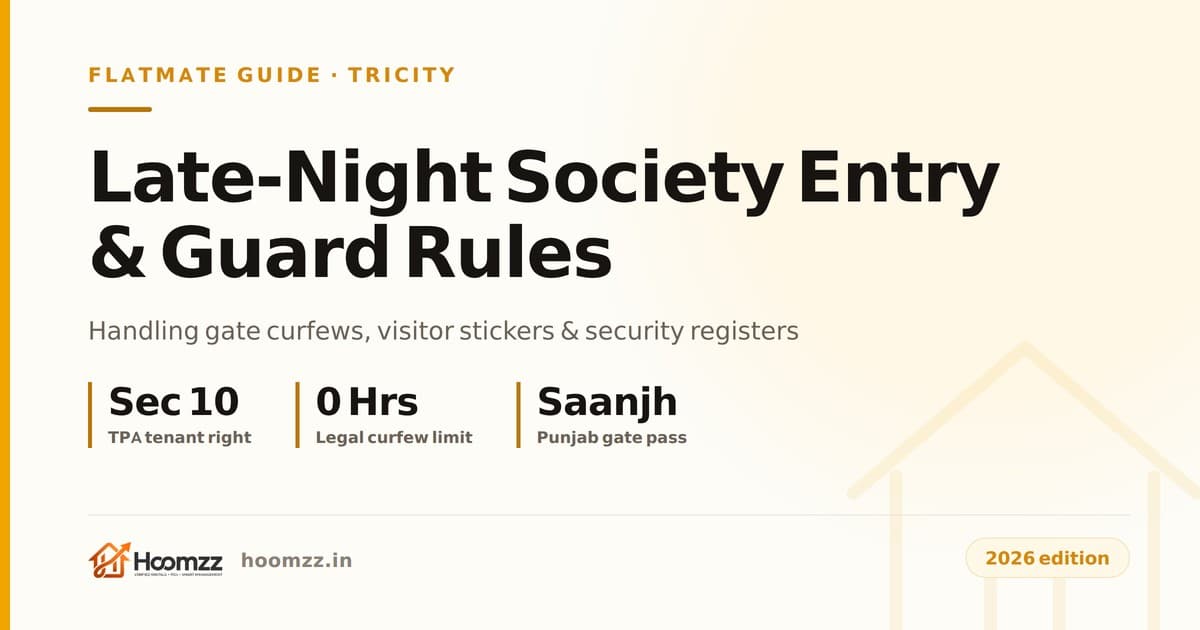
- 0 HoursLegal curfew authorityRWAs cannot block lawful tenants
- Sec 126BNS wrongful restraintpenalises physical gate blockades
- 100%Police verification mandateunder SAS Nagar & UT DM orders
- ₹0Legal fine by RWAsocieties cannot levy penal fines
The 1 AM Gate Reality for Tricity Flatmates
It is 1:15 AM on VIP Road in Zirakpur. You have just finished a late shift at a technology firm in QuarkCity Phase 8B Mohali, or wrapped up study hours near the Sector 34 coaching hub in Chandigarh. You reach your society entrance, only to find the iron gates chained shut and the boom barrier padlocked. A private security guard steps out, shines a flashlight into your vehicle, and pushes a battered paper register forward.
The interrogation follows a familiar routine: Which flat? Who owns the property? Why are you returning so late? Where is your tenant gate pass? Write down your phone number, permanent hometown address, and father's name. If a coworker is in the car, the suspicion doubles. The guard announces an 11:00 PM curfew for bachelors, claiming visitors cannot enter after 10:00 PM without written approval from the society president.
Local real estate Instagram pages and creators are an active source of listings and area info for Tricity renters today, but they rarely prepare young flatmates for the late-night friction waiting at society security gates. Brokers take their commission during afternoon viewings, assure you that the society has no restrictions, and disappear the moment security guards turn bachelor living into a daily struggle.
A security guard is an employee of a private security agency hired by the society management committee. While guards follow instructions from RWA office-bearers, informal committee orders cannot supersede Indian criminal law. Physically barring a lawful tenant from entering their home constitutes wrongful restraint under Section 126 of the Bharatiya Nyaya Sanhita (BNS).
The Legal Position: What RWAs Can and Cannot Lawfully Mandate
Housing societies across Punjab and Chandigarh operate under the Societies Registration Act, 1860, or the Punjab Cooperative Societies Act, 1961. Both laws grant management committees authority to administer common areas—elevators, corridors, street lighting, perimeter security, and sanitation. Neither statute transforms an RWA into a police department or a municipal authority.
Three core legal principles protect flatmates from gate overreach:
- Right to Property Alienation and Enjoyment (Section 10, Transfer of Property Act, 1882): An owner who holds clear title to an apartment possesses an absolute legal right to lease it to any law-abiding citizen. Section 10 invalidates any condition or bylaw that restrains an owner from leasing or enjoying their property. An RWA circular that declares “no bachelors allowed” or “no single tenants after 11 PM” is legally void.
- Freedom of Movement and Residence (Article 19(1)(d) & (e)): The Constitution guarantees every citizen the right to move freely throughout India and reside in any locality. A private housing society cannot erect internal checkpoints that strip tenants of their personal liberty.
- Wrongful Restraint (Section 126, Bharatiya Nyaya Sanhita, 2023): Section 126 of the BNS defines wrongful restraint as voluntarily obstructing any person so as to prevent that person from proceeding in any direction in which that person has a right to proceed. When a guard locks a gate or physically prevents a tenant from accessing their flat, they commit an offense punishable by imprisonment up to one month, a fine up to ₹5,000, or both.
Societies also lack statutory authority to levy monetary penalties on tenants. When an RWA issues a ₹2,000 “bachelor fine” for an 11:30 PM entry or an unregistered food delivery, that charge has no judicial validity. RWAs have a contractual relationship only with property owners, not tenants, and cannot enforce arbitrary fines outside municipal bylaws.
Legitimate Society Security vs Unlawful Moral Harassment
Distinguishing between legitimate security protocols and unlawful harassment is essential. Gated communities must maintain safety, monitor unfamiliar visitors, and prevent unauthorized parking. Legitimate security focuses on access verification; illegal overreach attempts moral policing.
| Gate Scenario | Legitimate Security Protocol | Illegal RWA Overreach | Governing Rule & Remedy |
|---|---|---|---|
| Late-Night Entry | Logging entry time, verifying resident RFID windshield tag or gate app pass. | Locking gates, padlocking barriers, demanding explanations for late hours. | Section 126 BNS. Show lease and demand written bylaw authorization. |
| Visiting Guests | Logging visitor photo, phone number, vehicle plate, and flatmate app approval. | Banning opposite-gender guests or capping visitor entry at 10 PM. | Article 21 privacy protections. Guest conduct is governed by lease terms. |
| Parking Access | Enforcing assigned basement slots, directing guest cars to visitor bays. | Clamping flatmate two-wheelers without notice, charging unapproved fines. | Societies regulate common bays but cannot seize personal property. |
| Night Deliveries | Logging delivery partners, checking OTPs, enforcing internal speed limits. | Blanket bans on food deliveries past midnight, forcing walks to main gates. | Internal rules must balance safety with resident access to essential food. |
| Police Verification | Requiring official police verification acknowledgment receipts for gate passes. | Charging arbitrary verification fees, conducting invasive flat inspections. | Section 163 BNSS. Verification belongs to police, not RWA inspectors. |
Mandatory Compliance: What Gated Societies Can Lawfully Require
While arbitrary curfews are legally baseless, societies in Mohali, Zirakpur, and Chandigarh possess clear rights to enforce baseline security protocols. Flatmates who ignore these requirements give management committees genuine cause to restrict automated conveniences like RFID tags.
1. Mandatory Tenant Police Verification: Under standing preventive orders issued by the District Magistrate of SAS Nagar and the District Magistrate of Chandigarh under Section 163 of the Bharatiya Nagarik Suraksha Sanhita, 2023 (BNSS), tenant police verification is compulsory. Disobeying these orders is punishable under Section 223 of the BNS. In Punjab districts (Mohali, Kharar, Zirakpur), verification is submitted through the Punjab Police Saanjh portal. In Chandigarh UT, submission occurs via the Chandigarh Police Citizen Portal. Societies may lawfully withhold vehicle RFID tags and gate app access until tenants provide their official verification acknowledgment slips.
2. Executed Rent Agreement Submission: Societies require a copy of the executed tenancy agreement showing the names of all residing flatmates and emergency contacts. In cooperative societies across South Chandigarh, bylaws require owners to officially notify the society secretary before leasing. For detailed insights into south sector bylaws, explore our analysis of South Chandigarh cooperative housing society flats in Sectors 48 to 51, as well as the Sector 51 Chandigarh rental guide. Every flatmate must be named on the lease; omitting co-tenants leads guards to treat them as unauthorized guests.
3. Vehicle Registration Stickers and Parking Quotas: High-density developments along VIP Road, PR7 Airport Road, and Sector 68 Mohali face parking constraints. A standard flat is allocated exactly one designated parking slot. Societies issue RFID stickers only for vehicles registered to that single slot. Additional vehicles must use designated overflow visitor bays or external street parking. Demanding that guards open automated gates for unregistered secondary cars causes daily gate disputes.
4. Move-In Fees and Service Elevator Charges: High-rise towers in Zirakpur and Mohali commonly levy a one-time move-in or shifting charge of ₹1,000 to ₹3,000. This charge covers elevator protective padding and common area maintenance. While an RWA cannot invent punitive fees, reasonable shifting charges approved by the General Body are enforceable. Clearing these dues prevents moving trucks from being stalled at the barrier.
Step-by-Step: Handling Security Guards and Gate Curfews Without Escalation
When you face an aggressive guard at 1:30 AM, asserting your legal rights requires calm professionalism. Screaming at a security guard solves nothing; guards are executing orders issued by society management committees.
- Complete official police verification on day oneSubmit your Saanjh verification receipt or Chandigarh Police slip to the society office immediately after moving in. Obtain your permanent resident RFID vehicle sticker and activate your profile on the society security app (such as MyGate or NoBrokerHood). Having automated gate credentials removes manual guard interactions.
- Request written bylaws rather than oral guard instructionsWhen a guard asserts that bachelors cannot enter after 11:00 PM or that guests cannot visit, ask calmly for a copy of the registered RWA bylaw approved by the General Body. State firmly: “I am a verified tenant residing in Flat 402 under a valid lease. If the society has an approved bylaw restricting entry, please provide it in writing tomorrow, but you cannot physically block my entry tonight.”
- Involve the property owner immediatelyThe RWA answers to property owners, not to tenants. If security creates persistent late-night friction, call the owner or send a message detailing the incident. Landlords pay monthly maintenance charges and have legal leverage to demand that the management committee instruct the security agency to cease harassment.
- Escalate unlawful restraint through formal legal channelsIf a guard locks the gate and refuses physical entry despite valid identification, they are committing wrongful restraint under Section 126 of the BNS. Call the society security supervisor or estate manager first. If the blockade persists, dial the 112 emergency police helpline. A police PCR van visit swiftly clarifies to private security guards that locking tenants out of their rented apartments is an offense.
Proactive Flatmate Strategy
- All flatmate names listed on the lease and submitted to the society office.
- Saanjh police verification receipts filed within 7 days of moving in.
- Vehicle RFID stickers affixed to cars and bikes for automated barrier entry.
- Visitors pre-approved on MyGate or NoBrokerHood before arriving at the gate.
- Quiet hours respected between 10:00 PM and 6:00 AM to prevent neighbor complaints.
Costly Flatmate Mistakes
- Only one tenant named on lease; co-flatmates treated as unauthorized guests.
- Delaying police verification, forcing security to treat flatmates as visitors.
- Bringing unregistered second and third vehicles into single-slot parking bays.
- Arguing aggressively with nighttime guards rather than escalating to the RWA office.
- Hosting loud late-night gatherings that prompt neighbors to demand gate curbs.
Flatmate House Rules: Preventing Gate Disputes from Inside the Flat
Most gate crackdowns do not happen in isolation. RWAs usually implement harsh gate checks after resident families complain about late-night disturbances, multiple unfamiliar visitors wandering common corridors, or parking bays blocked by bachelor guests. Establishing disciplined internal house rules prevents society friction before it reaches the gate.
Flatmates should implement four ground rules: pre-approve all visitors arriving past 10:00 PM on society gate apps so guards do not make midnight intercom calls; assign the sole allocated parking space before signing the lease, renting an additional slot from an absentee owner for an observed market rate of ₹1,000 to ₹2,000 per month if needed; maintain strict quiet hours between 10:00 PM and 6:00 AM; and formalize roommate replacements by updating society records, gate apps, and Saanjh police verification. Remember that there is no statutory security-deposit cap anywhere in the Tricity—deposit terms are governed solely by your tenancy agreement.
Regional Society Breakdown: Living Realities Across Tricity
Security culture varies significantly across Chandigarh, Mohali, Panchkula, and Zirakpur:
- Zirakpur (VIP Road, PR7 Airport Road & Peer Muchalla): High-density complexes (300 to 1,200 units) rely on MyGate or NoBrokerHood. Guards are private agency personnel. As long as flatmates hold active app accounts, RFID stickers, and clean parking records, entry is straightforward. Parking shortages are severe along VIP Road, and driveway violators face prompt wheel clamping. For commuting flatmates on the eastern border, read our analysis on living in Peer Muchalla with flatmates and commuting to Chandigarh IT Park.
- Mohali (Sectors 67 to 82, Sector 88 & Aerocity): Housing thousands of IT and pharmaceutical professionals with rotating night shifts, Mohali high-rises rarely enforce midnight gate curfews. However, SAS Nagar police teams conduct periodic early morning verification checks, making Saanjh portal compliance essential.
- South Chandigarh Cooperative Societies (Sectors 48 to 51): CGHS societies here are frequently managed by retired allottees. Gates routinely lock at 11:00 PM, and guards often question late bachelors. Tenants must ensure their landlord formally submits all paperwork to the society office to avoid daily scrutiny.
- Kharar & Landran Corridor: Catering to Chandigarh University (CU) students and junior engineers, competition for tenants is intense. While some standalone societies attempt student curfews, flatmates can easily pick complexes offering 24/7 unhindered access.
To evaluate verified rentals across these micromarkets, browse rent properties in Tricity or review neighborhoods in our Tricity locations directory.
How Hoomzz Eliminates Gate Surprises and Bachelor Friction
Traditional classified ads and unverified listing platforms leave bachelors vulnerable to hostile housing societies. Brokers show apartments during mid-day open hours, collect hefty commissions, and leave flatmates to battle aggressive RWA committees alone. In many cases, brokers conceal that a society committee has passed an unwritten resolution barring bachelor sharing.
Hoomzz transforms this experience. As a dedicated property platform operating on zero brokerage, Hoomzz lists physically verified rentals across Chandigarh, Mohali, Panchkula, and Zirakpur. Every property badge represents a physical on-site verification where property details, ownership credentials, and tenancy permissions are confirmed on the ground.
When searching for shared flats or co-living spaces, young professionals can find verified flatmates on Hoomzz and connect directly with flatmate-friendly property owners. By confirming bachelor tenancy approvals and society security policies before a single rupee is exchanged, Hoomzz ensures that flatmates move into homes where their legal rights are recognized and their late-night arrivals are respected.
Frequently Asked Questions
Can an RWA legally ban bachelors or impose a late-night gate curfew in Tricity societies?
No, Resident Welfare Associations possess zero statutory authority to ban bachelors, restrict single tenants, or impose late-night entry curfews. Section 10 of the Transfer of Property Act, 1882 invalidates any rule that restricts a property owner's absolute right to lease to law-abiding citizens. In addition, physically shutting a resident or tenant out of their home constitutes wrongful restraint under Section 126 of the Bharatiya Nyaya Sanhita (BNS), punishable by imprisonment or fines.
How does Hoomzz help individuals find verified flatmates and flatmate-friendly societies?
Hoomzz connects prospective tenants directly with verified flatmates and direct-owner rental listings across Chandigarh, Mohali, Panchkula, and Zirakpur with zero brokerage. Through on-site physical verification, Hoomzz verifies property details and confirms landlord consent for bachelor tenancies upfront. This transparent process prevents young professionals and university students from signing leases in gated societies that harbor unwritten restrictions against flat sharing.
What documents must flatmates submit to society security to obtain gate passes and vehicle stickers?
Flatmates must submit an executed copy of their registered rent agreement, official government identification, passport-size photographs, and the police verification acknowledgment. In Mohali, Zirakpur, and Kharar, societies require the Punjab Police Saanjh verification receipt; in Chandigarh, the Chandigarh Police public portal submission slip is required. Providing these documents allows society management to issue vehicle RFID stickers, register flatmates on gate automation apps like MyGate, and grant unhindered resident entry.
What should be included in a flatmate house rules agreement to prevent society gate friction?
A comprehensive flatmate house rules agreement should establish clear expectations for visitor pre-approvals, vehicle parking management, and noise limits after 10:00 PM to comply with local noise regulations. The agreement should clearly designate who parks in the single allotted society slot, establish protocols for logging guests in society security apps, and specify how common utility bills and move-in maintenance charges are divided among flatmates.
How should security deposits and society records be handled when one flatmate vacates early?
When a flatmate vacates early, the outgoing tenant must coordinate with the remaining flatmates and the landlord to find a replacement roommate. The flatmates must inspect the private room and common areas, settle outstanding utility bills, and return the security deposit from the incoming roommate's contribution. Crucially, the outgoing flatmate's name must be removed from society gate apps, vehicle stickers surrendered, and fresh Saanjh police verification filed for the new flatmate.
What legal remedies are available if a society security guard physically locks a tenant out at night?
If a security guard physically blocks a lawful tenant from entering the society premises at night, the tenant should remain calm and contact their landlord and the society estate supervisor immediately. If the blockade persists, the tenant can dial the 112 emergency police helpline to report wrongful restraint under Section 126 of the Bharatiya Nyaya Sanhita. Subsequently, the landlord should serve a formal legal notice to the RWA president and register a complaint with the Registrar of Societies.
Sources, and what here is judgement rather than data
Statutory legal positions, administrative mandates, and criminal code references cited in this guide rest on official legal frameworks and government portals:
- Indian Kanoon, Bharatiya Nyaya Sanhita (BNS) 2023 & Transfer of Property Act 1882, confirming definitions of Wrongful Restraint under Section 126 and property alienation rights under Section 10.
- Punjab Police Saanjh Portal, Tenant Verification Guidelines, establishing mandatory tenant reporting under standing SAS Nagar District Magistrate preventive orders.
- Chandigarh Police Public Services, Tenant and Servant Verification Orders, outlining UT Chandigarh citizen portal verification requirements.
- The Tribune, Reporting on Tricity Tenant Verification Drives and Society Bylaws, documenting police compliance checks and RWA tenant policies across Mohali and Zirakpur.
What is editorial judgement: Practical guidance regarding late-night de-escalation strategies, observed society parking rental rates (₹1,000 to ₹2,000 per month), standard move-in elevator fees (₹1,000 to ₹3,000), and internal flatmate house rule templates represent practical market observations and rental management best practices in the Tricity, rather than statutory requirements codified in law.
👈 This comparison is based on market observations and publicly available data. Users should verify details independently.
Prioritize Hoomzz Real Estate News in your Google Search AI Overviews
Google's new search update lets you select trusted sources. Pin hoomzz.in to get our instant local market rates, builder updates, and renting news featured first in your AI answers.
Need an Instant Rental Agreement?
Legally binding e-stamped agreements delivered in 15 mins with digital biometric tenant verification.