Essential PG Amenities in Tricity: Wi-Fi Bandwidth, Commercial RO & Generator Sizing for 20+ Beds (2026)

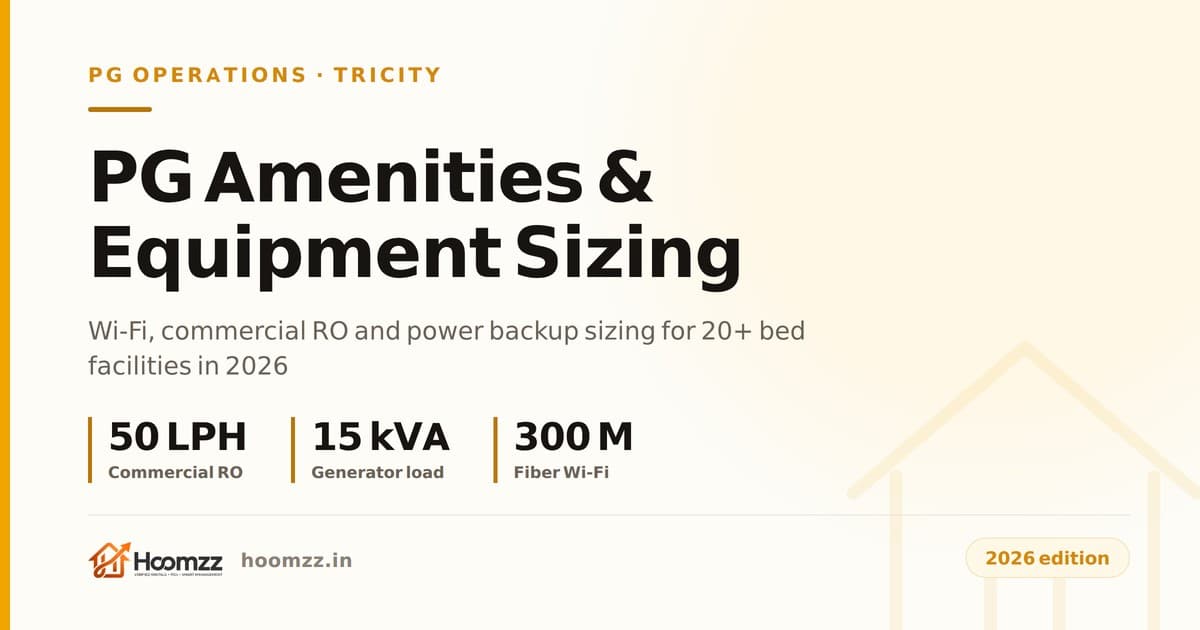
A 20-bed PG in Tricity needs commercial-grade utilities to avoid frequent tenant churn and negative reviews. Here is how to size RO filtration, generators, inverters, and Wi-Fi networks in 2026.
Short answer: Running a stable 20-bed PG in Tricity requires three commercial utilities: a 50 LPH commercial RO plant with a 500-litre storage tank to handle high groundwater TDS in Kharar and Mohali; a 15–20 kVA three-phase silent generator for air-conditioned rooms (or a 5–7.5 kVA hybrid solar inverter for non-AC fan and Wi-Fi backup); and a 200–300 Mbps commercial fiber connection with corridor-mounted Wi-Fi 6 access points. Domestic appliances fail within 90 days under 20 residents, causing tenant churn that erodes rental margins.
- 50 LPHCommercial RO Plant500L buffer tank for 20 beds
- 15–20 kVADG Set SizingThree-phase for staggered AC loads
- 200–300 MbpsDedicated BandwidthWi-Fi 6 APs on structured Cat6
- 28%–38%Typical Net MarginWhen utility breakdowns are curbed
Every commercial paying guest operator in Chandigarh, Mohali, and Kharar discovers that student and working tenants rarely vacate over room paint or furniture styling. They leave over warm drinking water, unannounced power cuts during humid July nights, and Wi-Fi connections that freeze during exams or corporate calls.
In competitive rental corridors near Chandigarh University in Kharar, CGC Landran, the Sector 34 coaching cluster in Chandigarh, and Phase 7 Mohali, tenant reputation spreads quickly. Today, local real estate Instagram pages and creators are an active source of listings and area info for Tricity renters, making tenant feedback immediate and public. A single week of purifier breakdowns or tripped circuit breakers leaves double-sharing rooms empty for an entire semester.
Transitioning from a home rental to a 20+ bed facility requires commercial planning. Hoomzz lists physically verified rentals across Chandigarh, Mohali, Panchkula, and Zirakpur, and our property audits show that operators who size utilities correctly maintain over 90% occupancy year-round. Here is the operational equipment blueprint for 20-bed PG facilities in 2026.
Commercial RO Water Filtration: Capacity, TDS, and Tank Setup
Placing a standard 15-litre-per-hour domestic purifier in a 20-bed hostel is a common operator error. With 20 residents refilling water bottles before morning lectures, alongside mess cooking needs, domestic booster pumps overheat and burn out within 60 to 90 days.
A 20-bed PG requires 4 to 5 litres of drinking and cooking water per resident daily, totaling 80 to 100 litres for hydration and 30 to 50 litres for meal preparation. Demand peaks between 7:30 AM and 9:00 AM, and again between 6:00 PM and 8:00 PM.
Water quality varies across the Tricity. While Chandigarh municipal tap water tests between 150 ppm and 250 ppm TDS, independent PG properties in Kharar, Landran, and peripheral Mohali rely on borewells. Central Ground Water Board (CGWB) data shows groundwater electrical conductivity in SAS Nagar district indicating TDS levels between 450 ppm and 900+ ppm, alongside heavy calcium hardness that chokes standard filters.
A durable water purification setup for a 20-bed building requires:
- 50 LPH Skid-Mounted Commercial RO UnitDual high-rejection commercial membranes powered by a brass-head booster pump deliver 50 litres hourly, quickly replenishing morning usage spikes.
- 500-Litre Food-Grade Storage TankStore filtered water in an SS-304 stainless steel or heavy food-grade plastic tank with an automatic float valve and inline UV disinfection chamber.
- Dual Pre-Filter StagesRoute raw borewell water through a 20-inch jumbo sediment filter and activated carbon block before the high-pressure pump, extending membrane lifespan to 18–24 months.
A 50 LPH commercial RO plant costs ₹22,000 to ₹35,000 in CapEx. An Annual Maintenance Contract (AMC) for quarterly filter replacements and membrane flushes runs ₹6,000 to ₹10,000 per year, or roughly ₹35 per bed monthly.
Power Backup and Generator Sizing: Base Load vs Full Air-Conditioning
During peak summer months between May and July, high regional electricity demand triggers distribution transformer trips and PSPCL maintenance outages across Mohali and Kharar. Unplanned outages during sultry nights lead to immediate tenant dissatisfaction.
PG operators must choose between two distinct power backup architectures:
Option 1: Base Utility Inverter Backup (Non-AC)
For non-AC facilities, a commercial inverter powers fans, LED lighting, Wi-Fi access points, the commercial RO unit, and security cameras. Ten double-sharing rooms with two fans and two LED lights draw approximately 1,900W. Adding common lighting, routers, and the water purifier brings running load to roughly 2.8 kW. A 5 kVA to 7.5 kVA pure sine wave hybrid inverter paired with 4 to 8 tubular 150Ah batteries delivers 4 to 6 hours of silent backup without diesel odors or maintenance calls.
Option 2: Full Air-Conditioning Backup (Silent Diesel Generator)
In premium facilities offering air-conditioned rooms, backup power must support compressor loads. Ten 1.5-ton inverter split air conditioners operating alongside baseline lighting and refrigeration produce a continuous draw of 12 kW to 14 kW. Generators must run at an 80% continuous operating ceiling to avoid overheating:
Required kVA = (Running kW ÷ 0.8) × 1.25 Safety Margin
For a 12 kW running load, this requires (12 ÷ 0.8) × 1.25 = 18.75 kVA. Operators should install a 15 kVA to 20 kVA three-phase silent diesel generator (DG set) with a soundproof CPCB-compliant acoustic canopy.
Operator Rule: Always balance heavy electrical loads evenly across all three phases (R, Y, B). Concentrating multiple air conditioners on a single phase causes neutral wire overheating, voltage drops, and frequent inverter trips.
Modern inverter air conditioners ramp up gradually, avoiding startup current surges. If operating older non-inverter air conditioners, install sequential delay timers on floor distribution boards so units power on in 15-second intervals rather than striking the generator alternator simultaneously.
Wi-Fi Bandwidth & Multi-Room Network Architecture
High-speed wireless internet is the most heavily scrutinized daily utility for students and remote employees. A 20-bed facility hosts 40 to 50 active connected devices across phones, laptops, and tablets.
A single domestic router on the ground floor with plug-in wall extenders cannot handle this concurrency. Repeaters halve wireless throughput on every hop and drop connections between floors. A commercial hostel network requires structured deployment:
- Dual Commercial Fiber ConnectionsCombine a 200–300 Mbps primary connection from Airtel or Jio with a secondary broadband line via a multi-WAN load balancer router to prevent outages.
- Structured Cat6 CablingRun solid copper Cat6 Ethernet lines from the router switch to every floor corridor. Hardwired backhauls do not suffer signal loss through concrete walls.
- Corridor Ceiling Access Points (APs)Install one commercial Wi-Fi 6 access point per floor. Each AP supports 60+ simultaneous connections with uninterrupted 802.11 roaming throughout corridors and stairwells.
- Per-Device Bandwidth CapsSet maximum speed limits of 15–20 Mbps per device on the router controller, preventing heavy file downloads from choking the entire building.
Tricity PG Infrastructure Sizing & CapEx Comparison
The table below summarizes equipment specifications, estimated setup capital expenditure (CapEx), ongoing operating expenses (OpEx), and operational risks for a 20-bed facility:
| Amenity System | Recommended Sizing | Est. Setup Cost (CapEx) | Est. Monthly OpEx | Risk of Under-Sizing |
|---|---|---|---|---|
| Drinking Water | 50 LPH Commercial RO + 500L SS buffer tank + Pre-filter | ₹22,000–₹35,000 | ₹600–₹900 (Filter AMC) | Pump failure, heavy scaling, tenant water complaints |
| Power Backup (Base Load) | 5 kVA–7.5 kVA hybrid inverter + 4–8 tubular batteries | ₹55,000–₹85,000 | ₹200–₹400 (Distilled water) | Complete darkness during outages, disconnected routers |
| Power Backup (Full AC) | 15 kVA–20 kVA 3-phase silent DG set with acoustic canopy | ₹2,60,000–₹3,40,000 | ₹3,500–₹8,000 (Diesel/Service) | Tripped alternator on AC startup, high summer tenant churn |
| Wi-Fi & Internet | Dual 200–300 Mbps fiber + Multi-WAN router + 3 Wi-Fi 6 APs | ₹18,000–₹28,000 | ₹1,800–₹2,500 (ISP plans) | Buffer bloat, exam-time disconnects, negative online reviews |
| Safety & Compliance | 8-channel 5MP CCTV (30-day storage) + ABC fire extinguishers | ₹24,000–₹36,000 | ₹300–₹500 (Inspection) | Police penal action under BNSS Section 223, theft liability |
Commercial Utility Blueprint Works If
- You operate 15 to 40 beds and target 10-to-12-month tenant retention.
- Your PG is located in high-density corridors like Kharar, Landran, or Mohali IT City.
- You utilize separate room submeters to track and recover air-conditioning power bills.
- You prefer upfront equipment investment over emergency repairs and midnight tenant calls.
Look Elsewhere If
- You are renting a single surplus bedroom in an owner-occupied flat to one tenant.
- Your premises cannot accommodate an outdoor acoustic canopy or proper battery ventilation.
- You operate low-cost seasonal beds where rental rates cannot support commercial hardware.
- You believe domestic water filters and home routers can support 20 active users.
Operational Economics: Profit Margins, University Cycles, & Commission Leakage
Operating a 20-bed PG in Tricity requires managing tight unit economics. In student markets like Kharar and Landran, double-sharing beds rent for ₹6,500 to ₹9,500 monthly including meals, while private AC rooms in Mohali command ₹10,000 to ₹14,000.
At an observed average rate of ₹8,000 per bed, 95% occupancy yields ₹1,52,000 gross monthly revenue. Deducting mess groceries (₹42,000–₹53,000), power and water (₹18,000–₹32,000), staffing (₹20,000–₹26,000), and utility upkeep (₹4,000–₹8,000) leaves a net margin of 28% to 38% for owned properties, or 14% to 20% on leased buildings.
College cycles create seasonal dips. In university corridors, May and June graduations cause temporary vacancies. Operators who understand student vs working professional PG operations stabilize revenue by leasing dedicated floors to corporate tenants from Mohali IT City.
Broker commission is another avoidable expense. Offline brokers charge 15 to 30 days of rent—or ₹2,000 to ₹4,000 per bed—draining ₹40,000 to ₹80,000 annually per 20 beds. Learning how PG operators acquire direct student tenants protects profits. By listing rooms and individual beds directly on Hoomzz at /create, operators connect directly with tenants seeking PGs in Tricity without middleman commissions.
Mandatory Security, CCTV, & Local Police Compliance in Tricity
Operating a shared residential facility in Chandigarh and SAS Nagar (Mohali) requires strict statutory compliance:
1. Tenant Police Verification Under BNSS Section 163
Standing orders under Section 163 of the Bharatiya Nagarik Suraksha Sanhita (BNSS, 2023)—replacing Section 144 CrPC—mandate submitting tenant verification to local police upon move-in. Non-compliance is punishable under Section 223 BNS (formerly Section 188 IPC). Forms can be filed via Punjab Police Saanjh Kendras or Chandigarh e-Sampark centers.
2. Mandatory CCTV Surveillance Architecture
Local directives require 24/7 CCTV covering entrances, corridors, and parking. Placing cameras in private rooms is illegal. Systems must retain 30 days of recording for police review.
3. Fire Safety and Emergency Clearances
Floors require at least one certified 4kg ABC fire extinguisher near the staircase, with hallways kept clear. Operators can model overheads and equipment amortizations using interactive rental calculators.
Frequently Asked Questions
What is the average profit margin of a PG in Tricity?
The average net profit margin for a commercial PG in Chandigarh, Mohali, and Kharar ranges between 28% and 38% for self-owned properties. For master-lease operators who sublet from a landlord, net margins typically range from 14% to 20% after deducting lease rent, mess staff, utilities, and commercial maintenance.
How does listing rooms and beds on Hoomzz reduce middleman commission?
Local brokers across Tricity typically charge operators 15 to 30 days of rent or ₹2,000 to ₹4,000 per tenant. Hoomzz provides direct discovery where operators list rooms and individual beds with verified photos and utility specs, connecting directly with prospective tenants with zero brokerage fees.
What are the key security and safety installations required by local authorities?
District Magistrate orders under Section 163 BNSS mandate formal police verification for all tenants through Saanjh Kendras or e-Sampark centers. Facilities must also operate 24/7 CCTV covering entrances and corridors with 30-day recording retention, plus certified ABC fire extinguishers on every floor.
How do seasonal university cycles affect PG cash flow?
In student hubs like Kharar and Landran, terms end around May and June, causing a temporary 20% to 40% occupancy dip. Operators manage this volatility by taking academic-year commitments, offering summer bag-storage rates, or leasing floors to corporate professionals working in Mohali IT City.
What size commercial RO plant is needed for a 20-bed PG in Mohali or Kharar?
A 20-bed PG requires a 50 LPH skid-mounted commercial RO unit paired with a 500-litre food-grade storage tank. Domestic purifiers fail quickly under commercial volume, and groundwater TDS levels in Kharar borewells (450–900+ ppm) require commercial high-rejection membranes and pre-filters.
Sources, and what here is judgement rather than data
Measured facts and regulatory citations:
- Groundwater mineral characteristics and electrical conductivity in SAS Nagar district are verified through surveys published by the Central Ground Water Board (CGWB).
- Tenant police verification mandates are referenced from executive orders under Section 163 BNSS processed via Punjab Police Saanjh Kendras and the Chandigarh Administration e-Sampark Network.
- Local PG safety checks and verification drives in Mohali and Chandigarh are documented by The Tribune India.
What here is editorial judgement:
Equipment price ranges (CapEx), monthly maintenance (OpEx), power calculations, and profit margins reflect observed market averages from local vendor quotes and hostel operators in Tricity in 2026. Actual costs vary based on electricity tariffs, ambient weather, water hardness, and building wiring.
👈 This comparison is based on market observations and publicly available data. Users should verify details independently.
Prioritize Hoomzz Real Estate News in your Google Search AI Overviews
Google's new search update lets you select trusted sources. Pin hoomzz.in to get our instant local market rates, builder updates, and renting news featured first in your AI answers.
Find Verified PGs & Hostels
Safe, hygienic AC/Non-AC PG accommodations with meals, Wi-Fi & zero broker markups in Tricity.