How Tricity PG Operators Acquire Direct Student and Corporate Tenants Without 1-Month Aggregator Fees (2026)

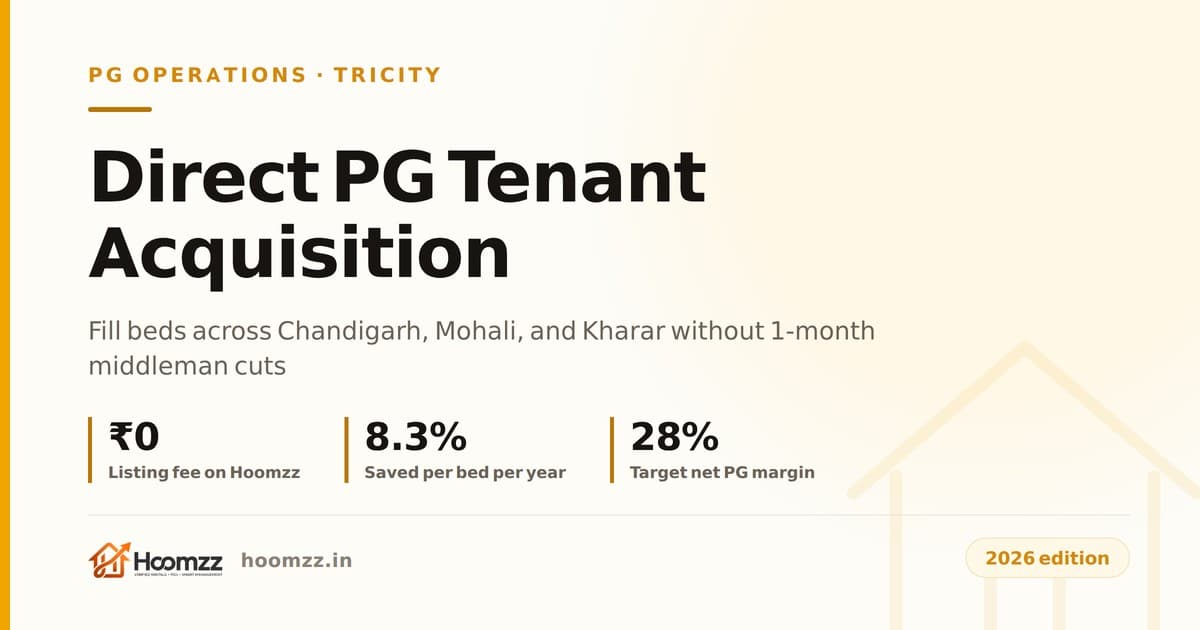
Paying guest operators across Chandigarh, Mohali, and Kharar lose 30% to 45% of annual net profits to 1-month aggregator commissions. Learn how direct bed-level listing on Hoomzz connects PG owners with students and corporate professionals without middleman deductions.
Short answer: Tricity paying guest (PG) operators lose between ₹6,000 and ₹12,000 per bed whenever an online aggregator or broker charges a standard one-month commission on student and corporate placements. For a 25-bed property, aggregator cuts devour 30% to 45% of annual net operating profit. By listing directly on Hoomzz with verified room and bed configurations, operators capture student demand from university clusters and corporate professionals from Mohali IT City, eliminating middleman commissions while retaining 100% of room tariffs.
- 1 MonthBrokerage per bedaggregator commission cut
- ₹1.5L–2.5LAnnual leakageper 25-bed Tricity facility
- 22%–32%Target net marginsustainable PG operations
- ₹0Commission on Hoomzzdirect verified listing
The True Unit Economics of Tricity PG Accommodation (2026)
Operating a paying guest facility across Chandigarh, SAS Nagar Mohali, or Kharar is a volume business governed by operational overheads. Unlike standard residential leasing, PG operators manage active hospitality environments. Every bed requires commercial power backup, sanitation, commercial waste clearing, fiber internet, and daily meal preparation.
Local real estate Instagram pages and creators are an active source of listings and area info for Tricity renters today, but casual social video clips rarely supply up-to-date vacancy status, verifiable food inclusions, or direct warden contacts. When operators depend on unstructured social channels or neighborhood street brokers, they struggle to maintain predictable occupancy throughout the calendar year.
In 2026, observed market rents for shared accommodations across the Tricity fall into three distinct locality brackets:
- Kharar (Near Chandigarh University & CGC Landran): Triple sharing ranges from ₹3,500 to ₹5,000 per bed monthly. Double sharing commands ₹5,000 to ₹7,500, while single rooms rent for ₹8,000 to ₹11,000 monthly with mess food.
- Mohali (Phases 3B2, 5, 7, and Sector 70): Double sharing observed rents range from ₹6,000 to ₹8,500 per bed monthly. Single AC rooms near commercial office corridors range from ₹9,000 to ₹14,000 monthly.
- Chandigarh (Sectors 15, 21, 22, and 34): Double sharing commands ₹7,000 to ₹10,000 per bed monthly with food, while private rooms for coaching aspirants range from ₹10,000 to ₹15,000 monthly.
From these tariffs, operators cover fixed overheads. In a 25-bed facility, grocery supplies cost ₹2,200 to ₹3,000 per resident monthly. Sub-metered electricity under PSPCL or the Chandigarh Electricity Department averages ₹800 to ₹1,500 per bed. Cook wages, cleaning staff, broadband, and maintenance leave owners with a gross margin between 35% and 45%, yielding a net margin of 22% to 32% in owner-occupied properties.
Why 1-Month Aggregator Fees Destroy PG Net Margins
Corporate aggregators and listing brokers promise fast tenant placement. In exchange, they enforce client acquisition fees equal to one full month of room rent (or 8.33% to 10% of total annual booking value) per placed tenant. In student housing, this fee destroys operating profits.
Consider a double-sharing bed in Mohali Phase 7 renting at ₹8,000 monthly (₹96,000 gross annual revenue). After monthly operational expenses of ₹5,800, net operating profit is ₹2,200 monthly, or ₹26,400 annually. Paying an aggregator one full month of rent (₹8,000) consumes 30.3% of the owner's net annual profit on that bed. If a student leaves after a 10-month academic session (generating ₹22,000 net profit), that ₹8,000 commission wipes out 36.4% of total earnings.
| Room Configuration | Monthly Rent (Per Bed) | Annual Net Margin (Pre-Fee) | Aggregator Cut (1 Month Rent) | Net Profit Lost to Broker | Hoomzz Direct Listing Savings |
|---|---|---|---|---|---|
| Triple Sharing — Kharar (CU Hub) | ₹4,500 | ₹14,400 | ₹4,500 | 31.2% | ₹4,500 / bed saved |
| Double Sharing — Mohali Phase 7 | ₹8,000 | ₹26,400 | ₹8,000 | 30.3% | ₹8,000 / bed saved |
| Single AC Room — Chandigarh Sec 34 | ₹12,000 | ₹38,400 | ₹12,000 | 31.2% | ₹12,000 / bed saved |
| 25-Bed Facility (Blended, 75% Churn) | ₹7,800 avg | ₹6,10,000 | ₹1,46,250 | 24.0% of facility profit | ₹1,46,250 – ₹1,95,000 retained |
Across a 25-bed property, an operator paying one-month placement fees loses ₹1,50,000 to ₹2,50,000 every year. That capital matches the cost of installing a commercial solar water heating plant or replacing four split air conditioners.
The Seasonal University Cycle: Solving the April–June Cash Flow Dip
Every PG operator in Kharar, Landran, Gharuan, and Sector 15 Chandigarh faces academic calendar swings. Institutions like Panjab University (PU), Chandigarh University (CU), and CGC Landran conclude end-semester examinations in May. Thousands of students return home, leaving beds unoccupied until late July.
During these 60 to 75 vacation days, student occupancy drops to 40% or 50%. Yet building maintenance, property taxes, lease commitments, and caretaker salaries continue. Operators who depend on aggregators discover inquiries collapse the moment university gates close.
Experienced operators counter this seasonal drop through three operational steps:
- 11-Month Agreements: Contracts require students to pay a room-retention retainer (35% to 50% of monthly base room rent without meals) to reserve their room through June and July.
- Summer Intern Housing: Engineering and management interns arrive in Mohali for summer industrial training at QuarkCity and Bestech Business Tower. Marketing vacant beds directly for short summer tenancies covers off-season utility bills.
- Margin Modeling: Operators calculate fixed overheads using tools like the Tricity rental yield and expense calculators to track cash flows across seasonal quarters.
Balancing Student Churn with Year-Round Corporate Tenants
Resilient Tricity accommodations do not rely exclusively on student occupants. They maintain a balanced resident base: 60% university students and 40% corporate professionals. The operational divergence between these groups is substantial, as examined in our study on student vs working professional PG operations.
Corporate staff along Airport Road, Mohali IT City (such as Infosys, Quark, and nearby IT parks), and Chandigarh Technology Park seek clean single or double rooms with reliable broadband and predictable meal schedules. Working professionals sign 12-month agreements, commute regularly, cause less furniture damage, and remain in residence through May, June, and July.
Direct corporate tenants also adhere to digital house rules and pay rent via bank transfer on time. Because they prioritize speed, they bypass street brokers and search for direct owner contacts on verified portals.
Direct Tenant Acquisition on Hoomzz
- Zero Commission: Keep 100% of the first month rent and all subsequent monthly tariffs.
- Direct Resident Verification: Speak directly with incoming students and working professionals before acceptance.
- Bed-Level Inventory Control: Mark individual single, double, or triple beds as available or occupied in real time.
- Year-Round Visibility: Reach corporate professionals in Mohali IT City as well as university students.
Relying on Commercial Aggregators
- 1-Month Commission Drain: Forfeit 8.3% to 10% of annual room revenue on every turnover.
- Broker Misrepresentation: Middlemen make false promises about food menus or air conditioning to close deals quickly.
- Forced Churn: External agents have a financial incentive to relocate tenants annually to earn fresh commissions.
- Payment Delays: Aggregators often hold tenant security deposits and advance rents in central escrow accounts.
Mandatory Security, Police Verification, and Administration Norms
Running a paying guest facility in the Tricity requires compliance with administrative orders and police safety directives. Non-compliance invites administrative penalties, closure notices, or criminal proceedings.
1. Mandatory Tenant Police Verification
Under standing preventive orders from the District Magistrate of Chandigarh and District Magistrate of SAS Nagar (Mohali), tenant police verification is legally mandatory. In Chandigarh, failure to submit verification records is punishable under Section 223 of the Bharatiya Nyaya Sanhita (BNS). Operators must submit occupant identification, permanent addresses, and college or workplace credentials through the Chandigarh Police Citizen Portal or at the local police station.
In Mohali, Kharar, and Zirakpur, operators register tenant records via the Punjab Police Saanjh Kendra portal (ppsaanjh.in). Keeping copies of verified ID proofs in an indexed register protects the operator during police inspections.
2. Safety, Biometrics, and CCTV Guidelines
Chandigarh Estate Office guidelines and Punjab municipal norms set explicit safety standards for commercial boarding houses:
- CCTV Surveillance: Operators must install operational cameras covering entry gates, stairwells, corridors, and dining halls, retaining recordings for at least 30 days.
- Digital Logging & Biometrics: Maintaining digital entry logs prevents unverified visitors from accessing residential floors unmonitored. Operators can examine safety compliance details in our PG safety and biometric compliance audit.
- Fire Safety Standards: Refilled fire extinguishers must be mounted on every floor near stairways. Passages and emergency exits must remain clear of beds and luggage at all times.
- Space Norms: Chandigarh Administration rules require a minimum usable floor area of 50 square feet per paying guest, with at least one bathroom and toilet per five residents.
3. The Legal Status of Security Deposits
There is no statutory security-deposit cap anywhere in the Tricity. The "two-month cap" reported in mid-2026 stemmed from a Chandigarh notification adopting the Assam Tenancy Act, 2021 (notified on 6 May 2026), but the Punjab and Haryana High Court placed that notification in abeyance on 29 May 2026. As a result, the East Punjab Urban Rent Restriction Act of 1949 continues to govern Chandigarh. SAS Nagar district remains governed by the Punjab Rent Act of 1995, while Panchkula operates under the Haryana Urban (Control of Rent and Eviction) Act of 1973. In practice, Tricity PG operators collect one or two months of refundable security deposit under mutually agreed terms.
Never rely on verbal agreements or casual WhatsApp chats for rent rules. Issue an itemized admission receipt detailing room number, bed identifier, exact monthly tariff, electricity billing basis, and clear security deposit refund conditions before handing over room keys.
The 4-Step Direct Acquisition Playbook on Hoomzz
Shifting from aggregator dependence to direct tenant acquisition is a straightforward operational change. Managing your inventory directly on verified platforms builds a reliable stream of inbound tenant inquiries.
- Publish Physically Verified Inventory on Hoomzz Create your property profile on Hoomzz by selecting your exact sector or village locality. Upload authentic photographs of bedrooms, study desks, attached washrooms, and the shared dining area. Hoomzz lists physically verified rentals across Chandigarh, Mohali, Panchkula, and Zirakpur, giving genuine operators higher search visibility over unverified broker listings.
- Specify Bed-Level Configurations and Tariffs List each room by its true occupancy type—single room, double sharing, or triple sharing. Clearly state whether food is included in the base tariff and specify sub-meter electricity rates per unit. When students browse verified PGs in Tricity, clear upfront pricing eliminates non-serious inquiries and saves hours of phone calls.
- Engage Directly with Prospective Residents Respond promptly to direct inquiries from university students and corporate professionals. Coordinate physical property visits during daylight hours, provide prospective tenants with a walkthrough of the kitchen and study facilities, and introduce them to the live-in warden.
- Institutionalize Tenant Police Verification and Check-In Collect verified government identification during room reservation. File the mandatory police verification proforma through the local police portal within 48 hours of move-in, issue the formal room receipt, and log the resident into your biometric entry system.
Operators looking to list their available rooms can immediately list your PG rooms and beds on Hoomzz at zero cost, connecting with serious students and professionals searching across the Tricity. To understand how direct discovery transforms rental economics for both tenants and owners, read our companion guide on zero-brokerage renting dynamics.
Frequently Asked Questions
What is the average profit margin of a PG in Tricity?
A well-run paying guest facility in the Tricity typically operates at a gross margin of 35% to 45% and a net operating margin of 22% to 32% before external broker commissions. Operating costs include commercial or sub-metered electricity, kitchen groceries, cook wages, high-speed internet, housekeeping, and regular maintenance. When an aggregator takes a full one-month brokerage fee of ₹6,000 to ₹12,000 on student placements, it consumes between 30% and 45% of that bed's net annual operating profit.
How does listing rooms and beds on Hoomzz reduce middleman commission?
Hoomzz provides a zero-brokerage property and bed discovery marketplace where PG operators list specific room types, private beds, meal plans, and amenities without paying customer acquisition cuts or placement fees. Prospective students and working professionals connect directly with the owner or warden to schedule on-site viewings. By eliminating the standard 15-day to one-month aggregator fee, an operator with 25 beds retains ₹1,50,000 to ₹2,50,000 in operational income every single year.
What are the key security and safety installations required by local authorities?
Local administrations in Chandigarh and SAS Nagar district require commercial PG accommodations to maintain continuous CCTV surveillance with at least 30 days of backup covering entry points, exit gates, and common areas. In addition, operators must maintain visitor logbooks, implement secure access controls, install serviced fire extinguishers on every floor, and ensure clear emergency exits. Mandatory tenant police verification must also be filed promptly through local police portals or Saanjh Kendras.
How do seasonal university cycles affect PG cash flow?
Tricity student housing experiences severe seasonality tied to the academic calendar of institutions like Panjab University, Chandigarh University, and CGC Landran. During the April to June examination and vacation break, student occupancy can plummet to 40% to 50%, causing cash flow to turn negative if fixed facility costs persist. Experienced operators stabilize revenue by offering 11-month academic contracts and diversifying bed allocation with year-round corporate professionals working in Mohali IT City and Chandigarh IT Park.
Is there a statutory security deposit cap for paying guest accommodations in Chandigarh or Punjab?
No statutory security deposit cap exists in Chandigarh or Punjab. Although a notification regarding the Assam Tenancy Act was issued in May 2026 proposing a two-month limit in Chandigarh, the Punjab and Haryana High Court placed that notification in abeyance on 29 May 2026, leaving the East Punjab Urban Rent Restriction Act of 1949 in effect. SAS Nagar district is governed by the Punjab Rent Act of 1995. Standard Tricity market practice remains one to two months of refundable deposit determined by mutual contract.
Sources, and what here is judgement rather than data
Government portals and regulatory sources confirming legal mandates:
- Chandigarh Police Citizen Portal: Confirms mandatory tenant and paying guest verification procedures under Section 223 BNS and local District Magistrate orders.
- Punjab Police Saanjh Citizen Portal: Confirms online tenant verification filing requirements for SAS Nagar Mohali district and Kharar sub-division.
- Chandigarh Administration Estate Office: Confirms residential building bylaws, minimum 50 sq. ft. per guest space norms, and sanitary guidelines for paying guest accommodations.
Editorial judgement versus measured data: The rent brackets (₹3,500–₹15,000), monthly grocery costs (₹2,200–₹3,000 per head), and typical net operating margins (22%–32%) represent empirical market observations gathered across active PG clusters in Chandigarh, Mohali, and Kharar during 2026. Exact expenses depend on building ownership, electrical load tariffs, meal quality, and amenities. The recommendation to allocate 40% of beds to corporate tenants reflects operational risk management rather than a statutory requirement.
👈 This comparison is based on market observations and publicly available data. Users should verify details independently.
Prioritize Hoomzz Real Estate News in your Google Search AI Overviews
Google's new search update lets you select trusted sources. Pin hoomzz.in to get our instant local market rates, builder updates, and renting news featured first in your AI answers.
Find Verified PGs & Hostels
Safe, hygienic AC/Non-AC PG accommodations with meals, Wi-Fi & zero broker markups in Tricity.