60 Gaj & 30 Gaj in Square Feet: Exact Conversions (540 & 270 Sq Ft), Micro-Plot Bylaws & Regularization in Tricity (2026)

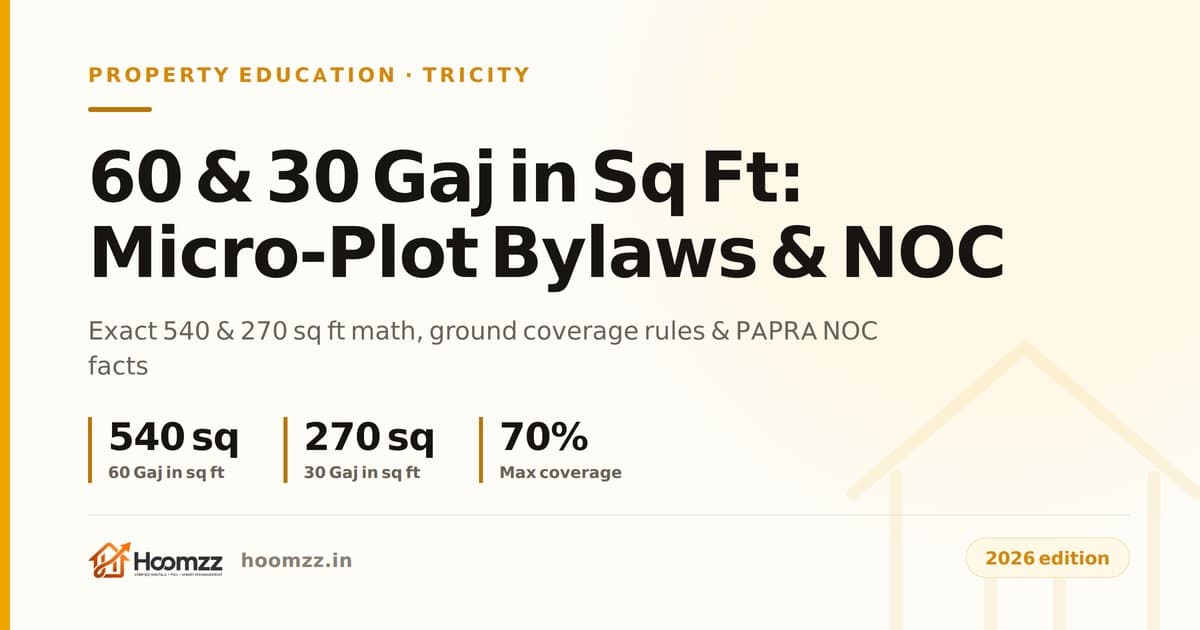
60 Gaj equals exactly 540 square feet, while 30 Gaj equals 270 square feet. Here is the complete legal and architectural guide to micro-plot conversions, Punjab building coverage rules, PAPRA Section 20(5) NOC exemptions, and municipal regularization across Tricity.
Short answer: In Chandigarh Tricity and Greater Mohali, 60 Gaj equals exactly 540 square feet (60 square yards or 50.17 square metres), representing 2.4 urban Marlas under GMADA standards (25 Gaj per Marla) and 1.98 rural Marlas. A 30 Gaj parcel converts to exactly 270 square feet (30 square yards or 25.08 square metres, equal to 1.2 urban Marlas), while a 25 Gaj plot equals 225 square feet (exactly 1.0 urban Marla). Under the Punjab Urban Planning and Development Building Rules, residential plots under 100 square metres permit up to 70% maximum ground coverage with zero side setbacks for attached row houses. While the PAPRA Amendment Act 2024 exempts plots up to 500 square yards from NOC requirements for sale deed registration if transacted on or before July 31, 2024, registration does not confer municipal regularization, and unapproved micro-plots remain ineligible for e-Naksha building approvals or bank home loans.
- 540Square Feet60 Gaj exact conversion
- 270Square Feet30 Gaj exact conversion
- 70%Max CoveragePunjab bylaws (<100 sq m)
- 31 Jul 2024PAPRA Cutoff500 sq yd NOC exemption
The Micro-Plot Market Across Mohali, Kharar & Zirakpur
In the residential property market across Greater Mohali, Kharar, and Zirakpur, micro-plots measuring 60 Gaj (540 square feet), 30 Gaj (270 square feet), and 25 Gaj (225 square feet) serve an active segment of entry-level homebuyers. While planned authority sectors developed by GMADA (Greater Mohali Area Development Authority) and HSVP (Haryana Shehri Vikas Pradhikaran) rarely parcel residential land below 100 Gaj (4 Marlas / 125 square yards), micro-plots dominate peripheral private colonies and village expansion zones.
Active pockets include Kharar peripheral belts (Sunny Enclave extensions, Chajju Majra Road, Jandpur, Badala Road, and Bhagomajra), Zirakpur fringes (Baltana, Gazipur, and Dhakoli outskirts), and developing sectors near Dera Bassi and Lalru. These parcels appeal to buyers seeking an independent freehold residence on a modest capital outlay of ₹15 lakh to ₹35 lakh.
Local real estate Instagram pages and creators are an active source of listings and area info for Tricity renters and buyers today, frequently showcasing walk-through videos of newly built 60 Gaj independent houses in peripheral pockets. However, promotional social video tours rarely examine critical statutory and civil engineering realities: municipal regularization status, narrow 15-foot access lanes, absence of storm-water drainage, and building plan sanction risks.
Hoomzz lists physically verified rentals across Chandigarh, Mohali, Panchkula and Zirakpur to help property seekers evaluate genuine on-ground housing conditions without broker misdirection. Understanding the exact mathematical conversions, building bylaws, and statutory regularization requirements is essential before committing capital to a micro-plot in Punjab.
Exact Mathematical Conversions: 60 Gaj, 30 Gaj & 25 Gaj
In Punjab, Haryana, and Chandigarh revenue practice, “Gaj” is legally synonymous with the standard imperial square yard (3 linear feet × 3 linear feet). One Gaj contains exactly 9 square feet. Using this constant, the land dimensions convert with exact precision:
- 60 Gaj Conversion: 60 × 9 = 540 square feet (50.17 square metres or 60 square yards). Under urban GMADA standards (25 Gaj per Marla), 60 Gaj equals 2.40 urban Marlas. In rural revenue records based on the 5.5-foot Karam (272.25 sq ft per Marla), 60 Gaj equals 1.983 rural Marlas.
- 30 Gaj Conversion: 30 × 9 = 270 square feet (25.08 square metres or 30 square yards). This equals 1.20 urban Marlas under GMADA standards and 0.992 rural Marla in rural revenue registers.
- 25 Gaj Conversion: 25 × 9 = 225 square feet (20.90 square metres or 25 square yards). This converts to exactly 1.00 urban Marla (225 sq ft benchmark) and 0.826 rural Marla.
To compare these micro-plots with mid-sized residential parcels, review our companion guides to 125 Gaj in square feet and plot plans, 150 Gaj in square feet builder floor layouts, 160 Gaj independent floor construction and bylaws, and our Gaj to square feet and square yards conversion table.
The Urban Marla vs Rural Marla Revenue Discrepancy
A frequent source of confusion for buyers in peripheral Tricity colonies involves distinguishing urban Marlas from rural revenue Marlas. In Punjab, two distinct land measurement standards exist side by side:
- Urban Master-Planning Benchmark (GMADA, PUDA & Town Planning): In all planned sectors and approved municipal colonies, 1 Marla is standardized at 25 Gaj (225 square feet). Under this metric, 60 Gaj contains 2.40 urban Marlas, and 30 Gaj contains 1.20 urban Marlas.
- Rural Revenue Benchmark (Department of Revenue Jamabandi): In agricultural land records maintained under the Punjab Land Revenue Act, land is surveyed using the traditional 5.5-foot Karam. Under this system, 1 rural Marla equals 9 Sarsahis (272.25 square feet or 30.25 Gaj). On rural revenue fard documents, 60 Gaj represents 1.983 rural Marlas.
Dealers often quote land in vague “Marla” terms. If a broker offers an unapproved “2 Marla plot”, you might expect 544.5 square feet under rural records, but receive an urban 450 sq ft parcel (50 Gaj) or a 540 sq ft parcel (60 Gaj). Always require that the registered sale deed explicitly states physical boundary dimensions in linear feet alongside total square feet.
| Plot Size | Dimensions (Front × Depth) | Total Area | Viable Residential Layout | Ventilation & Parking Assessment | Common Tricity Pockets |
|---|---|---|---|---|---|
| 60 Gaj | 15 ft × 36 ft | 540 sq ft | Ground Floor: 1BHK + Scooter Porch; First Floor: 1BHK + Balcony (2BHK Duplex) | Two-wheeler parking only; central OTS light shaft required for bathroom ventilation | Sunny Enclave extension, Kharar-Landran link, Baltana, Dera Bassi municipal wards |
| 60 Gaj | 18 ft × 30 ft | 540 sq ft | Ground Floor: Wide 1BHK with separate living room and open kitchen; First Floor: 2 compact bedrooms | Compact hatchback parking feasible (e.g. Alto or WagonR); superior natural facade daylighting | Chajju Majra Road Kharar, Gazipur Zirakpur, Bhagomajra approved layouts |
| 60 Gaj | 12 ft × 45 ft | 540 sq ft | Linear shotgun house: tandem room configuration (porch, drawing room, bedroom, rear washroom) | No car parking; narrow 12-foot span creates dark interior rooms requiring dual vertical air shafts | Older unauthorized ribbons along Kharar bypass, unauthorized colony splits in Baltana |
| 30 Gaj | 10 ft × 27 ft | 270 sq ft | Single-storey 1RK studio: 9×14 ft room, 4×5 ft attached bath, 4×6 ft kitchenette | Two-wheeler parking inside entry gate; rear 2-foot ventilation cut-out required for toilet exhaust | Jandpur village perimeter, Badala Road unauthorized colonies, Dera Bassi industrial fringes |
| 30 Gaj | 9 ft × 30 ft | 270 sq ft | Ultra-compact 1RK studio or multi-floor rental units (Ground: 1RK; First: 1RK; Second: 1RK) | Zero vehicle parking; staircase consumes 3 feet of width, leaving a 6-foot net room clearance | High-density rental pockets catering to industrial workers and junior students in Kharar |
| 25 Gaj | 10 ft × 22.5 ft | 225 sq ft | Single room unit with partition toilet (1 urban Marla exact footprint) | Bicycle/scooter parking only; natural light restricted exclusively to front entrance door | Abadi deh extensions, unauthorized colony subdivisions, resettlement corridors |
Punjab Urban Building Bylaws for Plots Below 100 Square Metres
When constructing on residential land in SAS Nagar district, building norms are governed by the Punjab Urban Planning and Development Building Rules. For micro-plots categorized under the “below 100 square metres” slab (60 Gaj is 50.17 sq m; 30 Gaj is 25.08 sq m; 25 Gaj is 20.90 sq m), the rules provide specific architectural relaxations:
- Maximum Ground Coverage: The statutory building rules permit up to 70% ground coverage for residential plots below 100 square metres. On a 60 Gaj plot (540 sq ft), the maximum permissible ground plinth footprint is 378 square feet, leaving 162 square feet as mandatory unbuilt open area. On a 30 Gaj plot (270 sq ft), 70% coverage yields 189 square feet of plinth, with 81 square feet unbuilt open area.
- Setbacks & Margins:
- Front Setback: Minimum 1.5 metres (approx. 5 feet), or as delineated in the approved municipal zoning control sheet.
- Rear Setback: Minimum 1.0 to 1.5 metres across the rear boundary to serve as an open-to-sky courtyard for sanitation pipelines and cross-ventilation.
- Side Setbacks: Zero side setbacks are permitted. Micro-plots are planned as attached row houses sharing common structural party walls on both flanks.
- Permissible Floor Area Ratio (FAR): Standard FAR for micro-plots ranges between 1:1.65 and 1:2.0, with options for compounding or purchasing additional FAR from the local municipal authority where permitted by road width.
- Maximum Building Height: Construction is typically restricted to Ground + 2 Floors (G+2) up to a total height of 11 metres. Stilt parking (Stilt + 3 Floors) is generally not sanctioned on micro-plots because a 10-foot to 18-foot frontage cannot support structural vehicle turning circles, and local municipal bylaws require a minimum road width of 30 to 40 feet for stilt approvals.
- Open-To-Sky (OTS) Shaft Mandate: Because row houses share side walls with adjacent neighbors, every habitable room, kitchen, and water closet must have an external window opening either to the street, the rear yard, or an internal OTS shaft measuring at least 9 to 12 square feet.
The Golden Rule for 60 Gaj Plots: Never sacrifice the rear setback courtyard to build an oversized ground-floor bedroom. Without a rear air shaft, your kitchen and bathroom will have no external exhaust vent, trapping moisture, causing permanent wall dampness (seelan), and failing municipal building inspection standards.
Approved Municipal Micro-Plot Fits If
- The colony holds a formal regularization certificate or layout sanction from GMADA or Municipal Council.
- The abutting internal road is at least 25 to 30 feet wide with connected municipal sewer and water mains.
- You intend to secure an e-Naksha building sanction and apply for a nationalized bank construction loan.
- You want an affordable independent freehold home under ₹35 lakh with clean, resaleable legal title.
Avoid Unapproved Peripheral Micro-Plots If
- The seller relies on an agricultural Khasra number without an approved colony layout or regularization receipt.
- The access lane is under 20 feet wide, preventing fire brigade and septic maintenance vehicle access.
- You require a bank home loan; commercial banks reject construction financing on unapproved layouts.
- You expect guaranteed municipal water supply; unapproved colonies often rely on private tubewells with deep drawdown risks.
The Legal Reality: PAPRA Amendment Act 2024 & Section 20(5) NOC Rules
The most critical legal issue surrounding micro-plots in Punjab is the distinction between sale deed registration and municipal regularization. Dealers frequently mislead buyers by claiming: “Tehsil mein registry ho rahi hai, toh plot legal hai” (The deed is registering at the Tehsil, so the plot is completely legal). This statement conflates two entirely different legal processes.
Historically, Section 20 of the Punjab Apartment and Property Regulation Act, 1995 (PAPRA) made a No Objection Certificate (NOC) from GMADA or the Department of Local Government mandatory before any Sub-Registrar could register a property deed. Because hundreds of thousands of small buyers were stranded in unauthorized colonies created by private colonizers, the Punjab Legislative Assembly enacted the Punjab Apartment and Property Regulation (Amendment) Act, 2024 (Punjab Act No. 11 of 2024).
- Section 20(5) Exemption: Any person who entered into an Agreement to Sell, Power of Attorney (POA), or full transaction for an area up to 500 square yards (500 Gaj) in an unauthorized colony on or before July 31, 2024 is exempt from presenting an NOC for sale deed registration.
- Direct Tehsil Registration: Eligible micro-plot holders (including 25, 30, and 60 Gaj buyers) can register their sale deed directly before the Sub-Registrar without an administrative NOC.
- Subsequent Sales Allowed: If the eligible parcel is not further subdivided, subsequent sale deeds can also be executed, provided the Sub-Registrar sends formal intimation of the registration to the concerned urban development authority.
- Severe Penalties for New Illegal Plots: While granting relief to past buyers, the amendment introduced harsh criminal sanctions for promoters carving out new unauthorized colonies after the cutoff date: mandatory imprisonment of 3 to 7 years and fines ranging from ₹25 lakh to ₹5 crore.
Securing a registered sale deed at the Sub-Registrar office records legal title ownership. It does not certify that your plot is part of a regularized, approved layout. If an unauthorized colony has not paid external development charges (EDC) and secured a formal regularization order under the Punjab regularization policy, the local Municipal Council will refuse to approve building plans on the Punjab e-Naksha portal, public utilities can deny permanent connections, and commercial banks will reject loan applications. For related statutory procedures on land-use conversions, review our analysis of CLU conversion and town planning norms along PR7 Zirakpur.
Step-by-Step Verification Sequence Before Buying Micro-Plots
Before transferring token money or signing an agreement to sell for a 60 Gaj or 30 Gaj plot in Punjab, execute this rigorous statutory verification sequence:
- Fard Jamabandi and Khasra Title AuditVerify ownership records on the Department of Revenue Jamabandi portal (jamabandi.punjab.gov.in). Confirm whether the seller holds a clear, unencumbered title on the revenue register or is merely selling an undivided fractional share (hissedari) of agricultural land without physical demarcation.
- Regularization and Layout Sanction VerificationDemand the official Regularization Order or Sanctioned Layout Plan issued by GMADA or the local Municipal Council. If the seller claims the plot qualifies under the PAPRA 2024 amendment, inspect the original registered Agreement to Sell or stamp paper dated on or before July 31, 2024.
- Physical Demarcation and Right-of-Way InspectionVisit the plot with an independent licensed surveyor or patwari. Measure the exact frontage and depth with a steel tape. Confirm that the front approach road matches the layout drawing and measures at least 20 to 30 feet wide; access lanes below 20 feet create severe congestion and fail municipal fire access norms.
- Groundwater and Basic Drainage CheckCheck whether the colony connects to an active municipal sewer line or relies on individual soak-pit septic tanks. In dense 30 Gaj clusters, overcrowded septic tanks can contaminate shallow groundwater. For water supply dynamics, read our operational review of deep tubewell permissions and water supply in Kharar.
Tricity Jurisdiction Comparison: Punjab vs Chandigarh UT vs Haryana
Micro-plot property rights and building bylaws differ sharply across the three administrative jurisdictions of the Tricity:
- Punjab (Mohali, Kharar, Zirakpur, Dera Bassi): Regulated by GMADA and the Department of Local Government under the Punjab Urban Planning and Development Building Rules. Micro-plots are widespread in peripheral municipal pockets. Building approvals are processed via the Punjab e-Naksha portal. Registration is governed by PAPRA and the Registration Act, 1908.
- Chandigarh UT: The Chandigarh Master Plan 2031 strictly prohibits the subdivision of residential plots below 1 Kanal, and the Supreme Court of India has upheld the ban on apartmentalization and fragmenting of residential bungalows in Phase 1 (Sectors 1 to 30). Consequently, independent freehold 30 Gaj or 60 Gaj plots do not exist in planned UT sectors. Micro-parcels are confined to historical EWS rehabilitation colonies or village abadi deh (lal dora) pockets under strict UT Estate Office architectural controls.
- Haryana (Panchkula, Pinjore, Kalka): Plotted developments in HSVP sectors adhere to the Haryana Building Code via the HOBPAS digital portal. Under Haryana rules, small residential plots up to 60 square metres permit up to 85% ground coverage with a minimal 0.5-metre front setback. Independent micro-plots are available primarily in affordable plotted schemes or municipal extensions in Pinjore and Kalka.
2026 Construction Costs & Development Budget
Constructing an independent residence on a micro-plot requires disciplined budgeting. Because micro-plots share structural party walls and have restricted site access, material staging demands careful logistics. Observed civil construction costs across Greater Mohali, Kharar, and Zirakpur in late 2026 fall into distinct brackets:
- Grey Structure (Civil Framework): Observed between ₹1,300 and ₹1,550 per square foot. Includes foundation excavation, RCC columns and slabs using Fe-550 TMT steel, first-class red brick masonry, internal and external plaster, electrical conduit piping, and plumbing line rough-ins.
- Standard Turnkey Finishing: Observed between ₹1,900 and ₹2,350 per square foot. Covers 2×2 ft vitrified tile flooring, flush doors, aluminium sliding windows, internal acrylic paint, basic granite kitchen slabs, and standard sanitary fixtures.
- Premium Turnkey Finishing: Observed between ₹2,500 and ₹3,100 per square foot. Incorporates false ceilings with profile lighting, modular kitchen cabinets with chimney, premium CP fittings, and UPVC sound-insulated windows.
| Plot Size & Building Configuration | Total Covered Area | Grey Structure Cost (₹1,400/sq ft) | Standard Turnkey Cost (₹2,100/sq ft) | Premium Turnkey Cost (₹2,800/sq ft) |
|---|---|---|---|---|
| 60 Gaj — Ground Floor Only (1BHK) | ~378 sq ft plinth | ₹5.29 Lakh | ₹7.94 Lakh | ₹10.58 Lakh |
| 60 Gaj — Ground + 1 Floor (2BHK Duplex) | ~750 sq ft total | ₹10.50 Lakh | ₹15.75 Lakh | ₹21.00 Lakh |
| 60 Gaj — Ground + 2 Floors (3 Independent Units) | ~1,120 sq ft total | ₹15.68 Lakh | ₹23.52 Lakh | ₹31.36 Lakh |
| 30 Gaj — Ground Floor Only (1RK Studio) | ~189 sq ft plinth | ₹2.65 Lakh | ₹3.97 Lakh | ₹5.29 Lakh |
| 30 Gaj — Ground + 1 Floor (1BHK Compact) | ~375 sq ft total | ₹5.25 Lakh | ₹7.88 Lakh | ₹10.50 Lakh |
| 30 Gaj — Ground + 2 Floors (3 Rental Studios) | ~560 sq ft total | ₹7.84 Lakh | ₹11.76 Lakh | ₹15.68 Lakh |
Rental Economics & Tenancy Regulations in Tricity
Investing in a 60 Gaj or 30 Gaj independent building in Greater Mohali provides steady rental demand from industrial employees, junior software trainees, and college students seeking budget housing near employment hubs. Observed market rental rates in late 2026 fall into specific ranges:
- 60 Gaj 2BHK Independent House (Kharar / Zirakpur Fringes): Observed between ₹7,500 and ₹11,500 per month for semi-furnished units, needing independent verification based on road width and locality.
- 30 Gaj 1RK Studio Unit: Observed between ₹4,000 and ₹6,500 per month, popular among single working professionals and students.
- Multi-Unit Rental Yields: An owner who constructs a G+2 building on a 60 Gaj plot (creating three independent 1BHK units) can generate an observed gross rental income of ₹18,000 to ₹24,000 per month, yielding 5.5% to 7.0% gross annual rental returns on total capital invested.
When leasing residential premises anywhere in the Tricity, landlords and tenants must comply with statutory requirements:
- Mandatory Police Verification: Under standing preventive orders issued by the SAS Nagar District Magistrate and Chandigarh Administration, tenant police verification is legally mandatory prior to occupancy. Landlords who fail to register tenant verification face criminal prosecution under Section 188 of the Indian Penal Code. For legal remedies regarding rent disputes, read our legal analysis on drafting legal eviction notices for non-payment of rent in Punjab and Chandigarh.
- No Statutory Deposit Cap: There is no operative statutory cap on tenant security deposits anywhere in the Tricity. The “two-month deposit cap” reported in mid-2026 stemmed from a Chandigarh notification (Assam Tenancy Act, 2021, notified 6 May 2026) that the Punjab & Haryana High Court kept in abeyance on 29 May 2026. As a result, the East Punjab Urban Rent Restriction Act, 1949 continues to govern Chandigarh tenancies. Panchkula remains regulated by the Haryana Urban (Control of Rent and Eviction) Act, 1973. Security deposits remain subject to contractual negotiation between owner and tenant.
Hoomzz lists physically verified rentals across Chandigarh, Mohali, Panchkula and Zirakpur with zero brokerage and verified landlord contact details. You can explore verified rental listings on our rent properties in Tricity directory, review purchase options on buy properties in Tricity, assess neighborhood profiles on Tricity locations, or run instant unit conversion and stamp duty calculations using our interactive Tricity property calculators.
Frequently Asked Questions
What is the statutory legal requirement in Chandigarh UT vs Punjab vs Haryana?
In Punjab (Mohali, Kharar, Zirakpur), residential construction is regulated under the Punjab Urban Planning and Development Building Rules via the Punjab e-Naksha portal, and unapproved colony registries are restricted under the PAPRA Amendment Act 2024. In Haryana (Panchkula), approvals fall under the Haryana Building Code via the HOBPAS system, allowing up to 85% coverage on plots under 60 square metres. In Chandigarh UT, residential plot subdivision below 1 Kanal is prohibited under the Chandigarh Master Plan 2031, meaning independent 30 Gaj or 60 Gaj freehold plot titles do not exist within UT planned sectors.
How can citizens verify official records online without agent middlemen?
In Punjab, buyers can verify title ownership, Khasra numbers, and mutation entries directly through the Department of Revenue Jamabandi portal (jamabandi.punjab.gov.in) and inspect registered deeds on NGDRS Punjab. Colony regularization status and approved layout plans can be verified through the GMADA portal (gmada.gov.in) and the Department of Local Government. In Haryana, land records are verified on Jamabandi Haryana (jamabandi.nic.in), while Chandigarh UT records are hosted on the Chandigarh Administration Estate Office portal.
What are the typical government fees and charges involved in 2026 for micro-plots in Punjab?
In Punjab, stamp duty on residential property transfer in 2026 is 7% for male buyers, 5% for female buyers, and 6% for joint male-female co-owners, calculated on circle rate or deed value. An additional 1% state registration fee applies across all categories up to a statutory cap of ₹2,00,000, bringing total statutory government outgo to 8% for men, 6% for women, and 7% for joint couples. For a ₹15 lakh 60 Gaj plot in Kharar or Zirakpur, total statutory government registration outgo is ₹1,20,000 for a male buyer and ₹90,000 for a female buyer.
Where can readers find verified calculators and property guides on Hoomzz?
Readers can access interactive land measurement converters, stamp duty calculators, and rental yield estimators on the Hoomzz calculators page at hoomzz.in/calculators. Hoomzz lists physically verified rentals across Chandigarh, Mohali, Panchkula, and Zirakpur with zero brokerage and direct landlord contact details.
Does a registered sale deed mean a 60 Gaj or 30 Gaj plot is legally approved by GMADA or Municipal Council?
No, a registered sale deed at the Sub-Registrar Tehsil office only establishes legal title transfer and ownership rights between buyer and seller; it does not confer municipal layout approval or regularization. Under the PAPRA Amendment Act 2024, Section 20(5) exempts eligible small plots up to 500 square yards from the NOC requirement for deed registration, but Municipal Councils and GMADA will still refuse building plan sanctions (naksha pass) on unregularized layouts until the colony promoter or resident welfare association completes statutory regularization and pays external development charges.
What are the permissible building coverage and setback rules for a 60 Gaj or 30 Gaj plot in Punjab?
Under the unified Punjab Urban Planning and Development Building Rules, residential plots below 100 square metres (such as 60 Gaj measuring 50.17 sq m, or 30 Gaj measuring 25.08 sq m) permit a maximum ground coverage of 70% of total plot area. Mandatory setbacks require a minimum 1.5-metre front road margin and a 1.0 to 1.5-metre rear courtyard margin for light and sanitation shafts. Zero side setbacks are permitted for attached row-housing construction, with a standard permissible height limit of Ground + 2 floors (11 metres).
Sources, and what here is judgement rather than data
Official Data & Regulatory Sources:
- Plot measurement conversions, maximum ground coverage parameters (70% for plots under 100 sq metres), and setback standards are referenced from the Punjab Urban Planning and Development Building Rules published by the Greater Mohali Area Development Authority (GMADA).
- Statutory amendments governing NOC exemptions for plots up to 500 square yards under Section 20(5) of the Punjab Apartment and Property Regulation Act are sourced from legislative records documented by PRS Legislative Research.
- Digital building plan scrutiny standards and Smart-DCR architectural submission procedures are verified against the Punjab e-Naksha portal (enaksha.lgpunjab.gov.in).
- Revenue record verification procedures (urban 225 sq ft Marla vs rural 272.25 sq ft Karam Marla) and title mutations are verified through the Department of Revenue Punjab Jamabandi portal (jamabandi.punjab.gov.in).
- Stamp duty percentages, female ownership concessions, and registration fees are verified from the Punjab Revenue Department (revenue.punjab.gov.in).
- Judicial coverage regarding High Court stays on tenancy notifications and illegal colony regularization challenges in Punjab is referenced from The Tribune India.
Editorial Judgement & Observed Estimates:
Turnkey civil construction costs (₹1,300–₹3,100 per sq ft) and monthly market rental ranges (₹7,500–₹11,500 for 60 Gaj 2BHK houses; ₹4,000–₹6,500 for 30 Gaj studio units) represent observed market figures compiled from active contractors, architectural firms, and verified rental listings across Kharar, Zirakpur, and peripheral Mohali in late 2026. Actual civil expenses depend on foundation soil excavation depth, structural steel market pricing, and sanitary brand specifications.
👈 This comparison is based on market observations and publicly available data. Users should verify details independently.
Prioritize Hoomzz Real Estate News in your Google Search AI Overviews
Google's new search update lets you select trusted sources. Pin hoomzz.in to get our instant local market rates, builder updates, and renting news featured first in your AI answers.
Looking to Buy or Invest?
Access verified luxury kothis, plots & high-ROI commercial properties with clean clear titles in Tricity.