How to Draft a Legal Eviction Notice for Non-Payment of Rent in Chandigarh & Punjab: Statutory Timelines, Legal Templates & Court Precedents (2026)

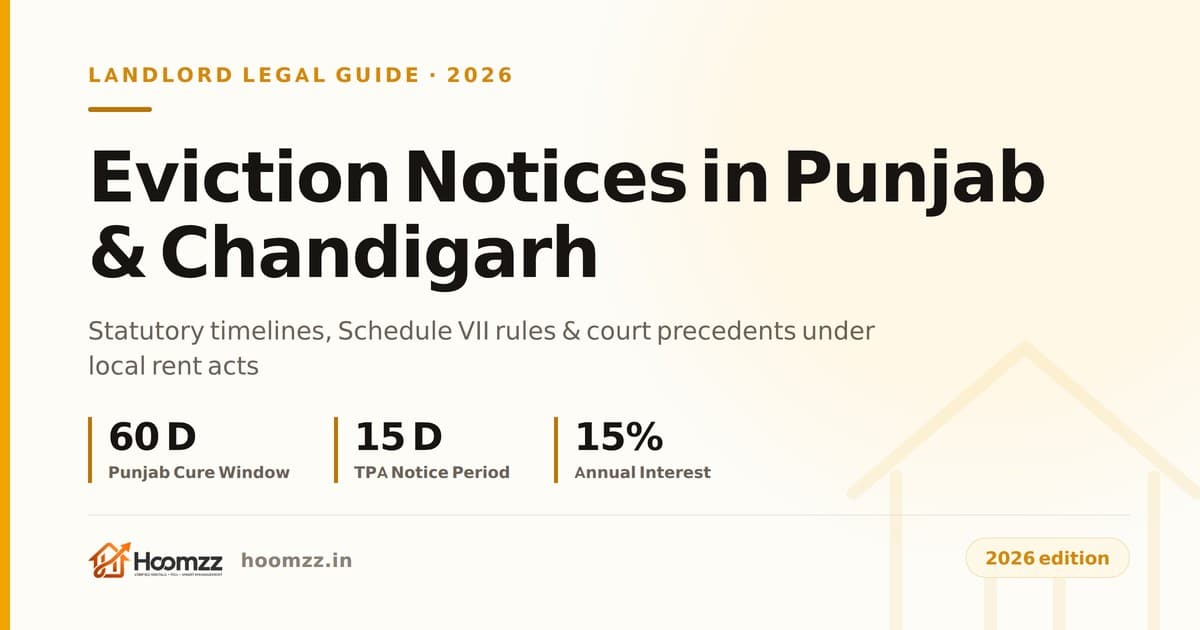
Recovering rent arrears and initiating eviction in Chandigarh and Punjab requires strict adherence to statutory demand formats under the East Punjab Rent Act and Punjab Rent Act, 1995. Here is the step-by-step legal guide to drafting an enforceable notice, managing court timelines, and protecting your rental yield.
Short answer: Under the Punjab Rent Act, 1995 (governing Mohali, Kharar, and Zirakpur), evicting a tenant for non-payment of rent under Section 20(2)(a) requires a default of 3 or more consecutive months, followed by a mandatory statutory notice of demand drafted strictly in the format of Schedule VII granting a 60-day (two-month) cure period with 15% per annum interest. In Chandigarh, the East Punjab Urban Rent Restriction Act, 1949 remains operational following the Punjab & Haryana High Court stay on the Assam Tenancy Act on 29 May 2026; landlords must serve a 15-day notice under Section 106 of the Transfer of Property Act, 1882 before petitioning the Rent Controller under Section 13(2)(i). Under the Supreme Court precedent in Rakesh Wadhawan v. Jagdamba Industrial Corp., the Rent Controller assesses arrears provisionally on the first hearing; if the tenant deposits that sum, eviction for that default is averted. Full eviction proceedings through local courts take 9 to 18 months.
- 60 DaysPunjab Cure WindowMandatory Schedule VII demand
- 15 DaysChandigarh NoticeSection 106 TPA termination
- 15% p.a.Statutory InterestPunjab Rent Act Section 20(2)(a)
- 9–18 MosLitigation TimelineRent Controller to decree
Every landlord in the Tricity dreads the month the rent transfer fails to arrive. Whether you own an independent builder floor in Sector 70 Mohali, a Chandigarh Housing Board flat in Sector 46, a family kothi in Panchkula Sector 12, or a high-rise flat on VIP Road in Zirakpur, tenant default tests both your patience and your balance sheet. In traditional local leasing, brokers frequently promise spotless corporate tenants, pocket half a month or a full month of rent as brokerage, and disappear the moment cheques bounce or UPI transfers stop after month two.
Renters and property owners across the Tricity actively browse local real estate Instagram pages and creator channels for market buzz and property tours, but informal social media arrangements and WhatsApp chats carry zero evidentiary weight when rent defaults begin. When unpaid rent piles up for two, three, or four months, frustrated owners often contemplate self-help measures: cutting off water connections, disconnecting power meters, or changing door locks while the tenant is away. Taking the law into your own hands is an immediate legal disaster. Disconnecting essential services violates Section 15 of the East Punjab Urban Rent Restriction Act, 1949 and Section 12 of the Punjab Rent Act, 1995, exposing landlords to criminal complaints, police intervention, and hefty judicial penalties. The only lawful, enforceable route to recover your property and arrears is serving an airtight legal demand notice followed by an eviction petition before the competent Rent Authority.
However, drafting an eviction notice for non-payment of rent in the Tricity requires navigating fundamentally different state statutes depending on which side of the municipal boundary your property stands. A demand notice that is legally valid for an apartment in Chandigarh will be summarily thrown out by a Rent Authority in SAS Nagar Mohali if it fails to adopt statutory state forms. Understanding these jurisdictional boundaries is the first step toward reclaiming possession.
| Jurisdiction | Governing Rent Statute | Default Threshold | Statutory Notice Requirement | First Hearing Protection Mechanism |
|---|---|---|---|---|
| Chandigarh (UT) | East Punjab Urban Rent Restriction Act, 1949 | Rent unpaid 15 days after due date | 15-day notice to quit under Section 106 Transfer of Property Act, 1882 | Provisional assessment of arrears, interest, and costs under Rakesh Wadhawan (SC 2002); tenant safe if paid |
| Mohali, Kharar, Zirakpur (Punjab) | The Punjab Rent Act, 1995 | Default of 3 or more consecutive months | Mandatory notice of demand under Schedule VII granting 2 months with 15% annual interest | Tenant gets 2-month cure window; can claim protection against eviction only once during tenancy |
| Panchkula (Haryana) | Haryana Urban (Control of Rent and Eviction) Act, 1973 | Rent unpaid 15 days after due date | 15-day notice under Section 106 TPA | Tenant pays arrears plus 8% annual interest and court costs on first hearing date |
Chandigarh vs Punjab: The Split Legal Reality for Property Owners
Many landlords assume that because the Tricity functions as a single commercial entity, the rental laws are identical. That assumption leads to costly procedural failures in court. Chandigarh and Punjab operate under completely distinct statutory regimes with different notice periods, interest mandates, and dispute bodies.
1. Chandigarh: East Punjab Urban Rent Restriction Act, 1949
Chandigarh remains governed by the East Punjab Urban Rent Restriction Act, 1949. On 6 May 2026, the Central Government issued a notification extending the Assam Tenancy Act, 2021 to the Union Territory of Chandigarh, aiming to replace the 1949 statute. However, on 29 May 2026, the Punjab & Haryana High Court issued an interim order keeping that notification in abeyance in response to petitions filed by the High Court Bar Association and District Bar Association. The High Court observed that the necessary subordinate rules, digital rent platforms, and executive Rent Authorities had not been established. Consequently, the 1949 Act continues to govern Chandigarh rental disputes, with Civil Judges designated as Rent Controllers.
Under Section 13(2)(i) of the 1949 Act, a landlord can seek eviction if the tenant has not paid or tendered rent within 15 days after the expiry of the time fixed in the tenancy agreement, or in the absence of an agreement, by the last day of the month following that for which rent is payable. To terminate the monthly tenancy before approaching the Rent Controller, the landlord must serve a 15-day notice in writing under Section 106 of the Transfer of Property Act, 1882.
2. Mohali, Kharar & Zirakpur: The Punjab Rent Act, 1995
Properties in SAS Nagar district—including Mohali sectors, Kharar urban areas near Chandigarh University, Landran, and Zirakpur town—fall strictly under the Punjab Rent Act, 1995. Here, dispute resolution sits with the designated Rent Authority (typically the Sub-Divisional Magistrate or an appointed officer), not the standard civil court.
Under Section 20(2)(a) of the Punjab Rent Act, 1995, an eviction application for non-payment can only be initiated if two strict statutory criteria are fulfilled:
- Three consecutive months of arrears: The tenant must have failed to pay or tender rent and other legally recoverable charges for three or more consecutive months. Landlords cannot initiate non-payment eviction under this section for a single month's delay.
- Mandatory Schedule VII demand notice: The landlord must serve a formal notice of demand prepared strictly according to the format set out in Schedule VII of the Act. This notice demands full arrears alongside statutory interest at 15% per annum for the period of default, and gives the tenant exactly two months from the date of service to clear the entire sum.
If the tenant tenders the complete arrears and 15% interest within those two months, the landlord cannot proceed with eviction for that specific default. Crucially, the proviso to Section 20(2)(a) specifies that a tenant can claim this cure benefit only once during their tenancy. If the tenant defaults a second time for three consecutive months on the same property, the landlord can file for eviction without providing a second grace period.
The Schedule VII Trap: If your rental property is located in Mohali, Zirakpur, or Kharar, never send a generic 15-day legal notice drafted purely under Section 106 of the Transfer of Property Act. Punjab & Haryana High Court rulings confirm that serving a demand notice strictly under Schedule VII granting the full two-month cure window is a mandatory condition precedent. Petitions filed without Schedule VII compliance are rejected at the threshold stage.
What Must Be Included in an Enforceable Eviction Notice
A vague legal notice signed by an advocate that merely states "my client demands you pay arrears and vacate immediately" is a defense lawyer's dream. To survive scrutiny before the Rent Controller in Chandigarh or the Rent Authority in Mohali, your notice must contain precise, unassailable facts. Every assertion in your notice will form the factual boundary of your eventual eviction petition.
- Complete Party and Premises Identification State full legal names, father's or spouse's names, permanent residential addresses, and current contact details. Provide an unambiguous physical description of the tenanted premises, including house number, floor (e.g., first floor independent unit), sector, phase, and municipal boundaries.
- Recital of the Rental Agreement and Tenancy Inception Reference the signed lease or rent agreement, specifying its execution date, registration or notarization number, initial tenure (typically 11 months), agreed monthly rent, and designated monthly payment date (e.g., on or before the 7th of each calendar English month). If the lease has expired and the tenant continues under an unrenewed oral understanding, identify the transition to a month-to-month tenancy under Section 106 of the Transfer of Property Act.
- Itemised Ledger of Defaulted Arrears Do not mention a single lump sum. Present a clear tabular statement showing each defaulting month, the rent due, any partial payments credited, outstanding electricity or water maintenance charges, and the specific statutory interest applied. In Punjab properties, calculate interest at exactly 15% per annum from the date each month's rent fell due.
- Clear Citation of Applicable Statutory Provisions For Chandigarh properties, cite Section 13(2)(i) of the East Punjab Urban Rent Restriction Act, 1949 read with Section 106 of the Transfer of Property Act, 1882. For Mohali, Kharar, and Zirakpur properties, explicitly cite Section 20(2)(a) and Schedule VII of the Punjab Rent Act, 1995.
- Unambiguous Statutory Cure Period and Possession Demand Grant the tenant the statutory timeframe to cure the default (15 clear days from receipt for Chandigarh; two calendar months from receipt for Punjab). State explicitly that failure to tender the total quantified arrears within this statutory window terminates the tenancy automatically, requiring the tenant to hand over vacant, physical possession.
- Notice of Mesne Profits and Unauthorised Occupant Status Specify that if the tenant fails to vacate upon expiry of the notice, their possession becomes unauthorised and unlawful holding-over. State the quantified per-day damages or mesne profits (customarily double the market rent) that the landlord will claim before court for continued illegal occupation.
- Proof of Mandatory Service Requirements Send the notice through Registered Post with Acknowledgment Due (RPAD) as well as Speed Post with tracking. Send an electronic copy to the tenant's verified email address and WhatsApp number. Retain the original postal booking receipts, signed return cards, and certified online delivery tracking printouts from India Post. Under Section 27 of the General Clauses Act, 1897 and Section 106(4) of the Transfer of Property Act, properly addressed registered postal delivery creates a legal presumption of valid service.
The Structural Format: Draft Breakdown for Landlords
When drafting an eviction demand notice through your legal counsel, ensure the document follows a structured legal narrative. While exact advocate wording varies, the core substantive clauses must remain uncompromised.
A legally enforceable notice opens with the advocate's formal letterhead and the tenant's exact tenanted address. The subject line must be specific: "Statutory Notice of Demand under Section 20(2)(a) and Schedule VII of the Punjab Rent Act, 1995" for Punjab, or "Notice of Termination of Tenancy and Demand under Section 106 of Transfer of Property Act, 1882 read with Section 13(2)(i) of East Punjab Urban Rent Restriction Act, 1949" for Chandigarh.
The substantive body begins by establishing the landlord's title and the creation of tenancy, noting whether the agreement was executed directly or through an intermediary. It then details the exact timeline of default. For instance, in a Mohali rental where the agreed rent is ₹22,000 per month, the notice outlines: default for June, July, and August 2026, totaling ₹66,000 in principal rent arrears, plus 15% annual statutory interest amounting to ₹2,475, alongside ₹4,800 in unpaid PSPCL electricity sub-meter bills. Explicitly itemising these dues prevents the tenant from claiming before the Rent Authority that the demand was vague or unliquidated.
The operative demand paragraph must provide the statutory curing window: "You are hereby called upon to pay or tender the total sum of ₹73,275 within two months of the receipt of this notice, failing which your tenancy shall stand terminated and an application for eviction under Section 20 of the Punjab Rent Act, 1995 shall be instituted against you before the Rent Authority at SAS Nagar Mohali at your sole cost and risk." For landlords who want to avoid end-of-lease friction before disputes escalate, reviewing vacation clauses and notice period guidelines offers practical ways to draft bulletproof move-out stipulations at the initial agreement stage.
Court Precedents and the Landmark Rakesh Wadhawan Doctrine
Understanding what happens after an eviction petition reaches court is vital for setting realistic expectations. In Chandigarh and older Punjab jurisdictions, tenant eviction for non-payment is entirely shaped by the landmark Supreme Court ruling in Rakesh Wadhawan & Ors. v. M/s. Jagdamba Industrial Corporation & Ors. [(2002) 5 SCC 440].
Prior to this judgment, if a tenant failed to tender rent or made a minor shortfall in calculations, landlords demanded instant eviction orders. The Supreme Court ruled that the proviso to Section 13(2)(i) of the East Punjab Urban Rent Restriction Act, 1949 contains a mandatory procedural safeguard for tenants:
- Mandatory Provisional Assessment: When an eviction petition for non-payment is filed, the Rent Controller cannot order eviction immediately. The Rent Controller is legally mandated to make a provisional calculation of the exact rent arrears, interest (calculated at 6% to 8% per annum), and court costs on or before the first hearing of the application.
- Specified Date for Tender: The Rent Controller then directs the tenant to pay or deposit this provisionally assessed amount by a specific scheduled date.
- Effect of Compliance: If the tenant tenders the provisionally assessed sum on or before that date, the eviction petition on the ground of non-payment is extinguished. The landlord gets their money, but the tenant retains possession.
- Effect of Failure to Tender: If the tenant fails or refuses to deposit the provisionally assessed amount on the specified date, the Rent Controller passes an immediate eviction order without proceeding to a full trial. No further defense is entertained.
This means that in Chandigarh, filing an eviction petition for non-payment functions primarily as an effective legal coercion mechanism to recover outstanding rent arrears rather than an automatic shortcut to reclaiming physical possession on day one. If the tenant has the financial capability to deposit the assessed arrears, they will remain in the property, and the landlord must rely on other grounds (such as personal bona fide necessity or material impairment of property) to seek vacant possession. For landlords structuring multi-year leases, aligning your rental contracts with established rules on lease renewal and rent escalation clauses in Punjab and Chandigarh prevents disputes over what rate of rent is legally enforceable during court assessments.
Eviction Petitions That Succeed
- Notice served via registered post and speed post with verified India Post tracking receipts.
- Strict compliance with Schedule VII format and 60-day window in Mohali/Punjab jurisdictions.
- Bank account statements proving non-receipt of rent transfers for each claimed month.
- Registered or stamp-duty-paid rental agreement with clear clause defining due dates and payment modes.
- Mandatory police verification acknowledgment filed at the time of tenant move-in.
Petitions That Stall or Get Dismissed
- Sending an ordinary 15-day TPA notice for properties in Mohali or Zirakpur, bypassing Schedule VII.
- Claiming ambiguous cash payments without signed rent receipts, creating contested factual disputes.
- Illegally disconnecting water, electricity, or elevator access, triggering punitive counter-petitions.
- Failing to calculate statutory interest (15% in Punjab) or failing to itemise unpaid utility arrears.
- Incomplete tenant identification due to skipping initial KYC and identity document verification.
Realistic Timelines and the Financial Cost of Court Eviction
How long does eviction actually take in Punjab and Chandigarh courts? Real estate marketing frequently portrays legal remedies as rapid, but seasoned Tricity property owners know that judicial recovery demands patience and capital.
From the date you serve an eviction notice in Mohali or Chandigarh, the realistic procedural milestones unfold as follows:
- Statutory Notice and Cure Window (Month 1 to Month 2) Waiting out the mandatory statutory period (15 days for Chandigarh; 60 days for Punjab under Schedule VII). Filing before this window expires renders your petition legally premature and void ab initio.
- Petition Drafting, Filing & Summons Issuance (Month 3 to Month 4) Your advocate drafts the eviction petition, files it before the Rent Controller (Chandigarh District Court, Sector 43) or Rent Authority (Mohali SDM Court), and issues summons to the tenant through ordinary process and registered post.
- First Appearance and Provisional Assessment (Month 5 to Month 6) The tenant appears. In Chandigarh, the Rent Controller conducts the provisional assessment under Rakesh Wadhawan. If the tenant deposits arrears, non-payment proceedings close. If the tenant disputes the rate of rent or fails to pay, the matter proceeds.
- Pleadings, Evidence & Cross-Examination (Month 7 to Month 14) Both sides file written statements, evidence affidavits, and bank ledgers. Landlords and tenants undergo cross-examination regarding payment records and lease terms.
- Final Arguments & Eviction Order (Month 15 to Month 18) The Rent Controller hears final arguments and pronounces an eviction order, granting the tenant 30 to 60 days to vacate.
- Execution Proceedings & Warrant of Possession (Month 19 to Month 24) If the tenant refuses to vacate peacefully, the landlord files an execution petition. The court issues a warrant of possession, appointing a court bailiff (nazir) accompanied by local police assistance to gain entry to the premises and hand over physical possession.
If the tenant files an appeal before the Appellate Authority (District Judge) or a Civil Revision before the Punjab & Haryana High Court under Section 15(5) of the 1949 Act, litigation can extend further if a stay of execution is granted. During this extended window, an owner loses between ₹1.5 lakh and ₹4 lakh in gross rent, alongside advocate fees ranging between ₹35,000 and ₹80,000.
Prolonged vacancy and default severely damage your real property returns. When evaluating investment properties, owners should benchmark their real net yields against geographic micro-markets, as demonstrated in our rental yield comparison across Mohali sectors. To check how tenant defaults and vacancy months erode your annual capital returns, landlords can run their numbers through the free Hoomzz rental yield calculator.
Preventative Protection: Mandatory Police Verification and Direct Vetting
The most effective eviction notice is the one you never have to send. In the Tricity, legal eviction is slow, but rigorous preventative diligence protects your capital before keys change hands.
Mandatory Police Verification in Chandigarh and Mohali
Tenant police verification is not an optional safety recommendation; it is a statutory legal mandate in Chandigarh and SAS Nagar district. Under standing preventive orders issued by the District Magistrate under Section 144 of the Code of Criminal Procedure (and corresponding provisions of the Bharatiya Nagarik Suraksha Sanhita, 2023), every property owner leasing residential or commercial premises must submit completed tenant verification forms alongside identity and employment credentials to their jurisdictional police station or through the Punjab Police Saanjh portal. Failing to submit tenant verification is a criminal offense punishable under Section 188 of the Indian Penal Code (Section 223 of Bharatiya Nyaya Sanhita, 2023).
In eviction proceedings, having a stamped police verification receipt serves as vital evidence. It proves the exact date the tenant took occupation, establishes verified government identification (Aadhaar, PAN, permanent address), and eliminates claims by unauthorized sub-tenants that they entered the premises under a separate unwritten agreement.
Eliminating Broker Conflicts: Listing Directly with Zero Brokerage
Traditional rental brokerage in the Tricity creates severe misaligned incentives. Street-corner brokers operate on quick turnover: their sole priority is closing the deal to collect immediate commission from both parties. They rarely perform thorough employment background checks, credit assessments, or past landlord references. When a tenant defaults three months later, the broker accepts no accountability and often offers to find the landlord another replacement tenant for yet another commission check.
Hoomzz eliminates this broker conflict entirely. As a dedicated Tricity property marketplace operating across Chandigarh, Mohali, Panchkula, Kharar, and Zirakpur, Hoomzz lists physically verified residential properties with zero brokerage. By cutting out commission-driven middlemen, property owners can list property on Hoomzz directly with zero brokerage, maintaining uncompromised direct control over applicant vetting, identity checks, and lease negotiation. Prospective tenants exploring verified rentals across Chandigarh, Mohali, and Zirakpur deal directly with verified landlords, ensuring transparent communication, verified bank records, and dispute-proof tenancies from day one.
Frequently Asked Questions
What are the mandatory legal requirements for landlords before serving an eviction notice in Tricity?
Landlords must hold a valid written rental agreement, maintain an itemised ledger of rent defaults with bank statements proving non-receipt, and ensure mandatory tenant police verification was completed at tenancy inception. In Mohali, Kharar, and Zirakpur under the Punjab Rent Act, 1995, rent must be unpaid for at least three consecutive months before issuing a statutory notice under Schedule VII. In Chandigarh under the East Punjab Urban Rent Restriction Act, 1949, rent must remain unpaid 15 days past the due date before issuing a 15-day termination notice under Section 106 of the Transfer of Property Act, 1882.
What is the statutory cure period for non-payment of rent in Punjab compared to Chandigarh?
Under Section 20(2)(a) and Schedule VII of the Punjab Rent Act, 1995 (governing SAS Nagar Mohali, Kharar, and Zirakpur), the tenant must be granted exactly two months (60 days) from the date of service to pay all arrears plus 15% annual statutory interest. In Chandigarh, governed by the East Punjab Urban Rent Restriction Act, 1949, a standard 15-day notice to quit under Section 106 of the Transfer of Property Act is served before filing an eviction petition, after which the Rent Controller provisionally assesses arrears on the first hearing.
What happens on the first date of hearing in a Chandigarh rent eviction petition under the Rakesh Wadhawan precedent?
Under the Supreme Court precedent in Rakesh Wadhawan v. Jagdamba Industrial Corporation (2002), the Rent Controller in Chandigarh must make a provisional assessment of the rent arrears, statutory interest (6% to 8% per annum), and court costs on the first hearing date. The Controller directs the tenant to tender that assessed sum by a specific date. If the tenant deposits the assessed sum, the eviction petition for non-payment is extinguished and possession is preserved; if the tenant fails to deposit, an immediate eviction order is issued without further trial.
Can a landlord cut electricity or water to force a defaulting tenant out in Mohali or Chandigarh?
No, cutting off electricity, water, sewerage, or other essential supplies is strictly illegal under Section 15 of the East Punjab Urban Rent Restriction Act, 1949 and Section 12 of the Punjab Rent Act, 1995. Even if rent has been unpaid for months, self-help measures expose the landlord to police complaints, criminal liability, and heavy financial penalties from the Rent Controller. The only lawful method to evict an errant tenant is serving a formal demand notice and obtaining a court decree.
How does listing directly on Hoomzz protect landlord interests against non-payment risks?
Hoomzz operates with zero brokerage, removing the commission incentives that drive street brokers to push unvetted tenants into properties for quick payouts. Landlords listing directly on Hoomzz connect straight with verified tenants, enabling thorough employment background screening, direct bank verification, and personal interviews before executing a registered lease. Direct communication ensures full transparency, eliminating intermediary misrepresentations regarding rent payment habits.
What is the standard dispute resolution process under local rent acts if the tenant ignores the notice?
If the tenant fails to pay arrears or vacate after the statutory notice period expires, the landlord files a formal eviction petition before the Rent Controller (in Chandigarh District Court) or the Rent Authority (in Punjab SDM Court). The court issues summons, conducts provisional assessments or collects written pleadings, records evidence of default, and delivers an eviction decree. If the tenant still refuses to surrender premises, the landlord files execution proceedings where court bailiffs enforce physical possession with police assistance.
How can property owners calculate their true net rental yield when accounting for tenant default risk?
Owners should deduct annual property taxes, maintenance sinking funds, insurance, and at least one to two months of vacancy or default allowance from their gross annual rental income, dividing the result by total capital acquisition costs. In Tricity markets, gross residential yields average 2.5% to 3.8%, but prolonged non-payment litigation can reduce net returns below 1.5%. Landlords can model exact scenarios and stress-test default risks using the Hoomzz rental yield calculator.
Sources, and what here is judgement rather than data
Statutory & Judicial Sources:
- Supreme Court of India ruling in Rakesh Wadhawan & Ors. v. M/s. Jagdamba Industrial Corporation & Ors. [(2002) 5 SCC 440], establishing the mandatory provisional assessment of arrears and interest before eviction under Section 13(2)(i) of the East Punjab Urban Rent Restriction Act, 1949.
- Statutory framework under Section 20 of The Punjab Rent Act, 1995, detailing the three-month consecutive default threshold, mandatory Schedule VII demand notice, 15% statutory annual interest, and two-month curing window.
- Notice to quit and mode of service provisions under Section 106 in The Transfer of Property Act, 1882, governing 15-day termination notices and registered postal delivery rules.
- The Tribune legal report on the Punjab & Haryana High Court order keeping the Assam Tenancy Act notification in abeyance in Chandigarh on 29 May 2026, confirming that the East Punjab Urban Rent Restriction Act, 1949 remains operational.
- Standing District Magistrate preventive orders in Chandigarh and SAS Nagar district mandating tenant police verification under Section 144 CrPC / Section 163 BNSS.
Editorial Judgement & Market Estimates:
- The litigation timeline of 9 to 18 months represents observed typical contested durations in Chandigarh District Courts (Sector 43) and SAS Nagar Rent Authority courts, not a statutory guarantee. Court backlogs, advocate strikes, and interlocutory appeals can prolong timelines.
- Advocate fee ranges (₹35,000 to ₹80,000) and market yield estimates (2.5% to 3.8%) are observed local market ranges and should be verified independently for specific property transactions.
- Characterisations of traditional brokerage dynamics reflect standard marketplace feedback from local property owners and tenant dispute records.
👈 This comparison is based on market observations and publicly available data. Users should verify details independently.
Prioritize Hoomzz Real Estate News in your Google Search AI Overviews
Google's new search update lets you select trusted sources. Pin hoomzz.in to get our instant local market rates, builder updates, and renting news featured first in your AI answers.
Need an Instant Rental Agreement?
Legally binding e-stamped agreements delivered in 15 mins with digital biometric tenant verification.