Transitioning Student PG to Executive Co-Living in IT City Mohali: Capex, Furnishing & Rental Yields (2026)

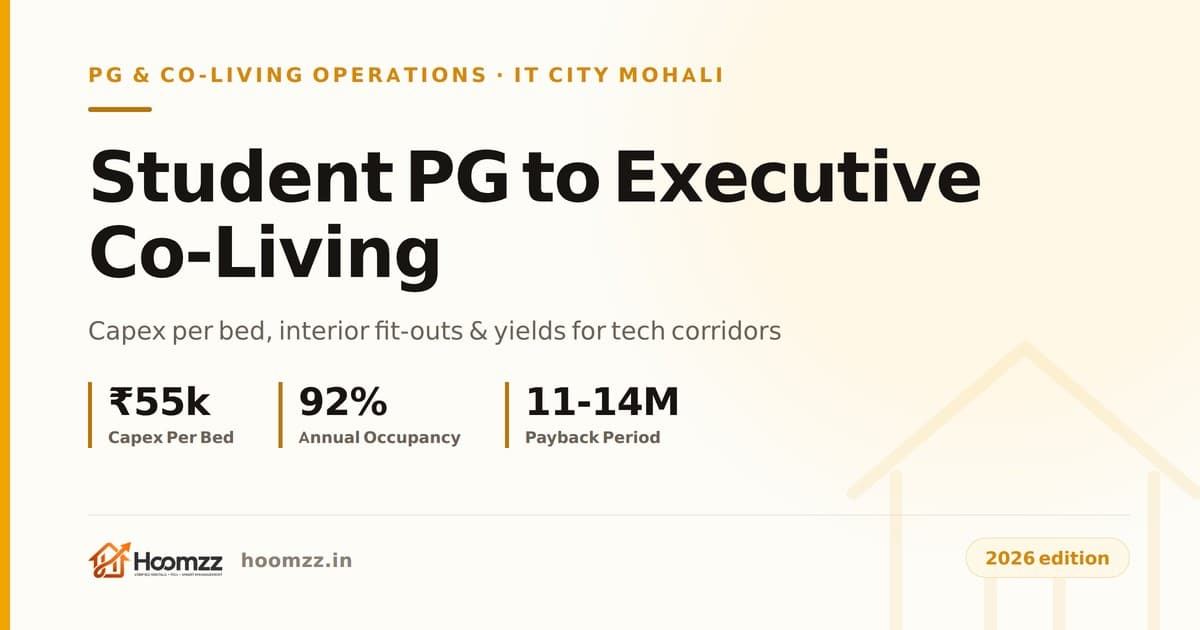
Upgrading a student PG to executive co-living in IT City Mohali requires ₹45,000 to ₹75,000 per bed in targeted capex, yielding 8.5% to 11.2% returns. Here is the operational blueprint covering interior fit-outs, Wi-Fi mesh, sub-metering, and year-round corporate tenancy.
Short answer: Converting a student PG into an executive co-living space in IT City Mohali requires a capital expenditure of ₹45,000 to ₹75,000 per bed for ergonomic workstations, commercial Wi-Fi mesh, 100% power backup, and acoustic upgrades. While student accommodations in Kharar or Landran suffer from a 2 to 3-month summer vacancy cliff that caps annual occupancy at 70% to 75% and yields at 4.5% to 5.5%, executive co-living near Sector 82, Sector 83, and Phase 8B commands ₹10,000 to ₹14,000 per bed in double sharing and ₹16,000 to ₹22,000 for private rooms. With continuous 11-month corporate tenancies, occupancy stabilizes at 90% to 95%, yielding 8.5% to 11.2% gross returns and achieving full capex payback within 11 to 14 months.
- ₹45k–75kCapex Per BedErgonomic fit-out & tech
- 90%–95%Annual OccupancyYear-round corporate demand
- 8.5%–11%Gross Yieldvs 4.5%–5.5% student PG
- 11–14 MoCapex PaybackFrom incremental cash flow
For over a decade, the private rental economy in Mohali expanded on a single, predictable formula: pack three or four students into a room, provide a generic iron cot with a thin foam mattress, hire a local mess cook, and collect ₹5,500 to ₹7,500 per bed. That model worked while thousands of engineering students poured into private colleges around Kharar and Landran. In 2026, however, that low-capex student PG model faces severe financial fatigue. Excessive room supply along the Kharar-Landran belt has triggered aggressive discounting, utility bills consume an increasing share of gross rent, and student tenancies leave properties completely vacant for nearly three months every summer.
At the same time, the southern sectors of SAS Nagar have transformed into a major employment corridor. IT City (Sector 82 and Sector 83), Sector 66, Aerocity, and the operational corporate clusters across Phase 8B house thousands of software engineers, data analysts, and corporate professionals employed at Infosys, HCL, Tech Mahindra, and growing tech enterprises along Airport Road. These professionals have disposable income, but they refuse to live in cramped student dormitories. As highlighted in our comparative analysis of Sector 91 vs Sector 82 Mohali housing dynamics, student housing has reached operational saturation, while modern corporate executive housing remains critically undersupplied.
Renters and property owners across the Tricity actively browse local real estate Instagram pages and creator channels for room walkthroughs and area overviews, but these social clips rarely address the operational economics required to run a sustainable, profitable hospitality asset. Transitioning an existing residential floor or student hostel into a premium executive co-living facility requires disciplined capital allocation, specific interior specifications, reliable utility sub-metering, and strict compliance with local administrative mandates.
The Financial Reality: Student PG vs Executive Co-Living
The primary flaw of the student PG model is the academic calendar. College students vacate their rooms between mid-May and late July, returning home during annual semester breaks. To avoid complete revenue loss, operators either offer steep summer discounts (charging 50% rent just to hold luggage) or absorb zero income on empty beds. When classes resume in August, operators must pay local street brokers 15 to 30 days of rental commission per bed to recruit fresh batches of students.
Corporate executive co-living completely eliminates this seasonal volatility. Tech professionals in IT City work year-round. Their agreements run on standard 11-month terms with a mandatory 30-day notice period. When a corporate tenant relocates, the bed is backfilled within days rather than waiting for an academic semester cycle. While student PGs average 70% to 75% annualized occupancy, a well-managed executive co-living asset in Sector 82 or Aerocity maintains 90% to 95% occupancy throughout the year.
| Operational Metric | Legacy Student PG Model (20 Beds / 6 Rooms) | Executive Co-Living Model (16 Beds / 6 Rooms) | Operational Difference & Impact |
|---|---|---|---|
| Room Configuration | 2 triple-sharing + 3 double + 1 quad | 4 twin-sharing (8 beds) + 4 private singles (4 beds) + 2 twin (4 beds) | Lower bed density, higher personal privacy |
| Gross Monthly Rent per Bed / Room | ₹6,500 per bed (all-inclusive with food) | ₹11,500 per bed (twin) / ₹18,000 (private single) | +76% to +176% higher pricing power |
| Gross Monthly Potential (100% Full) | ₹1,30,000 | ₹1,64,000 (8 twin beds @ ₹11.5k + 4 singles @ ₹18k) | +₹34,000 per month higher baseline revenue |
| Effective Annual Occupancy | 72% (2.5 months summer vacancy + turnover gaps) | 92% (Continuous 11-month corporate leases) | Ends the summer cash flow collapse |
| Realized Gross Annual Revenue | ₹11,23,200 | ₹18,10,560 | +₹6,87,360 (+61%) annual cash revenue |
| Annual Brokerage Leakage | ₹65,000 – ₹95,000 (annual student turnover broker fees) | ₹0 (Direct listing via Hoomzz zero brokerage) | Direct tenant acquisition saves full commission |
| Food & Kitchen Operational Drag | ₹3,60,000 (cook salary, grocery waste, cylinder costs) | ₹0 (Self-catering pantry + optional tiffin tie-ups) | Eliminates grocery wastage and kitchen disputes |
| Unmetered Power Loss (Owner Absorbed) | ₹1,40,000 (continuous unmonitored AC/geyser use) | ₹20,000 (Dedicated sub-meters; power billed at cost) | Tenants pay for actual individual consumption |
| Net Operating Income (NOI) | ₹5,28,200 | ₹14,90,560 | +₹9,62,360 (+182%) net operational cash flow |
| Estimated Asset Gross Yield | 4.8% (on ₹2.3 Cr building valuation) | 10.2% (on reconfigured building + capex) | More than doubles capital return on asset |
The numbers reveal an unmistakable operational truth: higher bed density in student PGs does not translate into higher net profit. By dropping total bed count from 20 to 16, an operator reduces physical strain on the building, slashes utility waste, removes food management overhead, and nearly triples the net operating income.
Capex Budget: Interior Fit-Out & Room Specifications
Executive tenants from corporate IT campuses will not pay ₹11,000 or ₹18,000 per month for particle-board furniture or squeaky metal bunks. Their expectations are shaped by hybrid work routines and hotel-grade comforts. The transition budget must be allocated into physical assets that are durable, easy to maintain, and functionally supportive of remote productivity.
Converting an existing 16-bed property requires a total capital expenditure between ₹7,20,000 and ₹11,50,000 (averaging ₹45,000 to ₹72,000 per bed). The complete budget breaks down into five tangible categories:
| Category | Specification & Materials | Estimated Cost per Bed / Unit | Operational Rationale |
|---|---|---|---|
| Workstation & Ergonomics | 4-ft commercial ply desk with PVC edge-banding, cable grommet, multi-plug power strip, and high-back ergonomic mesh chair with lumbar support | ₹7,500 – ₹10,500 per bed | Mandatory for hybrid IT engineers taking 8-hour Zoom and Teams calls from their rooms. |
| Bed & Orthopaedic Mattress | Heavy-gauge metal or commercial-ply hydraulic bed with headboard cushion; 6-inch high-density orthopaedic pocket-spring mattress with waterproof protector | ₹12,000 – ₹16,500 per bed | Mattress comfort is a primary physical touchpoint driving long-term corporate tenant retention. |
| Personal Wardrobe & Storage | Laminated commercial ply floor-to-ceiling wardrobe with internal lockbox, brass hinges, and hanging rail | ₹8,000 – ₹12,000 per bed | Working executives carry formal clothing and expensive laptops requiring secure in-room storage. |
| Climate Control (HVAC) | 1.5 Ton 3-star or 5-star split inverter AC (copper condenser) with silent compressor mode | ₹16,000 – ₹20,000 per room (split between twin beds = ₹8k–₹10k/bed) | Essential for surviving SAS Nagar summer temperatures reaching 44°C without explosive energy bills. |
| Smart Security & Access | Digital RFID keycard or biometric keypad lock for room doors; tamper-proof metal handles | ₹3,500 – ₹5,500 per room door | Eliminates lost physical keys and allows instant digital access revocation upon move-out. |
| Bathroom Modernization | 25L 5-star storage geyser, chrome diverter fixtures, health faucet, anti-skid floor tiles, and exhaust ventilation | ₹14,000 – ₹22,000 per bathroom (amortized across 2 beds = ₹7k–₹11k/bed) | Clean, high-pressure hot water bathrooms are non-negotiable for working professionals. |
| Common Tech & Power Infrastructure | Dual-WAN load-balancing router, ceiling Wi-Fi 6 mesh access points (CAT6 wired), and 5 kVA inverter/solar hybrid backup | ₹65,000 – ₹95,000 total property outlay (~₹4k–₹6k per bed prorated) | Guarantees zero dropped video meetings during local power cuts along Airport Road. |
With an incremental monthly cash flow gain of approximately ₹80,000 over the legacy student PG baseline, a total capex investment of ₹9,00,000 is fully recovered within 11.2 months. Every rupee earned after month 12 flows directly into net profit.
The unyielding rule of executive co-living: Corporate tenants will forgive a delay in laundry, but they will terminate their tenancy over dropped Zoom calls or uncooled rooms during Mohali's 42°C summer heatwaves. Redundant Wi-Fi routing and dedicated inverter power backup are baseline survival infrastructure, not luxury upgrades.
Critical Infrastructure: Wi-Fi, Power & Water Management
Operating a corporate co-living property requires treating utility backbones with commercial seriousness. Three operational systems determine whether an executive co-living facility thrives or degenerates into tenant disputes.
1. Enterprise-Grade Dual-ISP Wi-Fi Mesh
In a student PG, a single home broadband optical fiber terminal with a domestic range extender placed in a hallway is the typical setup. For IT professionals working remotely or on US and UK shift timings, that setup is disastrous. Wi-Fi signals dropping behind closed doors cause immediate work interruptions.
Install two independent fiber broadband connections from distinct service providers (such as Airtel Xstream and JioFiber) terminating into a dual-WAN load-balancing router. Run internal CAT6 Ethernet cabling to ceiling-mounted Wi-Fi 6 access points on every floor. This configuration ensures that if one service provider suffers a cable cut along PR-7 or Airport Road, the router automatically fails over to the secondary line within 300 milliseconds without dropping active video calls.
2. PSPCL Billing & Digital Sub-Metering
Electricity billing is the single largest source of financial leakage in multi-tenant properties. When AC electricity is included in the base rent, tenants leave air conditioning units running 24 hours a day while at the office. Conversely, charging tenants an arbitrary flat rate like ₹12 per unit violates Section 12 of the Electricity Act, 2003, which prohibits the unlicensed commercial resale of power.
As documented in our guide to dual electricity meters and sub-meter billing for Mohali builder floors, landlords must install certified digital sub-meters for each individual room. Record starting meter readings on handover day, track exact unit consumption, and bill tenants at the blended effective tariff from the official Punjab State Power Corporation Limited (PSPCL) bill without adding a commercial markup. This practice encourages energy conservation, lowers summer load peaks, and protects the owner from regulatory violations.
3. Continuous Commercial RO Water Supply
Water quality in SAS Nagar varies across sectors. In several developing sectors near IT City and Kharar, groundwater hardness exceeds 450 ppm, causing heavy scaling in geysers, pipe blockages, and tenant health complaints. Relying on small domestic 10-liter counter-top purifiers leads to frequent membrane burnouts when servicing 15 to 20 residents.
Operators should install a centralized 250 LPH or 500 LPH commercial reverse osmosis (RO) purification unit connected to stainless steel storage tanks, as detailed in our guide on commercial RO systems and water management in Tricity PGs. Providing chilled, purified drinking water on each floor via commercial dispensers eliminates water complaints and reduces plastic bottle clutter.
Executive Co-Living Works If
- Property is located within 15 minutes of IT City, Aerocity, Sector 82, Sector 83, or Phase 8B.
- At least 75% of bedrooms have attached private bathrooms.
- Owner is willing to invest ₹45,000–₹75,000 per bed in durable, ergonomic furniture and tech.
- 3-phase power connection with sanctioned load adequate for split ACs is installed.
- Owner chooses direct listing on Hoomzz to connect with corporate tenants without middleman fees.
Look Elsewhere (Keep Student Model) If
- Property is in remote Landran or Kharar interior villages with poor tech park connectivity.
- Layout forces 6 to 8 occupants to share a single common bathroom down the hall.
- Building wiring cannot support independent AC sub-meters or 100% inverter backup.
- Operator lacks capital for initial furnishing and depends on street broker referrals.
Operational Transition: The 5-Stage Operator Roadmap
Pivoting an active student property to executive co-living requires a structured transition plan to avoid extended vacancy during renovation:
- Structural Audit and Space DecouplingEvaluate existing floor plans. Remove extra cots to eliminate triple and quad sharing configurations. Convert surplus floor area into private workstations and spacious twin-sharing layouts.
- Electrical Infrastructure & Inverter UpgradeUpgrade PSPCL sanctioned load to match full split AC requirements. Install dedicated room-wise sub-meters and wire an inverter-hybrid backup system covering workstations, Wi-Fi routers, and ceiling fans.
- Durable Modular Joinery InstallationInstall commercial-grade laminated study desks, high-back mesh chairs, hydraulic storage beds, and 6-inch orthopaedic mattresses. Complete fresh interior paint using washable acrylic emulsion.
- Enterprise Network & Access ConfigurationDeploy dual-ISP fiber lines, configure ceiling-mounted Wi-Fi 6 mesh routers, and fit digital RFID or PIN-pad door locks to all bedroom doors.
- Direct Verification & Bed OnboardingDocument property features with high-resolution photography. List verified rooms on Hoomzz to attract corporate professionals directly, bypassing broker channels and eliminating commission leakage.
Legal Compliance & Police Verification in SAS Nagar
Operating executive co-living requires strict adherence to local administrative laws in SAS Nagar (Mohali). Unlike casual student rooms where compliance is often neglected, corporate tenants require formal lease documentation and official address proofs for employment records.
Mandatory Tenant Police Verification
Tenant police verification is strictly mandatory in SAS Nagar district under standing orders issued by the District Magistrate under Section 163 of the Bharatiya Nagarik Suraksha Sanhita (BNSS), 2023 (formerly Section 144 of the Code of Criminal Procedure). Renting to any individual without submitting tenant particulars to the local police constitutes a cognizable legal offense under Section 223 of the Bharatiya Nyaya Sanhita (BNS), 2023.
Operators must submit tenant Aadhaar details, permanent addresses, company identification, and signed lease agreements through the official Punjab Police Saanjh portal or at their nearest Community Policing Saanjh Kendra (such as the Phase-1 or Phase-11 Saanjh Centers in Mohali). Verification receipts must be preserved in property records.
Lease Agreements & Security Deposits
Tenancy relations in Mohali and Kharar are governed by the Punjab Rent Act, 1995. Operators must execute written rental agreements detailing the monthly license fee, maintenance charges, sub-meter billing mechanisms, and house rules.
While reports in mid-2026 suggested a statutory two-month security deposit cap based on a Chandigarh notification of the Assam Tenancy Act, that notification was kept in abeyance by the Punjab & Haryana High Court on 29 May 2026. In SAS Nagar, there is no statutory deposit cap under the Punjab Rent Act, 1995. The standard market norm for executive co-living is one to two months of security deposit. If tenant defaults occur, operators must follow statutory notice procedures under Schedule VII rather than resorting to arbitrary lockouts, as detailed in our guide on drafting legal eviction notices in Punjab.
Mess Kitchen vs Self-Catering Pantries
Running a commercial student kitchen requires mandatory FSSAI registration, health certifications for cooks, and daily grocery procurement, as outlined in our legal guide on FSSAI food safety regulations for Tricity PGs. Student mess operations frequently generate hygiene complaints and high food wastage. In executive co-living, operators are transitioning away from full-mess operations toward self-catering modular pantries equipped with microwaves, induction cooktops, double-door refrigerators, and electric kettles. Corporate tenants prefer preparing their own light meals or subscribing to specialized corporate meal services, saving the operator substantial cooking overhead.
Direct Listing on Hoomzz: Eliminating Broker Commission
Traditional real estate brokers in Mohali take 15 to 30 days of rent as commission every time a room turns over. In a 16-bed property experiencing standard annual rotation, broker leakage drains ₹1,20,000 to ₹2,00,000 directly from the operator's annual net earnings. Street brokers also frequently misquote property amenities to prospective tenants, promising services the operator does not provide and creating tenant friction before move-in.
Hoomzz eliminates this friction completely. Hoomzz lists physically verified rentals across Chandigarh, Mohali, Panchkula and Zirakpur with zero brokerage. When property owners list property on Hoomzz directly with zero brokerage, they deal directly with verified corporate professionals. Tenants searching for verified PGs and co-living rooms in Tricity review transparent photos, verified workstation features, and clear utility policies before scheduling a visit. To analyze how occupancy improvements and zero brokerage expand your net operating yield, property operators can model their numbers using the Hoomzz rental yield calculator.
Frequently Asked Questions
What is the average profit margin of a PG in Tricity?
Traditional student PGs in Tricity typically operate at net profit margins between 25% and 35% of gross revenue, severely reduced by high grocery bills, cook salaries, and a 2 to 3-month summer vacancy period. In contrast, premium executive co-living spaces in IT City Mohali achieve net margins between 55% and 65%. By removing mess kitchen overhead, eliminating seasonal student vacancies, and passing actual air-conditioning power consumption to individual room sub-meters, executive co-living generates significantly higher net cash flow per square foot.
How does listing rooms and beds on Hoomzz reduce middleman commission?
Street brokers in Mohali routinely charge 15 to 30 days of rental value as commission for every tenant placed, which can siphon ₹1,00,000 to ₹2,00,000 annually from a 16-bed facility. Hoomzz operates with zero brokerage, connecting property operators directly with verified working professionals and corporate employees. By listing directly on Hoomzz, operators retain 100% of their rental income, maintain full control over tenant vetting, and eliminate third-party misrepresentations.
What are the key security and safety installations required by local authorities?
Under standing orders from the District Magistrate of SAS Nagar, all commercial and residential accommodations must maintain mandatory tenant police verification through local Saanjh Kendras or the Punjab Police online portal. Properties must also install functional CCTV surveillance covering common entry and exit points with at least 30 days of footage retention. Operators should also equip every floor with certified ABC dry powder fire extinguishers, illuminated emergency exit signage, and secure biometric or digital RFID access locks.
How do seasonal university cycles affect PG cash flow?
Student PGs in Kharar and Landran depend entirely on college academic calendars, resulting in a severe cash flow drop from mid-May through late July when universities close for summer breaks. During these three months, occupancy often collapses below 30%, wiping out earlier profits and forcing owners to fund mortgage or operational expenses out of pocket. Executive co-living eliminates this vulnerability because tech professionals work year-round on continuous 11-month corporate agreements, maintaining stable 90% to 95% occupancy throughout every season.
What is the typical capex per bed to convert a student PG into executive co-living?
Converting an existing student property into executive co-living requires a capital investment between ₹45,000 and ₹75,000 per bed in the Mohali market. This budget covers an ergonomic work desk with a mesh chair, an orthopaedic pocket-spring mattress with a hydraulic storage bed, modular laminated wardrobes, 1.5-ton split inverter air conditioning, digital door locks, and enterprise-grade dual-WAN Wi-Fi mesh systems. With increased monthly rentals and continuous occupancy, operators typically achieve full capex payback within 11 to 14 months.
How should electricity billing be managed in an executive co-living property in Mohali?
Landlords should never bundle unlimited AC electricity into base rent, nor should they charge arbitrary flat rates like ₹12 per unit, which violates Section 12 of the Electricity Act, 2003. Instead, operators should install calibrated digital sub-meters for every room, record readings at move-in and handover, and calculate charges based on actual PSPCL bill tariffs. This ensures fair billing for tenants, prevents round-the-clock air conditioning abuse, and protects the owner from regulatory fines.
Sources, and what here is judgement rather than data
Statutory & Administrative Sources:
- District Administration SAS Nagar citizen service procedures and standing preventive orders available at District Administration SAS Nagar Official Portal.
- Punjab Police Saanjh Kendra tenant verification framework and procedural guidelines under the Punjab Right to Service Act at Punjab Police Official Portal.
- Punjab State Power Corporation Limited (PSPCL) commercial and domestic tariff schedules and Conditions of Supply at Punjab State Power Corporation Limited.
- Statutory framework under Section 12 of The Electricity Act, 2003 prohibiting unlicensed commercial trading or unauthorized resale of electricity.
- Punjab Rent Act, 1995 provisions governing residential tenancies, statutory demand notices under Schedule VII, and tenant dispute resolutions in SAS Nagar.
Editorial Judgement & Market Estimates:
- Capex ranges of ₹45,000 to ₹75,000 per bed reflect observed contractor quotes and material fit-out costs in Mohali industrial hubs for commercial-ply furniture, split inverter ACs, and Wi-Fi mesh hardware in 2026. Actual quotes will vary depending on pre-existing room conditions and chosen finish qualities.
- Rental yields (8.5% to 11.2% for executive co-living vs 4.5% to 5.5% for student PGs) and occupancy figures (92% vs 72%) are modeled estimates based on local market interviews and operational financial analysis across Sector 82, Sector 83, and Aerocity.
- The financial payback timeframe of 11 to 14 months represents an operational projection based on an incremental monthly cash flow gain of ₹70,000 to ₹85,000 on a 16-bed converted property. Operators should assess their individual debt servicing and localized overhead independently.
👈 This comparison is based on market observations and publicly available data. Users should verify details independently.
Prioritize Hoomzz Real Estate News in your Google Search AI Overviews
Google's new search update lets you select trusted sources. Pin hoomzz.in to get our instant local market rates, builder updates, and renting news featured first in your AI answers.
Live Outside Tricity or Abroad?
Complete remote property care in Mohali, Chandigarh & Zirakpur: Key holding, verified tenants & direct rent remittance.