Fast-Track Eviction Rights for Senior Citizen Landlords in Punjab & Chandigarh: Section 24, Section 13-B & the Maintenance Act Reality (2026)

Senior citizen landlords in Mohali can invoke Section 24 of the Punjab Rent Act for 15-day summary eviction, while Chandigarh NRIs use Section 13-B. Here is how local rent acts work and why the Maintenance of Parents Act cannot evict tenants.
Short answer: Under Section 24(1)(c) of the Punjab Rent Act, 1995, landlords aged 65 years or older in Mohali and Kharar hold statutory fast-track rights to recover immediate possession of one residential and one commercial unit, requiring tenants to secure leave to contest within 15 days. In Chandigarh, fast-track summary recovery under Section 13-B of the East Punjab Urban Rent Restriction Act, 1949 is reserved for NRI landlords holding property for at least 5 years (subject to a 5-year post-eviction lock-in), while retired public servants invoke Section 13-A. Crucially, the Punjab & Haryana High Court (*Vishwa Bhushan Bharti v. DM UT Chandigarh*) established that landlords cannot use the Maintenance and Welfare of Parents and Senior Citizens Act, 2007 to evict bona fide tenants.
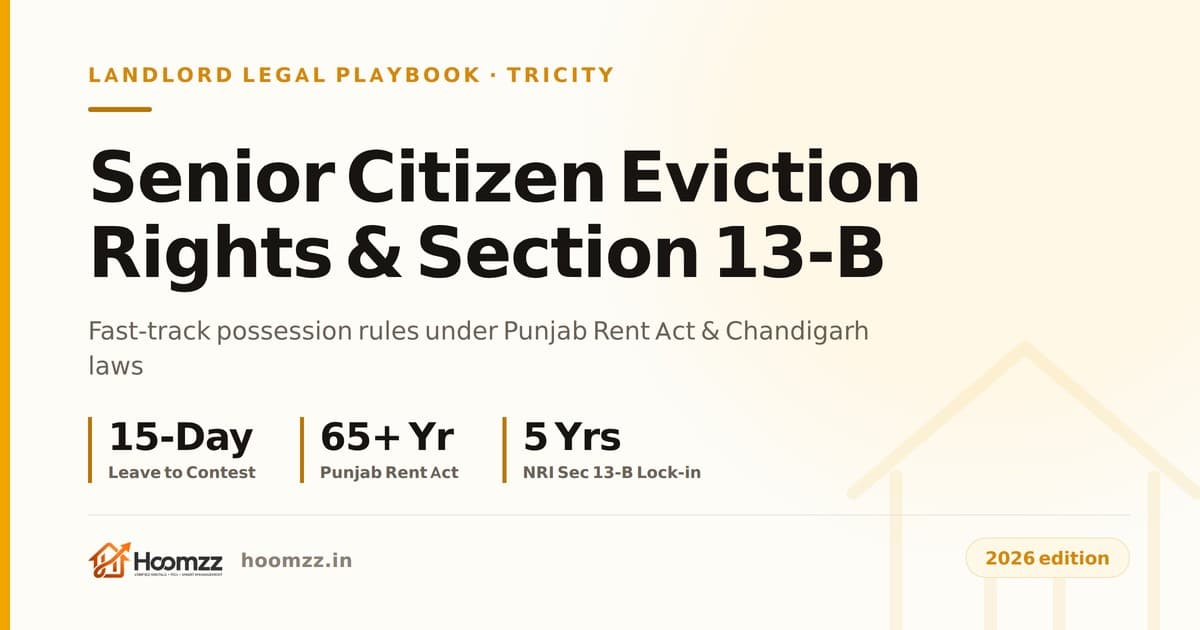
- 65+ YrsSection 24 AgePunjab Rent Act recovery
- 15 DaysLeave to ContestSummary tenant deadline
- 5 YearsSection 13-BOwnership & lock-in
- 1 UnitSummary QuotaPer property category
Senior citizen property owners across Chandigarh (from older sectors like Sector 8, Sector 11, and Sector 35 to society flats in Sector 49 Chandigarh), Mohali (Phase 3B2, Phase 7, Sector 70), and Kharar often rely on monthly rental yields to fund medical expenses and retirement living. Many elderly owners occupy the ground floor of their kothis while letting upper builder floors to tenants, managing the premises directly.
Local real estate Instagram pages and creators are an active source of listings and area info for Tricity renters today, but casual walkthrough videos never explain what happens when a tenancy breaks down. When a tenant stops paying rent or refuses to vacate after lease expiry, street brokers often offer inaccurate advice, claiming that senior citizens can file under the Maintenance of Parents Act before the Sub-Divisional Magistrate (SDM) to evict a tenant in 30 days. In other instances, landlords confuse the rights of Non-Resident Indians (NRIs) under Section 13-B with general elderly eviction relief.
Relying on incorrect legal avenues leads to dismissed petitions and years trapped in civil court. Here is how Section 24, Section 13-B, and the landmark High Court ruling in Vishwa Bhushan Bharti genuinely operate.
The Maintenance Act Trap: Why Senior Citizens Cannot Evict Tenants Under the 2007 Act
The Maintenance and Welfare of Parents and Senior Citizens Act, 2007 (MWPSC Act) grants District Magistrates and Maintenance Tribunals summary powers to evict abusive occupants from an elderly person's home. Many senior landlords attempt to use this administrative forum to bypass rent controllers when a tenant defaults or overstays.
This shortcut fails under established law. The Punjab & Haryana High Court resolved this question in Vishwa Bhushan Bharti v. District Magistrate, Union Territory, Chandigarh and another (2018). In that case, an elderly landlord initiated rent court proceedings, but simultaneously approached the District Magistrate under the Senior Citizens Act seeking summary eviction of the tenant.
The High Court quashed the eviction order, establishing three cardinal principles:
- Exclusive to Family Members and Licensees: Summary eviction under the MWPSC Act is enacted strictly to protect elderly parents from abusive children, relatives, and permissive family licensees.
- Rent Statutes Govern Tenancies: Contractual landlord-tenant disputes fall exclusively under state rent restriction acts. Maintenance Tribunals cannot bypass statutory tenancy protections.
- No Dual Forums: A landlord cannot maintain parallel proceedings before the District Magistrate to short-circuit regular rent court trials.
Filing before the Maintenance Tribunal against a legitimate tenant leads to High Court stay orders, wasting months of valuable time.
Section 24 of the Punjab Rent Act, 1995: Fast-Track Relief in Mohali & Kharar
While the Senior Citizens Act does not apply to tenants, senior citizen landlords in SAS Nagar (Mohali), Kharar, Zirakpur, and across Punjab possess a statutory fast-track remedy under the Punjab Rent Act, 1995 (as amended by Punjab Act No. 33 of 2013). This provision confers genuine summary powers before the Rent Authority (SDM).
1. Eligibility Under Section 24(1)(c) for "Old Persons"
Under Section 24(1)(c) of the Punjab Rent Act, 1995, a landlord aged 65 years or more has the statutory right to recover immediate possession of premises let out by them. Senior citizens form a protected class alongside widows (Section 24(1)(a)), persons with disabilities (Section 24(1)(b)), freedom fighters (Section 24(1)(d)), and Non-Resident Indians (Section 24(3)).
2. Scope: One Residential and One Commercial Property
Under Section 24(2), a senior citizen landlord can recover immediate possession of any one residential premises and any one commercial premises of their choice. The premises must be required for personal occupation by the landlord or family members dependent on them. This right can be exercised once in a lifetime per category.
3. The 15-Day Leave-to-Contest Procedure (Section 38 Summary Trial)
Under Section 38 of the Act, summary eviction proceeds on a strict timeline:
- Summons Issued Under Schedule III The Rent Authority issues statutory summons notifying the tenant that the petition is filed under the Section 24 summary chapter.
- Mandatory 15-Day Leave-to-Contest Window The tenant has no automatic right of defense. To contest, the tenant must file an affidavit within 15 days of receiving summons, disclosing facts disentitling the landlord from seeking possession.
- Statutory Admission Upon Default If the tenant fails to file within 15 days, the landlord's claims are deemed admitted, and the Rent Authority must order immediate eviction.
- Strict Threshold for Granting Leave Leave is rejected unless the tenant disproves ownership, proves the owner is under 65, or shows the lifetime quota was already used.
Chandigarh's Legal Framework: Section 13-A, Section 13-B & Ordinary Personal Necessity
The Union Territory of Chandigarh follows a different legal framework. While Punjab enforces the Punjab Rent Act, 1995, Chandigarh remains governed by the East Punjab Urban Rent Restriction Act, 1949. The Chandigarh Administration notified the adoption of the Assam Tenancy Act, 2021 on 6 May 2026, but the Punjab & Haryana High Court stayed that notification on 29 May 2026, directing that the 1949 Act continues to govern all tenancies in the city.
Under the East Punjab Urban Rent Restriction Act, 1949, summary eviction is restricted to specific categories:
1. Section 13-B for NRI Landlords: The 5-Year Rule and Lock-In Conditions
Many senior citizens in Chandigarh are Non-Resident Indians who returned to India after working abroad. For verified NRIs, Section 13-B provides a fast-track summary mechanism:
- 5-Year Ownership Rule: The NRI landlord must have owned the property for at least 5 continuous years before filing. Buying a tenanted property does not grant immediate Section 13-B rights.
- Once-in-a-Lifetime Right: The NRI can invoke this provision once in their lifetime for one residential and/or one commercial building.
- Bona Fide Need Presumed: In Baldev Singh Bajwa v. Monish Saini (2005), the Supreme Court held that the NRI landlord's personal need is legally presumed. The tenant cannot dispute why the owner returned to India.
- Section 18-A Summary Trial: The tenant must apply for leave to contest within 15 days of service.
- Mandatory 5-Year Lock-In: Under Section 13-B(3), the landlord cannot sell, transfer, or re-let the property for 5 years after taking possession. If breached, the evicted tenant can apply to be restored to possession.
2. Section 13-A for Retired Public Servants
Senior citizens who retired from the Central Government, State Government, or Armed Forces qualify as "specified landlords" under Section 13-A. They can recover immediate possession of a residential building under Section 18-A summary procedures, provided they owned the property during active service.
3. General Senior Citizens in Chandigarh (Section 13 Personal Necessity)
Civilian senior citizen landlords in Chandigarh who are neither NRIs nor retired public servants do not have access to Section 18-A summary trials. They must file an ejectment petition under Section 13(3)(a)(i) of the East Punjab Urban Rent Restriction Act, 1949 for bona fide personal necessity.
While Section 13 requires a regular trial, the Punjab & Haryana High Court directs Rent Controllers to give priority to elderly litigants, expediting cases where senior owners require ground-floor accommodation due to medical conditions or age-related mobility issues.
| Legal Route & Statute | Jurisdiction | Eligible Landlords | Summary Trial & Deadline | Key Conditions & Limits |
|---|---|---|---|---|
| Section 24(1)(c), Punjab Rent Act, 1995 | Mohali, Kharar, Zirakpur | Senior citizens aged 65 years or older | Yes (Section 38); 15 days for leave to contest | 1 residential & 1 commercial unit; bona fide personal use; once per lifetime |
| Section 13-B, East Punjab Rent Act, 1949 | Chandigarh (UT) | Non-Resident Indian (NRI) owners | Yes (Section 18-A); 15 days for leave to contest | 5-year prior ownership; 5-year re-letting lock-in; bona fide need presumed |
| Section 13-A, East Punjab Rent Act, 1949 | Chandigarh (UT) | Retired government & defense personnel | Yes (Section 18-A); 15 days for leave to contest | Must have owned property during active service; residential buildings only |
| Section 13(3)(a), East Punjab Rent Act, 1949 | Chandigarh (UT) | Civilian senior citizens (non-NRI) | No summary procedure; expedited regular trial | Must prove bona fide necessity (medical, family, or retirement housing needs) |
| MWPSC Act, 2007 (Maintenance Act) | All Tricity | Elderly parents abused by relatives | Summary inquiry before SDM Tribunal | Cannot evict tenants (*Vishwa Bhushan Bharti*); strictly for family licensees |
Summary Fast-Track Eviction Applies When
- The owner is 65+ years old and the property is in Mohali, Kharar, or Punjab (Section 24).
- The owner is a verified NRI with at least 5 years of continuous registered ownership (Section 13-B).
- The owner is a retired government servant who owned the home while in active service (Section 13-A).
- The occupant is an adult child or relative residing as an abusive permissive licensee (MWPSC Act).
Summary Eviction Fails or Does Not Apply If
- You file against a contractual tenant before the SDM under the Senior Citizens Maintenance Act.
- An NRI owner purchased a tenanted flat less than 5 years prior to filing the eviction petition.
- A civilian senior citizen landlord in Chandigarh attempts to bypass Section 13 regular rent court.
- You have already exhausted your statutory lifetime summary quota on another property.
The Prohibition on Self-Help: Regardless of rent default, landlords must never disconnect electricity, water, or municipal services. Under Section 12 of the Punjab Rent Act, 1995 and Section 10 of the East Punjab Urban Rent Restriction Act, 1949, cutting essential services is an offense carrying fines and mandatory restoration orders.
Practical Steps for Senior Citizen Landlords Facing Eviction Disputes
When dealing with a non-paying or recalcitrant tenant in the Tricity, following a structured legal roadmap prevents procedural missteps and protects your investment:
- Audit Lease Documentation and Utility Meters Review your lease agreement, verifying tenancy duration, notice covenants, and utility billing terms. If your builder floor shares an electrical connection, follow the billing rules outlined in our guide on dual electricity meters and sub-meter billing for Mohali floors.
- Select the Legally Competent Forum Avoid filing against tenants before the SDM Maintenance Tribunal under the 2007 Senior Citizens Act. If the property is in SAS Nagar district, file under Section 24 of the Punjab Rent Act, 1995 before the Rent Authority (SDM). If in Chandigarh, file under Section 13-B (if an NRI of 5+ years ownership) or Section 13 before the Rent Controller.
- Issue a Formal Statutory Demand Notice Have an experienced rent lawyer draft and serve a formal demand notice by Registered Post and Speed Post. State exact arrears, cite the relevant rent section, and provide the statutory cure period.
- Document Personal and Medical Grounds In your pleadings, clearly document why the property is required for personal occupation. Medical records establishing mobility impairments or ground-floor living needs provide compelling evidence of bona fide necessity.
- Follow Security Deposit Settlement Rules Document all utility arrears and property condition at move-in and handover, applying the principles in our guide on security deposit settlement and utility arrears holdbacks.
How Listing on Hoomzz Protects Senior Citizen Landlords
Most tenancy disputes suffered by elderly owners in Chandigarh, Mohali, and Kharar originate from careless tenant screening by street-corner brokers. Commission-driven brokers frequently rush unqualified tenants into flats without verifying income stability, checking rental histories, or enforcing formal police verification.
Hoomzz eliminates intermediary risk. As a dedicated property marketplace spanning Chandigarh, Mohali, Panchkula, Kharar, and Zirakpur, Hoomzz provides physically verified listings with zero brokerage. When senior property owners list property on Hoomzz directly with zero brokerage, they maintain total control over applicant screening. Hoomzz connects owners directly with verified corporate professionals, healthcare practitioners from PGI and Fortis, and stable families looking for verified rental flats and kothis across the Tricity. By establishing clear lease expectations and mandatory police verification from day one, senior owners avoid predatory tenancies and secure stable yields. Landlords can stress-test rental cash flows, vacancy risks, and net returns using the Hoomzz rental yield calculator.
Frequently Asked Questions
What are the mandatory legal requirements for landlords in Tricity?
Landlords in Tricity must execute a written rental agreement, verify tenant identity documents, and complete mandatory police verification under standing District Magistrate orders in Chandigarh and SAS Nagar (Mohali). Landlords cannot disconnect electricity or water services to resolve disputes under local rent restriction acts.
How does listing directly on Hoomzz protect landlord interests?
Listing directly on Hoomzz allows property owners to bypass street brokers who often rush unvetted tenants into flats without setting clear utility terms. Hoomzz operates with zero brokerage, connecting landlords straight with verified professionals and families who review transparent property specifications in advance.
What is the standard dispute resolution process under local rent acts?
When rent defaults occur in Mohali or Kharar, landlords must serve a formal statutory demand notice under Section 20(2)(a) of the Punjab Rent Act, 1995 before approaching the Rent Authority (SDM). In Chandigarh, disputes fall under the East Punjab Urban Rent Restriction Act, 1949 before the Rent Controller.
How can owners calculate their true net rental yield?
Property owners should subtract municipal property taxes, society maintenance, routine repairs, and estimated vacancy or utility arrears from gross annual rent, dividing the net sum by the total capital property value. In Mohali and Kharar, residential gross yields typically range from 2.8% to 4.2%.
Can a senior citizen landlord use the Maintenance of Parents Act, 2007 to evict a tenant?
No, the Punjab & Haryana High Court established in Vishwa Bhushan Bharti v. District Magistrate, UT Chandigarh (2018) that the Maintenance and Welfare of Parents and Senior Citizens Act, 2007 cannot be invoked to evict contractual or statutory tenants. It applies exclusively to abusive family members or permissive licensees.
How does Section 24 of the Punjab Rent Act, 1995 protect senior citizens in Mohali and Kharar?
Section 24(1)(c) of the Punjab Rent Act, 1995 grants landlords aged 65 years or older the right to recover immediate possession of one residential and one commercial premises for personal bona fide use. The tenant must apply for leave to contest within 15 days of summons; failure leads to automatic eviction.
What are the rules and lock-in restrictions under Section 13-B for NRI landlords?
Under Section 13-B of the East Punjab Urban Rent Restriction Act, 1949, an NRI landlord who has owned property for at least 5 years can seek summary possession for personal use once in their lifetime. The tenant has 15 days to apply for leave to contest, and the owner faces a strict 5-year lock-in prohibiting sale or re-letting.
Sources, and what here is judgement rather than data
Statutory & Judicial Sources:
- Section 24 in The Punjab Rent Act, 1995 granting immediate possession rights to senior citizens aged 65+ and Section 38 summary trial rules.
- Vishwa Bhushan Bharti vs District Magistrate, UT Chandigarh (2018) establishing that the Maintenance Act cannot evict contractual tenants.
- Baldev Singh Bajwa vs Monish Saini (2005) affirming the bona fide necessity presumption and Section 18-A summary rules under Section 13-B.
- The Tribune reporting on the High Court stay on the Chandigarh Assam Tenancy Act notification, confirming ongoing application of the 1949 Act.
- Standing District Magistrate orders in SAS Nagar (Mohali) and Chandigarh mandating tenant police verification under Section 144 CrPC / Section 163 BNSS.
Editorial Judgement & Practical Estimates:
- Summary proceeding timelines under Section 24 in Punjab and Section 13-B in Chandigarh typically require 3 to 9 months depending on court rosters and revision petitions.
- Rental yields across Tricity sectors (typically 2.8% to 4.2% for residential properties) and security deposit norms (standard 1 to 2 months' rent) represent observed market practices.
👈 This comparison is based on market observations and publicly available data. Users should verify details independently.
Prioritize Hoomzz Real Estate News in your Google Search AI Overviews
Google's new search update lets you select trusted sources. Pin hoomzz.in to get our instant local market rates, builder updates, and renting news featured first in your AI answers.
Are You a Real Estate Builder?
Get genuine buyer trust & verified inquiries. Hoomzz onboards builders only after stringent RERA, legal & track-record audits.