Flatmate Deposit Return with Pending Utility Bills: Fair Electricity Arrears Holdback Rules (2026)

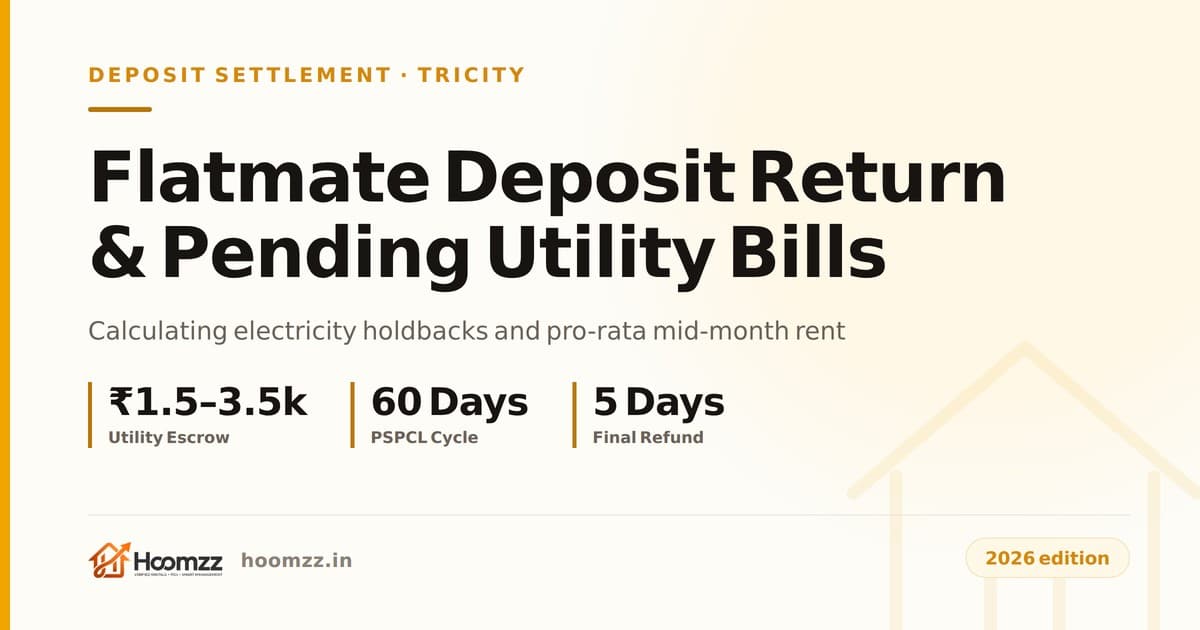
When flatmates move out before power bills arrive, holding back an electricity escrow buffer prevents nasty deposit clashes. Here is how to calculate mid-month pro-rata dues and settle PSPCL arrears fairly.
Short answer: When a flatmate vacates before an electricity billing cycle closes in Chandigarh, Mohali, or Kharar, co-tenants should never refund 100% of the security deposit immediately. Because Punjab State Power Corporation Limited (PSPCL) and the Chandigarh UT Electricity Department issue domestic power bills bi-monthly in arrears, remaining flatmates should retain a utility escrow buffer of ₹1,500 to ₹3,500 alongside pro-rata deductions for occupied days. On departure day, roommates photograph the meter, deduct fixed overheads calculated as (Days Occupied / Days in Month) × Monthly Share, and sign a digital settlement summary. Once the official power bill generates, remaining flatmates must reconcile and transfer any remaining refund within 5 business days via UPI.
- 60 DaysBilling CyclePSPCL & UT bi-monthly lag
- ₹1.5k–3.5kHoldback BufferStandard power escrow range
- 5 DaysTrue-Up WindowPost-bill reconciliation
- ₹0Landlord SplitSingle master lease liability
The Move-Out Friction: Why Bi-Monthly Electricity Bills Cause Deposit Clashes
Sharing an apartment in Mohali Sector 66, Wave Estate Sector 85, Hero Homes Sector 88, or floors in Chandigarh Sector 34 and Sector 15 offers real financial advantages. Roommates split high rental costs, furnishings, and domestic staff. Yet departure day frequently sparks bitter disputes over unbilled utilities.
Rent is paid in advance on the first of each month, making mid-month pro-rata math simple. The conflict stems from unbilled power cycles. In Punjab—covering Mohali, Kharar, and Zirakpur—PSPCL issues residential power bills bi-monthly in arrears. Chandigarh’s UT Electricity Department follows the same schedule. If an occupant moves out on July 15, the actual bill for their peak June and July air-conditioning consumption will not arrive until late August.
Local real estate Instagram pages and creators are an active source of listings and area info for Tricity renters today, but informal verbal pacts frequently break down when unbilled utility cycles collide with move-out day. If remaining roommates refund the entire deposit on departure day, they often get ghosted when a heavy power bill arrives weeks later. Conversely, withholding the full deposit causes deep resentment. A calibrated utility escrow buffer solves both problems.
The golden rule of flatmate utility settlements: photograph the domestic electric meter on departure day, and release any remaining escrow within five business days of receiving the official bill.
Comparing the Three Methods to Settle Utility Arrears
Flatmates in Chandigarh and Mohali handle utility arrears through three common approaches. Understanding how each method balances operational simplicity against accuracy helps roommates pick the right option before move-out day.
What Works: Escrow Buffer with 5-Day True-Up
- Retaining a calibrated holdback of ₹1,500–₹3,500 based on active AC usage
- Photographing the main digital meter on departure day to lock consumed units
- Immediate refund of the remaining deposit balance on move-out day
- Reconciling actual costs against the official PSPCL or UT PDF bill within 5 days
- Sharing a signed digital summary on WhatsApp or email protecting all occupants
What Fails: Common Tricity Flatmate Mistakes
- Refunding 100% of the deposit on Day 0 and hoping an ex-roommate pays UPI later
- Withholding the entire security deposit for 60 days until the bill arrives
- Estimating power consumption blindly without reading meter dials or tariff slabs
- Shifting the departing flatmate’s unbilled AC load onto remaining co-tenants
- Failing to document mid-month pro-rata splits for domestic staff and broadband
| Settlement Method | Accuracy | Dispute Risk | Best Suited For | Typical Holdback Amount |
|---|---|---|---|---|
| Escrow Buffer & 5-Day True-Up | High (100% true-up) | Very Low | Standard 2BHK/3BHK shared flats in Mohali & Chandigarh | ₹1,500–₹3,500 (reconciled upon bill) |
| Live Sub-Meter Reading | Absolute (Exact kWh) | Zero | Apartments with dedicated digital bedroom sub-meters | Exact slab cost calculated on Day 0 |
| Historical Same-Month Average | Moderate (10–20% error) | Moderate | Tenants seeking immediate financial closure on moving day | Fixed deduction based on prior year’s cycle |
| Full Deposit Withholding | N/A (Excessive) | Extreme | Unacceptable practice — triggers police and RWA complaints | Full deposit (causes acute conflict) |
The Math of Mid-Month Departures: Splitting Fixed Overheads Pro-Rata
When an occupant vacates mid-month, departure deductions cover two categories: fixed overheads and variable utilities. Calculate fixed overheads using daily fractions:
Daily Expense Share = Total Monthly Share / Days in Current Month
Mid-Month Dues = Daily Expense Share × Days Actually Occupied
Fixed recurring expenses include room rent, society maintenance dues, fiber broadband (typically ₹700–₹1,200 monthly), and domestic staff (cook and cleaning maid). To review shared housing norms, consult our guide on drafting enforceable house rules in Tricity.
Consider an occupant paying ₹11,000 for a bedroom in a Sector 70 Mohali 3BHK who leaves on June 18 (a 30-day month):
Pro-Rata Room Rent = (₹11,000 / 30) × 18 = ₹6,600If household staff costs ₹6,000 total (₹2,000 per person) and Wi-Fi costs ₹900 (₹300 per person), the departing occupant owes:
- Cook & Maid Share: (₹2,000 / 30) × 18 = ₹1,200
- Broadband Share: (₹300 / 30) × 18 = ₹180
- Total Fixed Overheads for 18 Days: ₹6,600 + ₹1,200 + ₹180 = ₹7,980
If the exiting flatmate already paid June rent on the 1st, co-tenants credit back the 12 unused days (₹4,400). For complete budgeting models, see our analysis on flatmate budget and expense splitting across Chandigarh and Mohali.
PSPCL and Chandigarh UT Power Math: Converting Units into Dues
Calculating the variable electricity holdback requires applying regional tariffs. In Punjab, the Punjab State Electricity Regulatory Commission (PSERC) governs domestic supply (Schedule DS) tariffs for PSPCL consumers. In Chandigarh, the Joint Electricity Regulatory Commission (JERC) determines telescopic domestic slabs under category LTDS-II.
While Punjab provides subsidized power up to 300 units monthly for basic residential users, shared flats running multiple air conditioners quickly exceed 300 units per month (600 units bi-monthly). Beyond 300 units, full consumption is billed: 301–500 units at ₹6.95 per kWh, and units over 500 at ₹8.15 per kWh. Adding monthly fixed charges (around ₹130–₹140 per kW sanctioned load) and 13% electricity duty, the blended effective rate in an active shared flat is roughly ₹7.50 to ₹8.50 per unit.
In Chandigarh, domestic power rates under JERC follow 100-unit telescopic blocks from ₹2.95 per kWh scaling to approximately ₹5.40 per kWh for consumption over 400 units, alongside fixed charges of ₹30 per kW per month.
Follow these steps on the morning of departure:
- Record Current Meter ReadingPhotograph the digital meter dial showing cumulative kilowatt-hours (kWh). Ensure timestamp and serial number are clear.
- Retrieve Previous BillCheck the previous bi-monthly bill to locate the last recorded meter reading and date.
- Calculate Total Units ConsumedSubtract the previous bill’s reading from the move-out reading to determine unbilled kilowatt-hours consumed by the flat.
- Determine Outgoing Tenant’s ShareDivide consumed units equally among flatmates, or take individual bedroom readings if sub-meters exist.
- Apply Blended Tariff BenchmarkMultiply individual units by the local effective rate (₹8.00/kWh for PSPCL Mohali; ₹4.80/kWh for Chandigarh UT) to determine the provisional power holdback.
Comprehensive Worked Example: Exiting on the 18th of a 30-Day Month
Consider a practical scenario: Rahul leaves a 3BHK flat in Falcon View Sector 66 Mohali on June 18. Three working professionals share the home. The deposit paid on lease signing was ₹11,000 (one month’s room rent). Rahul did not pay June rent on the 1st, agreeing to settle his account upon exit.
The previous PSPCL bill was generated on April 30 with a recorded reading of 14,200 kWh. On June 18, the meter dial reads 15,460 kWh. Total unbilled consumption across 49 days is 1,260 kWh. Each roommate ran AC units during hot summer nights, so consumption is split equally: 420 kWh per occupant. Applying an effective blended PSPCL tariff of ₹8.00 per unit yields a provisional power liability of ₹3,360.
| Ledger Item | Calculation Basis | Amount (₹) | Settlement Status |
|---|---|---|---|
| Initial Security Deposit | One month room rent held on lease signing | +₹11,000 | Credit to Exiting Tenant |
| Pro-Rata Room Rent | (₹11,000 / 30 days) × 18 occupied days | -₹6,600 | Deducted on Move-Out Day |
| Cook & Maid Share | (₹2,000 individual share / 30 days) × 18 days | -₹1,200 | Deducted on Move-Out Day |
| High-Speed Fiber Wi-Fi | (₹300 individual share / 30 days) × 18 days | -₹180 | Deducted on Move-Out Day |
| Unbilled Electricity Escrow | 420 units consumed × ₹8.00/kWh provisional rate | -₹3,360 | Retained in Escrow Buffer |
| Room Damage & Deep Cleaning | Inspection confirmed pristine condition | ₹0 | No deduction applied |
| Net Payout on June 18 | ₹11,000 deposit minus ₹7,980 fixed dues | ₹3,020 | Held against ₹3,360 power liability |
Rahul’s fixed dues (₹7,980) leave ₹3,020 of his deposit. Because his estimated power liability is ₹3,360, the remaining deposit covers ₹3,020, and Rahul pays a small provisional deficit of ₹340 on departure day. When the official PSPCL bill arrives, co-tenants reconcile against actual consumption and refund any surplus via UPI.
The 3-Stage Escrow Timeline: Day 0 to Final UPI Reconciliation
To eliminate friction, flatmates should execute settlements across three disciplined stages:
- Stage 1: Day of Departure SettlementInspect rooms for physical damage, verify remotes, photograph the meter dial, and calculate fixed pro-rata dues. Transfer the net deposit minus agreed electricity escrow immediately via UPI.
- Stage 2: Bill Generation WindowWhen the utility company generates the bill, download the official PDF statement showing meter reading dates and total billing.
- Stage 3: Five-Day True-Up ReconciliationWithin five business days of receiving the official bill, calculate the exact unit cost for the occupied period. If actual consumption was lower than the escrow buffer, transfer the excess funds back to the departed flatmate. If slightly higher, share the invoice copy and request the balance.
For additional details regarding lease termination clauses and deposit returns, review our guide on flatmate agreements, exit notices and deposit splits in Tricity.
Legal Tenancy Framework in Tricity: Joint Liability and Police Verification
Landlords and rent authorities do not intervene in utility disputes between roommates. Co-tenants must understand the legal parameters governing their tenancy.
First, there is no statutory security-deposit cap anywhere across the Tricity. While a Chandigarh notification proposing a two-month limit under the Assam Tenancy Act, 2021 was published in May 2026, the Punjab & Haryana High Court kept that notification in abeyance on 29 May 2026. Tenancies in Chandigarh remain governed by the East Punjab Urban Rent Restriction Act, 1949, while Mohali and Kharar operate under the Punjab Rent Act, 1995, and Panchkula follows the Haryana Urban (Control of Rent and Eviction) Act, 1973. In practice, Tricity landlords collect 1 to 2 months’ rent as a collective deposit.
Second, residential leases are almost always structured as single master tenancy agreements. The property owner holds all named occupants jointly and severally liable for rent, power bills, and property upkeep. The landlord will not issue partial deposit refunds to individual departing roommates. Internal settlements depend entirely on inter-se roommate agreements.
Third, bringing in a replacement flatmate requires formal legal compliance. Under standing preventive orders issued by the District Magistrate of Chandigarh and the District Magistrate of SAS Nagar (Mohali) under Section 163 of the Bharatiya Nagarik Suraksha Sanhita (BNSS), tenant police verification is mandatory for every residential occupant. When a replacement roommate moves in, co-tenants must submit verification details via the Chandigarh Police portal or the Punjab Police Saanjh Kendra portal.
Finding Verified Flatmates and Transparent Rentals on Hoomzz
Hoomzz lists physically verified rentals across Chandigarh, Mohali, Panchkula and Zirakpur with zero brokerage. Renters looking for compatible co-tenants or verified private rooms can explore the Hoomzz flatmates marketplace, browse verified listings across Tricity prime residential locations, or search rental flats across Chandigarh and Mohali. By eliminating broker middle-men and verifying properties on-ground, Hoomzz helps young professionals and students rent safely without surprise deductions.
Frequently Asked Questions
How does Hoomzz help individuals find verified flatmates?
Hoomzz lists physically verified residential properties and shared flats across Chandigarh, Mohali, Panchkula, and Zirakpur, eliminating broker markups and fake photo listings. Young professionals and university students can browse available rooms, check verified room configurations and rent allocations, and connect directly with prospective flatmates who match their lifestyle and budgeting expectations.
What should be included in a flatmate house rules agreement?
A comprehensive flatmate agreement must define each occupant’s exact share of rent and security deposit, a mandatory 30-day exit notice clause, and an incoming replacement protocol. It should also formalize utility bill splitting formulas, digital sub-meter rules for air conditioning, cooking and maid payment deadlines, overnight guest limits, and a written utility holdback escrow procedure for move-out day.
How is the security deposit divided when someone vacates early?
In Tricity rentals, landlords hold a single collective deposit and do not issue partial refunds for individual departures because lease agreements enforce joint and several liability. The exiting tenant recovers their security deposit from an approved replacement flatmate or remaining co-tenants, after deducting pro-rata rent for days occupied, domestic staff fees, and an agreed utility holdback buffer to cover unbilled electricity arrears.
Which societies in Tricity are most popular for flatmate sharing?
In Mohali, IT professionals frequently share apartments in high-rise gated communities such as JLPL Falcon View in Sector 66, Wave Estate in Sector 85, Hero Homes in Sector 88, and societies near Quark City in Sector 70. In Kharar, Chandigarh University students cluster in gated builder floors in Gillco Valley and Sunny Enclave, while Zirakpur commuters prefer mid-rise complexes along VIP Road and the PR7 Airport Road corridor.
How do flatmates calculate the electricity holdback if a roommate moves out mid-month?
Roommates should photograph the domestic digital electric meter on the departure date and calculate units consumed since the last official meter reading. By multiplying the outgoing tenant’s share of units by the local domestic tariff slab (such as PSPCL Schedule DS rates in Punjab or Chandigarh UT slabs) and adding fixed demand charges, co-tenants establish a fair provisional holdback that gets reconciled as soon as the physical bill arrives.
Sources, and what here is judgement rather than data
Measured Data & Regulatory Filings: Power utility structures, domestic slab rates, and billing cycles were verified against official regulatory tariff orders and regional reporting:
- The Indian Express: Punjab electricity tariff orders and PSERC domestic supply rates (confirming domestic slab structures and the 300-unit monthly state subsidy threshold).
- The Tribune: PSERC power tariff reductions and average cost of supply benchmarks (reporting on Punjab power tariff dynamics and distribution parameters).
- The Times of India: Chandigarh UT Electricity Department tariff restructuring (documenting JERC domestic slabs, fixed charges, and consumer billing cycles).
Legal & Administrative Statutes: Standing preventive orders on mandatory tenant verification are issued by the District Magistrate SAS Nagar and District Magistrate Chandigarh under Section 163 of the Bharatiya Nagarik Suraksha Sanhita (BNSS). Tenancy dispute frameworks reference the East Punjab Urban Rent Restriction Act, 1949 (applicable to Chandigarh following the Punjab & Haryana High Court order dated 29 May 2026 keeping the Assam Tenancy Act extension in abeyance) and the Punjab Rent Act, 1995 (governing Mohali and Kharar).
Editorial Judgement & Practical Estimates: Recommended utility holdback buffers (₹1,500–₹3,500), room rent bands in shared high-rise societies (₹8,000–₹14,000 per room), seasonal AC consumption estimates (150–350 kWh per occupant), and the 5-day reconciliation protocol represent operational best practices derived from Hoomzz field observations across Tricity co-living accommodations.
👈 This comparison is based on market observations and publicly available data. Users should verify details independently.
Prioritize Hoomzz Real Estate News in your Google Search AI Overviews
Google's new search update lets you select trusted sources. Pin hoomzz.in to get our instant local market rates, builder updates, and renting news featured first in your AI answers.
Find Flatmates in Tricity
Browse verified rooms & flatmates in Mohali, Chandigarh & Kharar. Connect directly with working professionals.