Lease Renewal & Rent Escalation Clauses in Punjab & Chandigarh (2026): Legal Caps, Notice Periods & Dispute Proofing

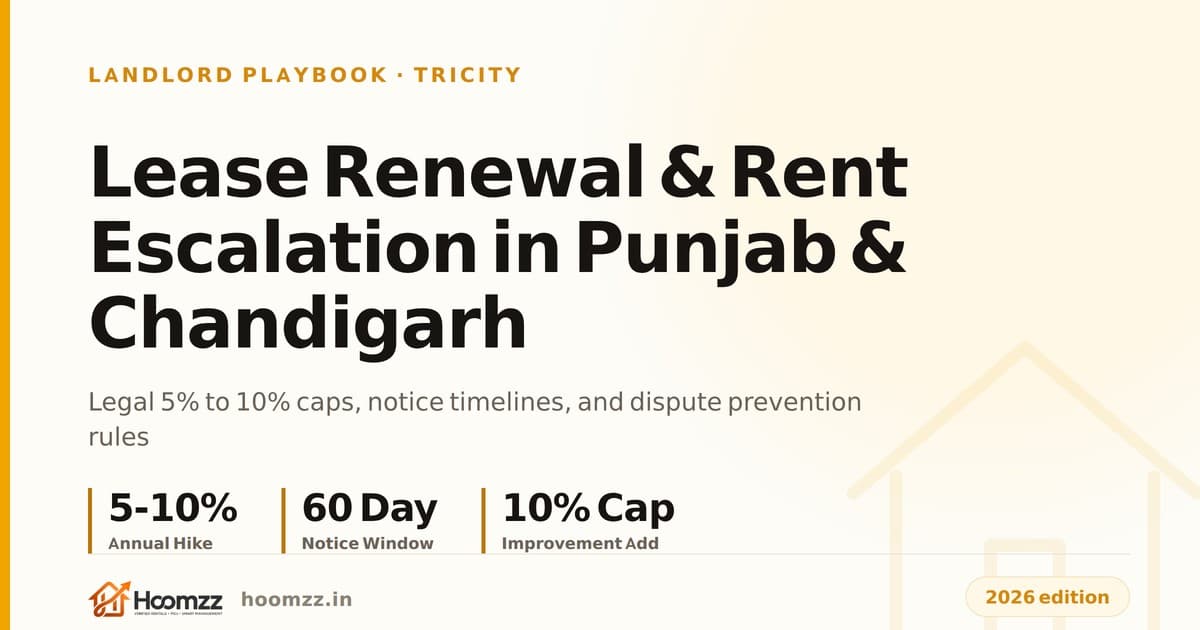
Understand legal rent escalation caps, renewal notice timelines, and dispute-proof drafting under the Punjab Rent Act and East Punjab Urban Rent Restriction Act. Avoid vacant month yield loss and holding-over risks.
Short answer: In Punjab (SAS Nagar Mohali, Kharar, Zirakpur), rent escalation is governed by the Punjab Rent Act, 1995, where Section 6 establishes an escalation baseline of 5% per annum for the first two years and CPI adjustments in year three, while Section 9 caps structural improvement increases at 10% per annum of capital cost. In Chandigarh, the East Punjab Urban Rent Restriction Act, 1949 remains operational because the High Court stayed the May 2026 Assam Tenancy Act notification, making annual hikes contractual. Standard Tricity residential practice is a 5% to 10% annual escalation, requiring 30-to-60-day written notice before expiration to avoid uncontracted holding-over tenancies under Section 116 of the Transfer of Property Act, 1882.
- 5%–10%Annual HikeTricity residential renewal range
- 60 DaysNotice Windowprior to 11-month lease expiry
- 10% CapImprovement Capstatutory cap under Punjab Rent Act
- 12%–15%Commercial Escalationstandard every 36 months
Every landlord in the Chandigarh Tricity encounters the renewal dilemma after ten months of smooth tenancy. You hand over keys to a fresh floor in Phase 7 Mohali or Sector 34 Chandigarh, collect rent on time, and suddenly the 11-month term expires. Some owners assume rent jumps by 10% automatically. Others avoid discussing increases, dreading friction with a good tenant, while maintenance charges eat into their net yields.
The Tricity rental market divides sharply along state borders. While local real estate Instagram pages and creators are an active source of listings and area info for Tricity renters today, serious landlords need verifiable agreements and enforceable paper trails rather than informal social DMs. Mohali, Kharar, and Zirakpur follow the Punjab Rent Act, 1995, with explicit rules on agreed rent and improvement caps. Chandigarh tenancies follow the East Punjab Urban Rent Restriction Act, 1949, where rent revision depends strictly on written contract covenants. Without a precise renewal clause and timely notice, owners risk frozen rents, bitter negotiations, or uncontracted holdovers.
The Statutory Framework: Punjab Rent Act 1995 vs Chandigarh Rent Laws
Drafting an enforceable rent increment clause begins with knowing which statute governs the property. A lease drafted for Sector 82 Mohali cannot rely on legal assumptions that apply to Sector 15 Chandigarh.
1. Punjab Tenancies: SAS Nagar Mohali, Kharar, Zirakpur
Tenancies across the Punjab belt fall under the Punjab Rent Act, 1995:
- Agreed Rent & Escalation (Section 6): Section 6 specifies an annual increase of 5% of the last rent paid for the first two years, followed by CPI adjustments in year three.
- Capex Revisions (Section 9): Structural improvement revisions are capped at 10% per annum of actual capital expenditure.
- Mandatory Written Agreement (Section 4): Tenancies must be executed in writing to access Rent Authority dispute resolution.
- Maintenance Levies (Section 8): Tenants pay 10% maintenance charges unless agreed otherwise, plus municipal taxes and utility bills.
2. Chandigarh: High Court Abeyance of the Assam Tenancy Act
On 6 May 2026, the central government extended the Assam Tenancy Act, 2021 to Chandigarh, attempting to repeal the legacy East Punjab Urban Rent Restriction Act, 1949. On 29 May 2026, the Punjab and Haryana High Court placed that notification in abeyance, restoring the 1949 Act. Consequently, there is no statutory security-deposit cap anywhere in the Tricity. Under the 1949 Act, open-market rentals rely entirely on contract terms; landlords cannot demand rent hikes without an express escalation clause.
3. Panchkula: Haryana Rent Control
In Panchkula, tenancies fall under the Haryana Urban (Control of Rent and Eviction) Act, 1973, where contractual terms govern modern properties.
| Jurisdiction | Governing Statute | Statutory Rent Hike Limits | Market Renewal Standard | Dispute Forum |
|---|---|---|---|---|
| SAS Nagar Mohali, Kharar, Zirakpur | Punjab Rent Act, 1995 | Section 6 provides 5% annual hike for years 1–2, then CPI-linked; Section 9 caps structural capex hike at 10% | 5%–10% residential renewal; 12%–15% every 3 years for commercial | Rent Authority (SDM/Civil Judge) under Section 11 |
| Chandigarh (UT) | East Punjab Urban Rent Restriction Act, 1949 | No statutory percentage cap for open contracts; hikes cannot be forced without written clause | 5%–10% residential renewal; 15% every 3 years commercial | Rent Controller (Civil Judge, Junior Division) |
| Panchkula (Haryana) | Haryana Urban (Control of Rent and Eviction) Act, 1973 | Contractual terms govern modern builds; fair rent provisions apply to older tenancies | 5%–8% residential renewal; 12%–15% every 3 years commercial | Rent Controller under 1973 Act |
Observed Market Escalation Ranges Across Tricity Micro-Markets
While statutes set legal guardrails, micro-market supply and demand determine what rent adjustments tenants accept upon renewal.
1. Residential 11-Month Lease Renewals
Most residential landlords in Punjab and Chandigarh utilize standard 11-month lease agreements to avoid mandatory registration costs under Section 17 of the Registration Act, 1908. Observed renewal escalation rates across major pockets include:
- Mohali Tech Corridor (Phase 8B, Sector 82 IT City, Sector 70): Observed 2BHK rents range between ₹18,000 and ₹28,000 per month, with annual escalation of 7% to 10%. For area details, review our Sector 82 IT City vs Phase 8B Industrial Area rental comparison.
- Chandigarh Core Sectors (Sector 34, Sector 35, Sector 15): Independent floors command observed rents of ₹12,000 to ₹22,000 per month, with annual escalation of 5% to 8%.
- Zirakpur Gated Belts (VIP Road, PR7 Airport Road): High-rise 3BHK flats command observed rents of ₹20,000 to ₹32,000 per month, with annual escalation at 5% to 8%.
- Kharar Student Belt (Sunny Enclave, NH-21 near CU Gharuan): Student units average ₹8,000 to ₹15,000 per month, with modest annual escalation of 5% to 7%.
2. Commercial Lease Escalation: Sector 17, Phase 8B, VIP Road
Commercial leases follow longer horizons as tenants invest in fit-outs and branding. Standard commercial terms follow a 3+3+3 structure (9-year lease) with 12% to 15% escalation every 3 years (or 5% annual compound increase), 3-year lock-ins, and explicit covenants regarding 18% GST under reverse charge rules.
Airtight Renewal Clauses
- Fixed percentage (e.g. 7% or 8%) instead of vague market rates
- 60-day advance written notice before 11-month term expiry
- Fresh written execution and updated police verification
- Negates implied holding over under Section 116 Transfer of Property Act
- Uncouples base rent escalation from maintenance and municipal cess
Vague Informal Extensions
- Relies on verbal WhatsApp chats or unconfirmed handshake promises
- Omits explicit escalation figures, triggering acrimonious negotiations
- Accepts continuing rent post-expiry without a signed renewal deed
- Skips mandatory tenant police verification updates under DM orders
- Conflates municipal tax increases with base rental growth
The Holding-Over Trap: Section 116 of the Transfer of Property Act
Allowing an agreement to lapse silently while accepting monthly rent triggers Section 116 of the Transfer of Property Act, 1882 (the doctrine of holding over). Accepting rent creates an implied month-to-month tenancy on original terms, forfeiting the right to demand retroactively increased rent. If the tenant disputes the hike, the owner must serve a 15-day termination notice under Section 106 and face Rent Controller litigation. For structuring termination clauses, refer to our vacation clause and notice period guide.
Step-by-Step Playbook: Drafting an Enforceable Escalation Clause
To preserve rental yields and avoid courtroom entanglements, landlords should apply this five-step renewal process:
- Initiate the 60-Day Renewal WindowSend formal written notice two months before 11-month expiry to confirm renewal at the agreed escalation rate.
- Lock the Exact Escalation PercentageSpecify an exact percentage (such as 7% or 8%) directly in the renewal covenant rather than ambiguous market phrases.
- Execute Fresh DocumentationDraft and stamp a fresh 11-month deed on non-judicial stamp paper; never depend on informal chats or oral extensions.
- Update Tenant Police VerificationSubmit renewed tenant details to the local police station as mandated under District Magistrate standing orders in Chandigarh and SAS Nagar.
- Reconcile Security Deposit and Utility MetersInspect utility meters (PSPCL in Punjab, UT Electricity in Chandigarh) before signing, ensuring bills are cleared to date.
The Vacancy Trap: One vacant month costs 8.33% of your annual gross rental income. Demanding a rigid 12% escalation on a reliable tenant who vacates over an ₹800 difference wipes out two full years of rental gains if the flat sits empty for 6 weeks.
True Net Rental Yield: Why Unreasonable Escalation Destroys Returns
Demanding excessive rent hikes often backfires. Forcing a 15% hike (₹20,000 to ₹23,000) triggers turnover costs: ₹12,000 for repainting, ₹11,500 in broker fees, and two vacant months costing ₹40,000. These expenses total over ₹63,500, taking two years at the higher rent to recover. Model your returns at /calculators.
Hoomzz lists physically verified rentals across Chandigarh, Mohali, Panchkula and Zirakpur, eliminating intermediary broker fees. Property owners can list verified units directly on Hoomzz via /create to find screened tenants without recurring broker costs. Renters can find transparent homes at /rent-properties-in-tricity. For remote owners, our guide on NRI property management in Mohali and New Chandigarh covers key-holding and remote leasing.
Sample Rent Escalation and Renewal Clause for Tricity Landlords
Below is a standardized contractual covenant suitable for inclusion in 11-month residential agreements across Chandigarh, Mohali, Panchkula, and Zirakpur:
"The tenancy hereby created shall be for a fixed term of 11 months from [Start Date] to [End Date]. Either party may express intent to renew by serving written notice of at least 60 days prior to expiry. Subject to mutual agreement, the lease may be renewed for another 11 months via a fresh deed with a revised rent reflecting an agreed escalation of [7%] over the preceding rent. Continued occupation post-expiry without an executed renewal deed constitutes unauthorized holdover, incurring liquidated damages of [₹1,500] per day until vacant possession is restored."
Frequently Asked Questions
What are the mandatory legal requirements for landlords renewing a lease in Tricity?
Landlords must execute a written renewal agreement specifying the revised rent and escalation percentage. In SAS Nagar Mohali and Chandigarh, renewing tenancies requires submitting updated tenant police verification forms under standing District Magistrate orders. Tenancies exceeding 11 months require formal registration under Section 17 of the Registration Act, 1908.
How does listing directly on Hoomzz protect landlord interests?
Listing directly on Hoomzz connects landlords with verified prospective tenants without recurring broker commissions that erode rental yields. Hoomzz verifies listings physically across Chandigarh, Mohali, Panchkula, and Zirakpur, eliminating fake leads and unauthorized subletting often encountered through unverified middlemen.
What is the standard dispute resolution process under local rent acts?
In Punjab (Mohali, Kharar, Zirakpur), rent escalation disputes and possession claims are filed before the designated Rent Authority under Section 11 of the Punjab Rent Act, 1995. In Chandigarh, disputes fall under the Rent Controller governed by the East Punjab Urban Rent Restriction Act, 1949, because the Assam Tenancy Act extension was stayed by the High Court.
How can owners calculate their true net rental yield?
To calculate true net rental yield, take gross annual rent, subtract property taxes, society maintenance, inter-tenancy repairs, and vacancy loss (each vacant month costs 8.33% of annual rent), then divide by property value and multiply by 100. Tricity residential properties typically deliver net yields between 2.2% and 3.4%.
What is the maximum legal rent escalation a landlord can demand in Mohali?
Under Section 6 of the Punjab Rent Act, 1995, statutory escalation allows 5% per annum for the first two years followed by CPI adjustments in year three, while Section 9 caps structural improvements at 10% per annum of capital cost. In practice, residential renewals operate on contractual escalation between 5% and 10%.
Can a landlord in Chandigarh increase rent without a written escalation clause?
No, a landlord in Chandigarh cannot unilaterally hike rent mid-tenancy or upon oral extension without an express escalation clause. Because the East Punjab Urban Rent Restriction Act, 1949 governs Chandigarh tenancies, landlords must execute a fresh written agreement with mutual consent or serve an advance notice to vacate prior to expiry.
Sources, and what here is judgement rather than data
Measured legal and statutory facts: The stay on the Assam Tenancy Act, 2021 notification and continuation of the East Punjab Urban Rent Restriction Act, 1949 in Chandigarh are sourced from judicial proceedings: The Tribune: HC Keeps Assam Tenancy Act in Abeyance in Chandigarh and Indian Kanoon: East Punjab Urban Rent Restriction Act, 1949. Statutory escalation rules derive from Indian Kanoon: The Punjab Rent Act, 1995 and Indian Kanoon: Section 9, Revision of Rent in Certain Cases.
Editorial and market judgement: The 5% to 10% residential renewal benchmark, 12% to 15% commercial escalation norm, 60-day renewal notification window, and net yield models reflect empirical analysis of active Tricity leasing practices and landlord interviews. Property owners must independently verify specific lease terms with qualified legal counsel.
👈 This comparison is based on market observations and publicly available data. Users should verify details independently.
Prioritize Hoomzz Real Estate News in your Google Search AI Overviews
Google's new search update lets you select trusted sources. Pin hoomzz.in to get our instant local market rates, builder updates, and renting news featured first in your AI answers.
Need an Instant Rental Agreement?
Legally binding e-stamped agreements delivered in 15 mins with digital biometric tenant verification.