Converting Residential Floors to Student Rentals in Kharar & Gharuan: Municipal Bylaws, PSPCL Tariffs & Neighbor NOCs (2026)

Converting residential floors to student rentals in Kharar and Gharuan offers strong yields if structured legally under Punjab tenancy laws. Learn how to comply with municipal bylaws, prevent PSPCL commercial tariff penalties, and eliminate tenant acquisition commissions on Hoomzz.
Short answer: Converting a residential floor to student rentals in Kharar or Gharuan is legally permissible as a residential tenancy without commercial conversion, provided you lease the floor as an entire unit. Under PSERC regulations, PSPCL classifies student residential housing under Domestic Supply (DS) tariffs rather than commercial (NRS) rates, but landlords must ensure sanctioned load meets peak air-conditioning demand—typically 5 kW to 8 kW. Resident associations possess zero legal power to ban bachelor tenants or demand neighbor NOCs under the Transfer of Property Act, yet tenant police verification with SAS Nagar police is strictly mandatory under District Magistrate standing orders.
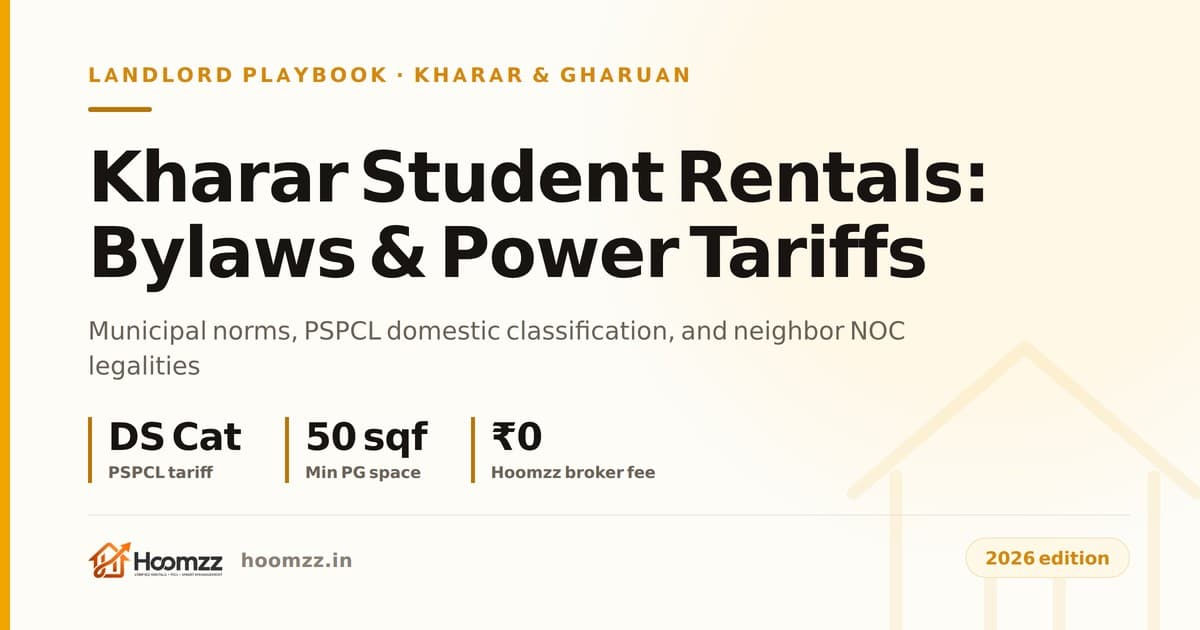
- DS CatPSPCL TariffDomestic schedule applies
- 50 sq ftMinimum SpacePer student under PG norms
- ₹0Broker CommissionDirect listing on Hoomzz
- Sec 163BNSS OrderMandatory police verification
The concentration of higher education along National Highway 5 (NH-5)—anchored by Chandigarh University (CU) in Gharuan and CGC Landran—makes Kharar a high-yield rental market. For kothi and builder-floor owners in Sunny Enclave (Sector 125), Gillco Valley, Chajju Majla Road, and Gharuan, converting upper floors into student housing yields steady cash flow. However, confusion between standard residential leases and commercial Paying Guest (PG) setups exposes owners to municipal fines, electricity penalties, and neighbor disputes.
Local real estate Instagram pages and creators are an active source of listings and area info for Tricity renters today, but landlords relying solely on informal social channels often struggle with unvetted tenants and seasonal turnover. Succeeding in this rental market requires understanding municipal building bylaws, power corporation load brackets, and police verification mandates. Hoomzz lists physically verified rentals across Chandigarh, Mohali, Panchkula, and Zirakpur, giving property owners an established platform to secure reliable student groups directly without paying intermediary commissions.
Municipal Bylaws: Residential Tenancy vs. Commercial PG
The primary legal boundary every property owner must understand is between leasing an independent residential flat to university students and running an institutional commercial PG hostel. This distinction determines whether your property falls under standard tenancy law or faces commercial inspections by the Kharar Municipal Council (Nagar Council Kharar) or GMADA.
Under Punjab urban planning guidelines, leasing an entire independent residential floor (such as a 2BHK or 3BHK unit) to a group of students under a joint residential lease agreement does not constitute a Change of Land Use (CLU). The premises retain their residential classification under the East Punjab Urban Rent Restriction Act, 1949 and the Transfer of Property Act, 1882. The tenants cook in their own kitchen, manage their own utilities, and occupy the flat as private co-tenants.
Conversely, operating a structured Paying Guest facility—charging per-bed tariffs, partitioning rooms into dormitories, running a commercial dining hall, or providing central housekeeping—triggers GMADA and Kharar Municipal Council PG regulations. These municipal frameworks enforce specific operational rules:
- Owner Occupancy: Under GMADA guidelines, a commercial PG facility cannot operate as an absentee investment. The owner or an immediate family member must reside permanently in the same residential building.
- Usable Floor Area: Every paying guest must have a minimum usable floor area of 50 square feet inside the bedroom. Packing students beyond capacity violates civic public health bylaws.
- Sanitation Norms: Civic guidelines mandate at least one dedicated Water Closet (WC) and bathroom for every five residents.
- Structural Norms: Erecting temporary terrace sheds or converting basements into living quarters without approved architectural plans leads to municipal sealing notices.
For individual kothi and builder floor owners in Kharar and Gharuan, leasing self-contained floors as private residential units avoids commercial registration obligations while keeping operational overhead low.
PSPCL Electricity Rules: Domestic Supply (DS) vs. Commercial Tariffs
A frequent concern among landlords renting to university students is whether Punjab State Power Corporation Limited (PSPCL) will reclassify their residential meter under Non-Residential Supply (NRS) commercial tariffs. Commercial power tariffs in Punjab carry higher base charges per kilowatt and elevated demand rates, eroding net returns.
The regulatory position established by the Punjab State Electricity Regulatory Commission (PSERC) is unambiguous: residential premises occupied by students, working professionals, or paying guests for domestic living fall under the Domestic Supply (DS) schedule. PSPCL circulars clarify that using electricity for residential lighting, space cooling, and personal cooking remains domestic consumption, even when rent is collected.
Even so, landlords occasionally face provisional assessment notices under Section 126 of the Electricity Act, 2003 (Unauthorized Use of Electricity) during field inspections. This problem almost always arises from three distinct issues:
- Commercial Food Preparation: If an owner sets up an industrial kitchen with commercial burners and catering staff to supply meals across multiple floors, PSPCL considers the kitchen an unauthorized commercial operation requiring an NRS meter.
- Exceeding Sanctioned Connected Load: Most builder floors in Kharar were originally energized with a modest domestic load of 2 kW to 4 kW single-phase supply. When student tenants run 3 to 4 split air conditioners, geysers, induction cooktops, and laptops simultaneously, peak demand quickly reaches 6 kW to 8 kW. Exceeding your sanctioned contract demand registers on electronic meters and incurs steep Maximum Demand Indicator (MDI) surcharges on every billing cycle.
- Substandard Internal Cabling: Running heavy summer AC cooling on undersized domestic wiring causes phase imbalance and burnt service cables, leading to power outages during university exams.
To keep operations trouble-free, submit an online load enhancement application through the PSPCL consumer portal before tenants move in. Upgrading a floor connection to a 6 kW to 8 kW three-phase domestic meter prevents MDI penalties and guarantees stable voltage. Installing calibrated digital sub-meters for each floor also eliminates disputes among flatmates over shared power bills. For a thorough review of meter guidelines, read our analysis of commercial electricity tariff and sub-meter rules in Mohali and Kharar.
Critical Load Requirement: While PSPCL classifies student residential housing under Domestic Supply, running 3 to 4 split ACs on an old 2 kW single-phase domestic meter triggers severe Maximum Demand Indicator (MDI) penalties and cable failures. Apply online via the PSPCL portal for a voluntary load extension to 6 kW–8 kW three-phase domestic supply before student tenants move in.
The Neighbor Objection & RWA “NOC” Myth in Punjab
In residential areas throughout Kharar—including Sunny Enclave, Gillco Valley, and surrounding sectors—landlords often face pushback from neighbors or resident welfare committees claiming that student tenants are forbidden. Some committees insist that landlords secure an informal neighbor No Objection Certificate (NOC) before renting out a floor.
In Indian property law, an RWA or neighboring resident has zero statutory standing to dictate who occupies private residential property. Under Section 10 of the Transfer of Property Act, 1882, any condition imposing an absolute restriction on an owner's right to lease their property is legally void. Multiple rulings from the Punjab & Haryana High Court have affirmed that resident associations are registered only to oversee common maintenance and sanitation. They hold no legal authority to create discriminatory tenant restrictions based on marital or student status.
Any society resolution enforcing a blanket ban on bachelor or student tenants is ultra vires and unenforceable. Neighbors cannot legally block tenant access to public colony roads, lifts, or basic utility lines. At the same time, property owners must address genuine, actionable civil and criminal nuisance. Neighbors have every right to complain about:
- Road and Gate Blockages: Student vehicles parked across neighboring driveways or narrowing residential lanes.
- Late-Night Noise Disturbances: High-decibel sound systems or terrace gatherings past 10:00 PM.
- Littering: Discarding waste or cigarette ends from balconies into adjoining properties.
To prevent neighbor disputes, write clear quiet-hour, parking, and hygiene covenants directly into your tenancy agreement. For practical methods to manage shared spaces, see our guide on WFH quiet zones and flatmate rules in shared Tricity flats. Additionally, clarify maintenance obligations early by consulting our review on recovering unpaid society maintenance dues in Mohali and Zirakpur.
Mandatory Police Verification under SAS Nagar DM Orders
While neighbor NOCs are an informal myth, tenant police verification is an enforceable legal duty. The District Magistrate of SAS Nagar (Mohali) issues regular standing preventive orders under Section 163 of the Bharatiya Nagarik Suraksha Sanhita, 2023 (BNSS)—which replaced Section 144 of the Code of Criminal Procedure (CrPC)—mandating tenant verification for all landlords, kothi owners, and PG operators across Kharar, Gharuan, Landran, and Mohali.
Omitting tenant registration with the local police station constitutes a punishable offense under Section 223 of the Bharatiya Nyaya Sanhita, 2023 (BNS), carrying financial penalties or simple imprisonment. Local police stations, including Kharar City Police Station, Kharar Sadar, and the Gharuan Police Post, carry out routine verification inspections across major student clusters.
To remain compliant, complete tenant verification within 7 days of lease execution by taking three essential steps:
- Gather Student Credentials: Collect self-attested photocopies of each tenant's Aadhaar card, university identity card from Chandigarh University or CGC Landran, and two passport photos.
- Secure Parental Guarantors: Record verified permanent contact details, residential addresses, and phone numbers for each student's parents or guardians.
- Submit the Verification Form: Complete the standard Punjab Police tenant verification proforma, attach identity documents and a copy of the lease agreement, and file it at the local police station or post. Keep the stamped police receipt with your property files.
Comparison Matrix: Independent Floor vs. Commercial PG in Kharar
The table below summarizes the statutory, economic, and operational differences between an independent residential floor tenancy and an institutional PG facility.
| Operational Parameter | Independent Residential Floor Lease | Commercial Paying Guest (PG) Facility |
|---|---|---|
| Governing Framework | East Punjab Urban Rent Restriction Act, 1949 | Kharar Municipal Council & GMADA PG Norms |
| PSPCL Tariff Status | Domestic Supply (DS) standard schedule | Domestic Supply (DS), unless commercial kitchen run |
| Owner Occupancy | Not required (owner may live elsewhere) | Mandatory on-site residency under GMADA rules |
| Space Allocation | Agreed privately in residential lease | Mandatory minimum 50 sq ft usable area per guest |
| Police Verification | Mandatory under SAS Nagar DM standing order | Mandatory under SAS Nagar DM standing order |
| Neighbor / RWA NOC | No legal standing; unenforceable by law | No legal standing; subject to nuisance laws |
| Observed Monthly Rent Range | ₹14,000–₹20,000 per 2BHK floor | ₹6,500–₹10,500 per bed (with meals) |
Independent Student Floor Lease
- Standard residential agreement under Punjab tenancy laws
- Maintains domestic electricity billing without commercial tariffs
- Avoids municipal PG licensing fees and civic inspections
- Direct listing on Hoomzz with zero broker commission
Unregistered Commercial PG Setup
- High risk of municipal sealing or SDM inspection notices
- PSPCL Section 126 scrutiny if central dining facilities run
- Recurring operational costs for cooks, cleaners, and wardens
- Severe summer revenue loss during university semester breaks
True Net Rental Yield: Gross Rents vs. Kharar Realities
Kharar and Gharuan present appealing gross rental yields, often quoted between 7% and 9% annually. However, calculating true net rental yield requires owners to account for seasonal vacancies and operational costs rather than relying solely on gross rental projections.
In 2026, observed market rents across Kharar and Gharuan fall within the following ranges, subject to physical verification of furnishings and road access:
- 1BHK Independent Builder Floor: Observed market range of ₹8,000 to ₹13,000 per month. Preferred by research scholars and single students seeking quiet living.
- 2BHK Independent Floor: Observed market range of ₹14,000 to ₹20,000 per month. Typically shared by 3 to 4 university students pooling accommodation expenses.
- 3BHK Independent Floor: Observed market range of ₹18,000 to ₹27,000 per month. Popular among larger student groups or junior IT flatmates.
To determine your real return, factor in the two-month summer vacancy cycle. Academic semesters at Chandigarh University wrap up in May, with incoming batches arriving in late July or August. If your tenancy ends in May without a renewal or lock-in clause, the property sits vacant for up to 60 days, cutting annual gross rental receipts by roughly 16%.
To protect cash flow, experienced landlords structure 11-month non-breakable leases running from August through June, or offer a 50% retainer rate over the two summer months for students who wish to store their belongings. You can calculate your net returns using the Hoomzz rental yield calculators.
On the subject of security deposits, property owners should recognize that there is no statutory security-deposit cap anywhere in the Tricity. A Chandigarh administration notification in May 2026 that sought to introduce a two-month deposit cap under the Assam Tenancy Act was kept in abeyance by the Punjab & Haryana High Court on 29 May 2026. The East Punjab Urban Rent Restriction Act, 1949 continues to govern tenancy agreements in Punjab and Chandigarh. In the Kharar student rental market, a security deposit of 1 to 2 months of rent remains the standard contractual custom to protect against unpaid electricity dues and furniture damage.
Step-by-Step Landlord Playbook for Kharar & Gharuan
To prepare and lease an independent residential floor to university students in full compliance with local rules, follow this four-step sequence:
- Audit electrical load and install digital sub-metersCalculate total appliance wattage across split air conditioners, geysers, and induction plates. Apply for a voluntary load extension on the PSPCL portal to obtain a 6 kW to 8 kW three-phase domestic connection. Mount a dedicated digital sub-meter for the rental floor to prevent billing friction.
- Draft an individual-liability joint residential lease agreementExecute an 11-month agreement naming all student occupants as joint tenants with shared liability. Include permanent contact details and counter-signatures from parental guarantors. Incorporate strict parking, hygiene, and quiet-hour covenants to prevent neighbor friction.
- Complete SAS Nagar police verification within 7 daysSubmit the completed tenant verification form along with student Aadhaar copies, university identity cards, and passport photos to the Kharar City Police Station, Kharar Sadar, or Gharuan Police Post. Retain the stamped receipt safely.
- List directly on Hoomzz to screen verified student groupsSkip traditional intermediaries who charge half a month's rent from both parties and cycle unvetted tenants. Use Hoomzz to list your property directly, reach verified students seeking to rent properties in Tricity, and keep 100% of your rental yield.
For more details on student living dynamics near Chandigarh University, read our guide on CU Gharuan student flatmate and flat-sharing realities.
Frequently Asked Questions
What are the mandatory legal requirements for landlords in Tricity?
Landlords in the Tricity must execute a written lease agreement, complete mandatory tenant police verification under District Magistrate standing orders, and comply with state rent control legislation. In Punjab, tenancy is governed by the East Punjab Urban Rent Restriction Act, 1949, while Panchkula falls under Haryana rent laws. Tenant verification must be submitted to the local police station within the prescribed window, and landlords must maintain sanctioned connected loads with power authorities to prevent electrical penalties.
How does listing directly on Hoomzz protect landlord interests?
Listing directly on Hoomzz allows property owners to retain 100% of their rental yield by eliminating traditional broker commissions that typically siphon off 15 to 30 days of annual rent. Hoomzz connects owners directly with physically verified tenants, enabling landlords to personally interview student groups and review their institutional credentials before executing a lease agreement. By cutting out intermediary pressure, owners maintain complete control over lease terms, security deposits, and house rules.
What is the standard dispute resolution process under local rent acts?
Disputes between landlords and tenants in Kharar and Mohali are adjudicated by the Rent Controller under the East Punjab Urban Rent Restriction Act, 1949, rather than standard civil courts. Grounds for legal eviction include non-payment of agreed rent, personal bonafide necessity, unauthorized structural alterations, or causing nuisance to neighbors. The standard process involves issuing a formal legal notice through an advocate, followed by filing an eviction petition before the Rent Controller in the relevant subdivision.
How can owners calculate their true net rental yield?
To calculate true net rental yield, take the total gross annual rent collected, subtract annual property taxes, maintenance expenses, routine repainting reserves, and seasonal vacancy losses, and divide the resulting net figure by the total property market value. In student belts like Kharar and Gharuan, owners must account for 1 to 2 months of potential vacancy during the June-July university semester break. Utilizing calibrated sub-meters ensures that utility consumption is paid entirely by tenants, preventing electricity arrears from eroding net income.
Does renting an independent floor to students attract commercial electricity tariffs under PSPCL?
No, renting an independent residential floor to university students for domestic living falls strictly under the Domestic Supply (DS) category of PSPCL tariffs. According to Punjab State Electricity Regulatory Commission (PSERC) guidelines, student housing and paying guest accommodations utilized for ordinary domestic living do not attract Non-Residential Supply (NRS) commercial tariffs. Commercial tariffs only apply if the landlord operates an unauthorized commercial kitchen, dining facility, or retail establishment on the residential premises.
Sources, and what here is judgement rather than data
The regulatory and statutory positions discussed in this guide are derived from published government directives, electricity tariff schedules, and judicial records:
- Punjab State Power Corporation Limited (PSPCL), Tariff Schedule & Conditions of Supply: Confirms that student residential living falls under the Domestic Supply (DS) schedule and details Maximum Demand Indicator (MDI) parameters.
- District Administration SAS Nagar (Mohali), Tenant Verification Directives: Confirms standing preventive orders under Section 163 BNSS mandating police verification of all tenants and PGs.
- Punjab & Haryana High Court, Tenancy Jurisprudence: Confirms the stay on the May 2026 tenancy notification regarding deposit caps and establishes limits on RWA overreach regarding tenant selection.
Editorial Judgement: The observed rental ranges (₹8,000–₹13,000 for 1BHKs, ₹14,000–₹20,000 for 2BHKs, and ₹18,000–₹27,000 for 3BHKs in Kharar and Gharuan) and the recommendation favoring independent residential floor leases over commercial PG operations represent market observations and operational assessments. Exact rents depend on furnishing levels, proximity to highway transit, and individual property condition.
👈 This comparison is based on market observations and publicly available data. Users should verify details independently.
Prioritize Hoomzz Real Estate News in your Google Search AI Overviews
Google's new search update lets you select trusted sources. Pin hoomzz.in to get our instant local market rates, builder updates, and renting news featured first in your AI answers.
Are You a Real Estate Builder?
Get genuine buyer trust & verified inquiries. Hoomzz onboards builders only after stringent RERA, legal & track-record audits.