Recovering Unpaid Society Maintenance Dues in Zirakpur & Mohali: Landlord Liability vs Tenant Obligations (2026)

When a tenant defaults on society maintenance in Zirakpur or Mohali, RWAs hold the landlord legally liable under the Punjab Apartment Ownership Act. Here is the 2026 owner playbook on utility disconnection bans, lease drafting, security deposit offsets, and Rent Authority recovery.
Short answer: Under Punjab property law and society bylaws, primary legal liability for society maintenance dues rests strictly with the registered apartment owner, not the tenant. Even if your lease deed designates maintenance as a tenant obligation, Resident Welfare Associations (RWAs) in Zirakpur and Mohali hold privity of contract with the owner and can legally recover arrears from the landlord under Section 24 and Section 29 of the Punjab Apartment Ownership Act, 1995 via the district Collector. However, RWAs have zero legal power to disconnect essential utilities like water, electricity, or lift access under Section 19 of the Punjab Rent Act, 1995. Landlords can legally deduct unpaid maintenance dues from security deposits, charge 15% statutory interest under Schedule VII, and pursue eviction under Section 20(2)(a) after serving a mandatory 2-month demand notice.
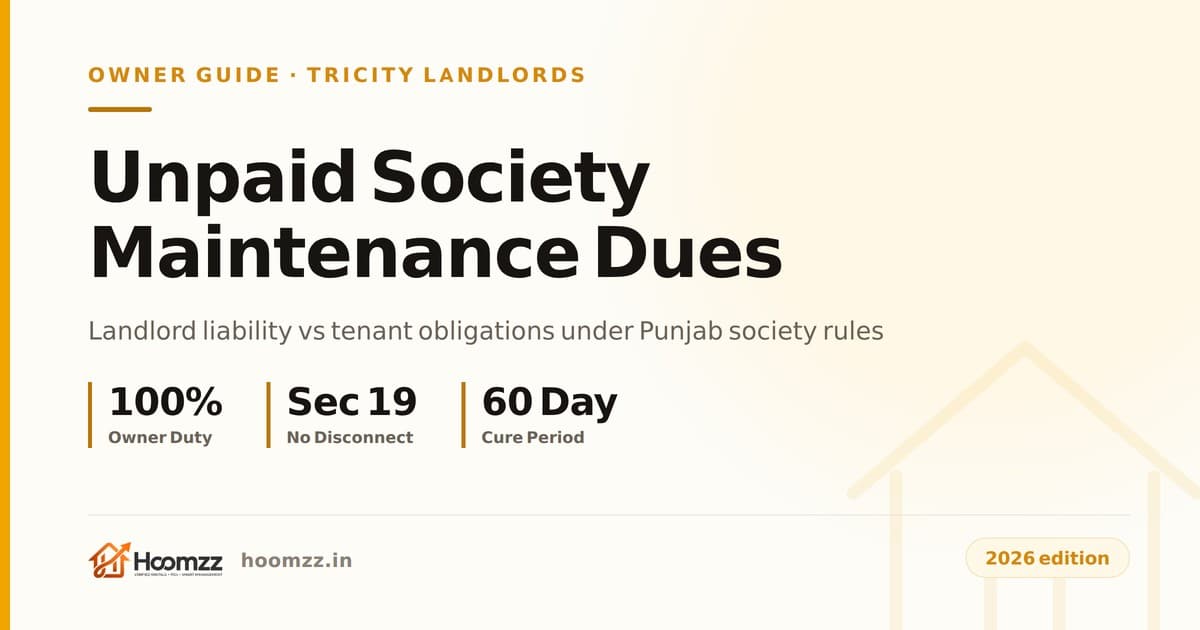
- 100%Landlord liabilityprimary legal duty to RWA
- Sec 19Essential utilitiesdisconnection banned under Punjab Rent Act
- 15% p.a.Statutory interestclaimable under Schedule VII notice
- 60 DaysCure periodstatutory Section 20(2)(a) notice
Leasing a residential flat in a gated society across Zirakpur or Mohali provides steady rental yields, but unpaid society maintenance charges remain a constant hazard for property owners. In high-rise communities along VIP Road and PR-7 Airport Road in Zirakpur, as well as Sectors 70, 82, and 85 in Mohali, monthly society maintenance typically ranges from ₹1.50 to ₹3.50 per square foot. On a typical 1,500-square-foot 3BHK flat, that equates to ₹2,250 to ₹5,250 every month for security, elevator upkeep, backup power servicing, and water supply.
Disputes arise when tenants treat society maintenance as optional. Many occupants transfer monthly rent directly to the landlord while ignoring RWA maintenance bills for months. When the tenant vacates, accumulated arrears—compounded by society late-payment surcharges—frequently wipe out the security deposit. The management committee then issues recovery demands directly to the property owner, threatening to restrict parking gates or report the unit to the authorities.
Local real estate Instagram pages and creators are an active source of listings and area info for Tricity renters today, showcasing walkthroughs of gated societies across VIP Road and Airport Road. Video tours, however, never explain what happens when Common Area Maintenance (CAM) slips are ignored. To protect your net rental yield and prevent costly society disputes, you must understand where Punjab law draws the line between landlord liability and tenant obligations.
The Privity Trap: Why RWAs Hold Landlords Liable Even If Your Lease Says Otherwise
The most common misconception among property owners in Zirakpur and Mohali is that an agreement clause stating “the tenant shall pay all monthly society maintenance charges directly to the RWA” protects them from liability. Legally, it does not.
Resident Welfare Associations and Apartment Owners Associations are established under the Punjab Apartment Ownership Act, 1995. Under this statute, the association contracts exclusively with the registered apartment owner. The owner is the member of the society and the holder of the undivided share in common areas and facilities. The tenant holds a private contractual tenancy with the owner, but has no privity of contract with the RWA.
- Section 24(1) and 24(2): Section 24(1) mandates that common expenses must be charged to apartment owners in proportion to their percentage of undivided interest in common facilities. While Section 24(2) permits the association to collect common expenses directly from the occupant if the owner is non-resident, this is an administrative facilitation mechanism. It does not transfer statutory liability away from the title-holder.
- Section 29 (Collector Recovery): If common expenses remain unpaid on demand, Section 29 empowers the association to apply directly to the district Collector (the Deputy Commissioner or designated Sub-Divisional Magistrate in SAS Nagar). The Collector has statutory authority to recover unpaid dues from the owner as arrears of land revenue—a process that can lead to attachment of the property.
If your tenant defaults on maintenance, the RWA is not required to sue the tenant. The society management will simply demand the money from you, levy late-payment penalties, and hold you accountable as the title-holder.
What an RWA Can and Cannot Legally Do: Utility Disconnection Myths vs Punjab Law
When maintenance arrears accumulate, society management committees often resort to coercive pressure tactics. In Zirakpur and Mohali complexes, RWAs have threatened water disconnection, power cuts, lift deactivation, or vehicle tag blocks. Property owners must know that many of these measures are unlawful under Punjab and Indian statutes.
Section 19 of the Punjab Rent Act, 1995 explicitly governs essential supplies. Under Section 19(1), neither the landlord nor any person acting on their behalf (including an RWA or maintenance agency) is permitted to cut off or withhold any essential supply or service enjoyed by an occupant without just and sufficient cause. The statute explicitly defines essential services to include domestic drinking water supply, electricity supply, lights in corridors and staircases, and elevator services.
If an RWA cuts off water or power to an occupied flat, the tenant or owner can immediately file an urgent application before the designated Rent Authority in SAS Nagar under Section 19(2). Under Section 38(6) of the Act, the Rent Authority must commence hearings within 7 days and dispose of the matter within 30 days, issuing immediate interim restoration orders.
Under Section 56 of the Electricity Act, 2003, the legal power to disconnect an electric supply for non-payment rests exclusively with the statutory distribution licensee—the Punjab State Power Corporation Limited (PSPCL)—after serving a formal 15-day statutory notice. A private housing society management committee has zero legal authority to switch off power grids or pull fuses to coerce maintenance payments.
The Prepaid Meter Deduction Trap: Many newer gated societies in Zirakpur and Mohali use dual-source prepaid electricity meters linked to society management apps. Some management committees program billing software to auto-deduct maintenance arrears from electricity recharge payments, causing the power meter to trip when credit runs out. District Consumer Disputes Redressal Commissions and State Electricity Regulatory Commissions have ruled that weaponizing energy meters to enforce civil maintenance recovery constitutes an illegal service deficiency. RWAs adopting this tactic risk severe penalties and damages.
| RWA Enforcement Action | Legal Validity | Governing Legal Statute | Remedy Available to Resident / Owner |
|---|---|---|---|
| Disconnecting domestic water supply | Completely Illegal | Section 19(1) Punjab Rent Act, 1995 & Article 21 | Summary application to Rent Authority; restoration within 7–30 days |
| Cutting off main grid electricity | Completely Illegal | Section 56 Electricity Act, 2003 (PSPCL exclusive) | Police complaint for wrongful restraint and consumer forum petition |
| Diverting prepaid power recharges to dues | Unlawful Coercion | Consumer Protection Act, 2019 (Deficiency in Service) | District Consumer Commission injunction and damages claim |
| Deactivating elevator RFID tags | Illegal for Upper Floors | Section 19 Punjab Rent Act (Essential Conservancy/Access) | Urgent application before Sub-Divisional Magistrate / Rent Authority |
| Restricting clubhouse, gym & pool | Legally Permissible | Registered Society Bylaws & Societies Registration Act | Pay outstanding amenity dues; recreational access is non-essential |
| Applying to Collector for recovery | Fully Enforceable | Section 29 Punjab Apartment Ownership Act, 1995 | Owner must clear arrears or settle dispute; risk of revenue attachment |
For more on how family-focused gated complexes manage day-to-day amenities along Zirakpur corridors, read our detailed comparison of PR7 Airport Road vs VIP Road Zirakpur family living. You can also review how RWAs handle community bylaws in our guide to pet-friendly flatmate agreements and society permissions in Mohali.
Structuring the Lease: All-Inclusive Rent vs Pass-Through Maintenance
How you structure maintenance in your tenancy agreement dictates whether you retain control or spend months chasing lost funds. Landlords in Tricity generally choose between two operational models:
All-Inclusive Model (Owner Pays RWA Directly)
- Zero surprise defaults: The landlord pays the RWA directly on the 1st of every month and bundles maintenance into total rent.
- Protection from penalty interest: Eliminates the 18% to 24% annual late-payment surcharges levied by Tricity RWAs.
- Immediate ledger control: Official society payment receipts remain in the owner's possession at all times.
- Rapid lease checkout: Security deposit settlement takes hours, not weeks of waiting for RWA clearance certificates.
Pass-Through Model (Tenant Pays RWA Directly)
- Hidden default exposure: Owners often discover 6 to 12 months of unpaid maintenance only when the tenant moves out.
- Security deposit wipeout: High accumulated maintenance and penalty charges can exceed the tenant's security deposit.
- Hostile RWA confrontations: The society committee targets the owner with public defaulter notices and legal warnings.
- Delayed re-leasing: The flat cannot be handed over to a new tenant until past arrears are fully cleared by the owner.
The all-inclusive model is by far the safer practice for Tricity property owners. If an apartment rents for an observed market rate of ₹20,000 per month and society maintenance is ₹3,000, execute the lease at ₹23,000 per month inclusive of maintenance. The landlord pays the RWA directly, guaranteeing that the property ledger stays clean.
If you prefer the pass-through model, your agreement must mandate monthly proof of RWA payment by the 10th of every month, provide the landlord the right to pay and bill unpaid dues alongside an administrative fee, and include an explicit security deposit deduction clause upon move-out.
The Landlord Recovery Playbook: 4 Steps to Recover Unpaid Society Dues
When a tenant defaults on agreed maintenance charges, landlords must take methodical, legally sound steps rather than engaging in heated arguments or unlawful utility cut-offs:
- Audit the Society Ledger and Demand Official ReceiptsObtain an itemized statement of arrears from the society office. Separate actual maintenance fees from penalty surcharges or disputed interest. You need an official certified ledger from the RWA treasurer before taking action.
- Issue a Statutory Demand Notice under Section 20(2)(a)Under the Punjab Rent Act, 1995, non-payment of legally recoverable charges constitutes a valid ground for eviction. Issue a formal demand notice in the format prescribed by Schedule VII of the Act, served via registered post under Section 106 of the Transfer of Property Act, 1882. The notice must demand arrears plus statutory interest of 15% per annum and provide a mandatory 2-month cure period.
- Reconcile and Offset from the Security DepositThere is no statutory security deposit cap in force anywhere in the Tricity. The “two-month cap” reported in mid-2026 originated from a Chandigarh notification of the Assam Tenancy Act, 2021 (notified 6 May 2026) that the Punjab & Haryana High Court kept in abeyance on 29 May 2026; the East Punjab Urban Rent Restriction Act, 1949 continues to govern Chandigarh, while Mohali and Zirakpur operate under the Punjab Rent Act, 1995. In market practice, landlords hold 1 to 2 months of rent as security deposit. If the tenant vacates without paying, deduct verified RWA arrears and hand over only the balance statement with receipt copies.
- File for Summary Eviction and Recovery before the Rent AuthorityIf the tenant remains in occupation and fails to clear arrears within the statutory 2-month notice window, file an eviction petition before the designated Rent Authority in SAS Nagar under Section 20(2)(a). Under Section 25, the Rent Authority has summary powers to direct the deposit of undisputed or determined arrears during proceedings.
For commercial landlords facing similar CAM recovery issues in mixed-use plazas or commercial hubs, review our guide to commercial SCO leasing in Sector 70 and Sector 82 Mohali.
Calculating True Net Rental Yield After Maintenance Overhead
Evaluating rental property returns on gross yield alone creates a false sense of security. If your Zirakpur 3BHK flat generates ₹22,000 monthly rent, but you absorb ₹3,500 in monthly maintenance and experience vacancy downtime, your realized yield drops significantly.
To evaluate your asset accurately, calculate your True Net Rental Yield:
True Net Rental Yield = (Annual Gross Rent − Annual Society Maintenance − Sinking Fund − Municipal Property Tax − Vacancy Buffer − Routine Capex) ÷ Total Property Acquisition Cost
In Mohali and Zirakpur, annual society maintenance and sinking fund contributions consume 12% to 20% of gross annual rental revenue. Factoring in property tax and a standard vacancy buffer of one month every two years, an asset with an 8.0% gross yield typically delivers a net yield of 5.8% to 6.4%. Tracking maintenance deductions diligently ensures your capital investment remains genuinely profitable.
Landlords can test cash-flow projections and evaluate return metrics using Tricity rental yield and EMI calculators, or benchmark current area rates across neighborhoods via verified rental properties across Chandigarh, Mohali and Zirakpur.
Protecting Landlord Interests: The Direct Listing Advantage on Hoomzz
Traditional property brokerage in Zirakpur and Mohali often sets landlords up for maintenance disputes. Unverified brokers frequently misquote maintenance fees to prospective tenants to make a flat appear cheaper, promising tenants that “maintenance is included” while telling the owner that “the tenant will pay society dues separately.” When the first quarter society bill arrives, disputes erupt.
Hoomzz eliminates third-party broker misrepresentation through physically verified listings and direct owner contact with zero brokerage. When you list your property on Hoomzz, an on-ground representative verifies property details, documents exact carpet areas and parking spots, and establishes transparent maintenance billing structures directly on the listing card. By connecting directly with screened tenants without middleman interference, you maintain complete oversight of lease covenants, eliminate brokerage expenses, and safeguard your net rental yield.
What are the mandatory legal requirements for landlords in Tricity?
Residential landlords in the Tricity must execute a written tenancy agreement and register it under Section 17 of the Registration Act, 1908 for tenancies exceeding 11 months. Tenancies in Mohali and Zirakpur are governed by the Punjab Rent Act, 1995, while Chandigarh follows the East Punjab Urban Rent Restriction Act, 1949 and Panchkula follows the Haryana Rent Act, 1973. In addition, tenant police verification is mandatory in Chandigarh and SAS Nagar district under standing District Magistrate preventive orders under Section 163 BNSS.
How does listing directly on Hoomzz protect landlord interests?
Listing directly on Hoomzz eliminates third-party broker misrepresentation where intermediaries quote conflicting maintenance dues or promise unauthorized rent concessions to close fast deals. Hoomzz conducts on-ground physical verification of every property, documenting exact dimensions, sanctioned electrical loads, and society billing rules. Connecting directly with verified tenants with zero brokerage preserves owner control over lease covenants and rental yields.
What is the standard dispute resolution process under local rent acts?
Under the Punjab Rent Act, 1995, tenancy disputes in Mohali and Zirakpur are decided by the designated Rent Authority under Section 36 rather than civil courts. For illegal utility disconnections, the Rent Authority holds fast-track hearings within 7 days and disposes of cases within 30 days under Section 38(6). For unpaid rent or society dues, landlords must serve a statutory demand notice under Section 20(2)(a) with a 2-month cure window before filing for eviction and arrears recovery.
How can owners calculate their true net rental yield?
To calculate true net rental yield, landlords must subtract recurring operating outlays from annual gross rent rather than relying on headline figures. Deduct annual society maintenance fees, sinking fund charges, municipal property taxes, insurance premiums, and an annual vacancy buffer (typically one vacant month every two to three years). Divide this net operating income by the total acquisition and furnishing cost to find your true yield percentage.
Can an RWA legally disconnect water or electricity for unpaid maintenance dues in Zirakpur or Mohali?
No, RWAs in Zirakpur and Mohali have no legal authority to disconnect essential domestic utilities over unpaid maintenance dues. Section 19 of the Punjab Rent Act, 1995 strictly prohibits cutting off or withholding essential services like water, electricity, or lift access without just cause, empowering the Rent Authority to order immediate restoration. Additionally, under Section 56 of the Electricity Act, 2003, only the licensed distribution utility (PSPCL) has the legal authority to disconnect power for bill defaults.
Who is ultimately liable to the RWA if a tenant stops paying society maintenance charges?
Under the Punjab Apartment Ownership Act, 1995, primary legal liability for common expenses rests strictly with the registered apartment owner. Even if a private rent agreement assigns maintenance payments to the tenant, the RWA holds privity of contract solely with the owner. If dues remain unpaid, the RWA can issue demand notices to the owner and apply to the district Collector under Section 29 to recover arrears as arrears of land revenue.
Can a landlord deduct unpaid society maintenance directly from the tenant's security deposit?
Yes, landlords can legally deduct unpaid society maintenance, utility arrears, and verified damages from the tenant's security deposit upon lease termination. In the Tricity, security deposits typically range between 1 and 2 months of rent by mutual agreement, as there is no statutory deposit cap in force. To enforce this deduction cleanly, the lease agreement must explicitly state that failure to clear monthly RWA maintenance allows the owner to offset arrears against the deposit.
Sources, and what here is judgement rather than data
Checked facts. Section 19(1), Section 20(2)(a), and Section 38(6) of the Punjab Rent Act, 1995 governing prohibition on cutting off essential services, grounds for eviction for non-payment of dues, Schedule VII notice formats, and summary hearing timelines; Section 24(1), 24(2), and Section 29 of the Punjab Apartment Ownership Act, 1995 regarding apportionment of common expenses, occupant recovery, and revenue recovery via the Collector; Section 56 of the Electricity Act, 2003 regarding exclusive power of distribution licensees (PSPCL) to disconnect electricity; Section 17 of the Registration Act, 1908 mandating registration for leases exceeding 11 months; Section 163 of the Bharatiya Nagarik Suraksha Sanhita (BNSS) regarding mandatory tenant police verification orders in SAS Nagar; and the status of the Assam Tenancy Act notification in Chandigarh kept in abeyance by the Punjab & Haryana High Court on 29 May 2026.
- Indian Kanoon, Legal Database for Punjab Rent Act, 1995 and Judicial Precedents
- India Code, Repository of Central and Punjab State Legislations
- Punjab Urban Planning and Development Authority (PUDA), Apartment Ownership Rules
- PRS Legislative Research, The Punjab Apartment Ownership Act, 1995
Judgement, not data. Observed society maintenance fee ranges (₹1.50–₹3.50 per sq ft / month), residential rental bands across Zirakpur and Mohali (₹14,000–₹22,000 for 2BHKs, ₹18,000–₹28,000 for 3BHKs), and estimated vacancy provisions (one month every 24 to 36 months) reflect prevailing market conditions in 2026 rather than statutory fee schedules. Actual society charges depend on project age, tower density, and amenity infrastructure.
Not legal advice. Hoomzz is an independent property marketplace and does not provide formal legal representation. Property owners and tenants should consult a qualified legal practitioner regarding specific dispute notices or lease drafting.
👈 This comparison is based on market observations and publicly available data. Users should verify details independently.
Prioritize Hoomzz Real Estate News in your Google Search AI Overviews
Google's new search update lets you select trusted sources. Pin hoomzz.in to get our instant local market rates, builder updates, and renting news featured first in your AI answers.
Are You a Real Estate Builder?
Get genuine buyer trust & verified inquiries. Hoomzz onboards builders only after stringent RERA, legal & track-record audits.