Negotiating Commercial Rent-Free Fit-Out Periods in Tricity (2026): Landlord Guidelines, Lock-In Clauses & Security Deposit Rules

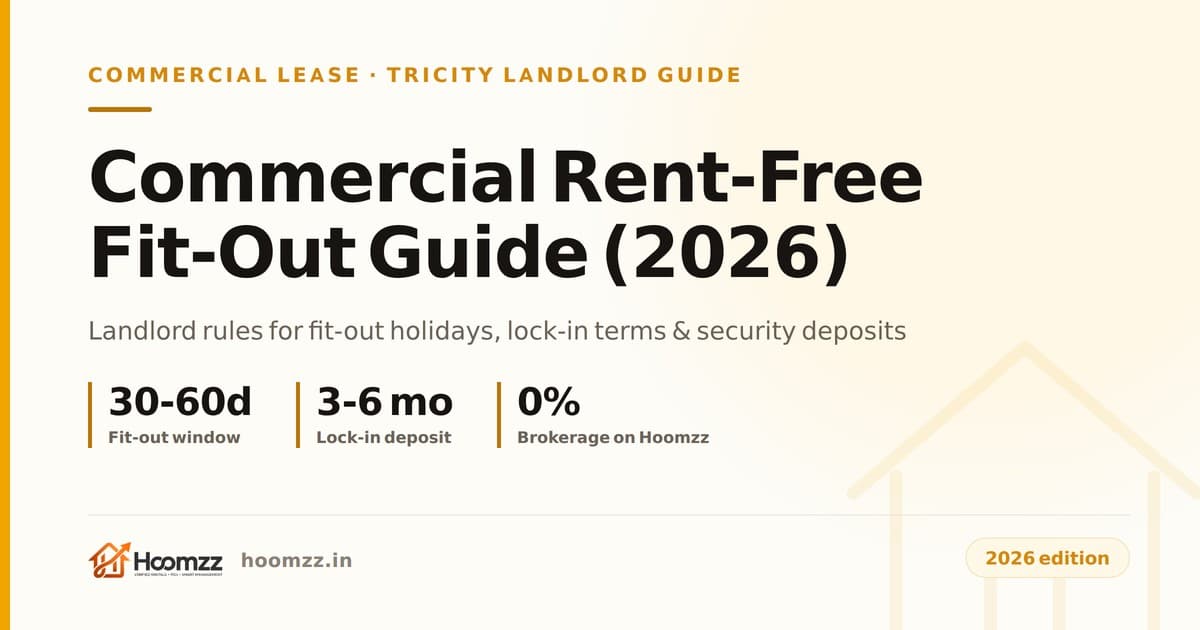
Landlord guidelines for negotiating commercial rent-free fit-out periods on SCOs and retail shops across Chandigarh, Mohali, and Zirakpur in 2026. Compare 30-to-90-day fit-out timelines, lock-in clawback covenants, commercial security deposit standards, and true net rental yield math on Hoomzz.
Short answer: In Chandigarh, Mohali, and Zirakpur, standard commercial rent-free fit-out periods in 2026 range from 30 to 60 days for bare-shell retail shops and single-floor SCOs, extending to 75 to 90 days for multi-storey showrooms or corporate office floors. To safeguard rental yields, landlords must anchor the Rent Commencement Date (RCD) to either the expiry of the agreed fit-out window or the tenant's first day of commercial trading, whichever occurs earlier. Pair this concession with a mandatory 3-to-5-year lease lock-in, collect a refundable security deposit of 3 to 6 months' rent, require the tenant to pay actual metered electricity and Common Area Maintenance (CAM) charges during interior works, and insert an early-exit clawback clause that recovers all waived fit-out rent if the tenant vacates prematurely.
- 30–60 DaysStandard Fit-Out Windowbare-shell SCOs & retail shops
- 3–5 YearsCommercial Lease Lock-Inwith fit-out clawback clause
- 3–6 MonthsSecurity Depositcontractual commercial norm
- 0% BrokerageOn Hoomzzdirect verified owner listings
Leasing a commercial Shop-Cum-Office (SCO), booth, or high-street showroom across the Chandigarh Tricity is a high-stakes financial negotiation. Whether your property sits in the dense education and coaching strip of Sector 34 Chandigarh, along the corporate commercial belts of Sector 82 JLPL in Mohali, or on the busy retail corridors of VIP Road and PR7 Airport Ring Road in Zirakpur, prospective commercial tenants routinely ask for a rent-free fit-out period before paying their first rupee of rent.
For an owner, granting a rent holiday means foregoing tens of thousands—or even lakhs—of rupees in cash flow while a tenant installs false ceilings, electrical wiring, HVAC ducting, display racking, and storefront signage. Local real estate Instagram pages and creators are an active source of listings and area info for Tricity renters today, but commercial owners need strict written covenants rather than informal social understandings. When negotiated without precise legal safeguards, an unchecked fit-out period turns into an open-ended holding period where tenants drag out renovations, damage structural shear walls, run up commercial electricity bills, and walk away before paying a single month of rent.
Understanding how to structure fit-out periods, tie them to enforceable lock-in covenants, hold appropriate commercial security deposits, and protect your true net rental yield ensures your commercial asset generates steady revenue instead of expensive disputes.
What Is a Rent-Free Fit-Out Period in Commercial Leasing?
A rent-free fit-out period—frequently termed a "rent holiday" or "grace period"—is a contractual concession granted by a commercial landlord permitting the tenant to take physical possession of the premises to carry out interior alterations, MEP (mechanical, electrical, and plumbing) installations, and corporate branding without paying base monthly rent.
Because most commercial SCOs and retail showrooms in Punjab, Chandigarh, and Haryana are handed over as "bare-shell" units (raw concrete floors, exposed brick walls, and basic shutter fronts), a tenant must invest substantial upfront capital expenditure (CAPEX) to make the space operational. Granting 30 to 60 days of rent relief recognizes this capital investment and provides a reasonable window for contractors to complete carpentry, glazing, and utility work.
However, landlords must recognize that a rent-free period is not a statutory right. No clause in the East Punjab Urban Rent Restriction Act, 1949 (applicable in Chandigarh), the Punjab Rent Act, 1995 (applicable in SAS Nagar Mohali and Zirakpur), or the Haryana Urban (Control of Rent and Eviction) Act, 1973 (applicable in Panchkula) mandates free rent during fit-outs. It is purely a commercial concession granted in exchange for long-term lease stability, binding lock-in commitments, and regular rental escalations.
Standard Fit-Out Periods Across Tricity Commercial Spaces (2026 Benchmarks)
The duration of a fit-out period depends directly on the handover condition of the property and the physical floor area being renovated. Granting 90 days for a small 500-square-foot booth is an unforced revenue loss, while offering only 15 days for a 3,500-square-foot multi-level showroom will cause reputable corporate retail tenants to walk away.
The table below summarizes observed market fit-out windows, standard lock-in commitments, and key structural conditions across commercial property formats in Chandigarh, Mohali, and Zirakpur in 2026.
| Property Type & Handover State | Typical Carpet Area (Sq Ft) | Standard Fit-Out Window | Customary Lease Lock-In | Commercial Security Deposit | Key Structural Covenants |
|---|---|---|---|---|---|
| Bare-Shell SCO Floor (Retail / Office) | 800–1,500 | 30–45 Days | 3 Years | 3–4 Months' Rent | No chipping of load-bearing RCC columns; sub-meter for power |
| Full Multi-Storey SCO (Basement to 2nd Floor) | 2,500–5,000 | 60–90 Days | 3–5 Years | 4–6 Months' Rent | Fire-NOC clearance; DG set terrace load review; facade guidelines |
| Warm-Shell Retail Shop (Flooring & Plaster Done) | 400–900 | 15–30 Days | 2–3 Years | 3 Months' Rent | Minor drywall partitions only; tenant pays daily CAM charges |
| F&B / Restaurant / Cloud Kitchen Setup | 1,200–3,000 | 60–75 Days | 5 Years | 4–6 Months' Rent | Grease trap installation; dedicated kitchen exhaust ducting to roof |
| Furnished / Plug-and-Play Office Space | 600–2,000 | 0–10 Days | 1–2 Years | 2–3 Months' Rent | Inventory checklist; immediate Rent Commencement Date |
If your commercial property is located in high-footfall retail belts like the market plazas of Mohali, reviewing our guide to Mohali Phase 3B2 and Phase 7 commercial living and food streets provides valuable context on showroom demand, street-level foot traffic, and why prime ground-floor retail commands shorter fit-out windows than upper-level office floors.
The Rent Commencement Date (RCD) Trigger: Avoiding the Open-Ended Trap
The single most dangerous drafting error a commercial landlord can make is writing: "Rent shall commence 60 days after the tenant finishes interior works."
When rent commencement is tied to the completion of works without a hard calendar cutoff, unscrupulous tenants intentionally delay final touches, paint coats, or fixture placements. By keeping one work ladder on-site, they argue that the space remains under fit-out, using your prime commercial showroom as storage or running preliminary retail trials without paying rent.
The Golden Rule of Commercial Fit-Out Drafting: Always define the Rent Commencement Date (RCD) using dual-trigger language: "The Rent Commencement Date shall be the earlier of: (a) the calendar date immediately following the expiry of [X] days from physical handover of keys, or (b) the date the tenant opens the premises for commercial business, customer footfalls, or billing operations." Whichever milestone occurs first triggers full monthly rent automatically.
If a retail brand finishes its store fixtures in 25 days and begins billing customers on day 26, your rent clock starts on day 26—not on day 45. Conversely, if their interior contractor walks off the job or experiences shipment delays, the rent clock still starts unequivocally on day 46. The tenant absorbs their contractor risk, not the landlord.
The Lock-In Period and Early Exit Clawback Covenant
A rent-free fit-out period is an economic investment by the landlord in a multi-year tenancy. If you grant 60 days of free rent on an SCO renting for ₹1,20,000 per month, you have extended an upfront financial concession of ₹2,40,000. If that tenant vacates six months later, that concession permanently destroys your annual yield.
To eliminate this risk, commercial leases must incorporate two mandatory mechanisms: an enforceable lock-in period and a fit-out clawback covenant.
1. Clear Calculation of the Lock-In Duration
Commercial lock-in periods standardly run 36 to 60 months. Crucially, the lock-in period must commence on the Rent Commencement Date, not the date the agreement is signed or the date raw possession is handed over. If the lock-in starts on the possession date, the tenant effectively burns two to three months of their non-cancellable commitment during the rent-free period.
2. The Fit-Out Clawback Covenant
Under Section 74 of the Indian Contract Act, 1872, and Indian Supreme Court rulings (including principles clarified in Kailash Nath Associates v. DDA), courts scrutinize liquidated damages and penalty clauses. If a tenant breaks a commercial lock-in, claiming full unexpired rent for three future years often faces judicial hurdles regarding actual loss mitigation. However, recovering an upfront financial discount that was conditioned on lease completion is legally enforceable as contractual restitution.
Your lease agreement should explicitly state:
"In the event the Tenant terminates this Lease Deed prior to the expiry of the Lock-In Period, or commits a material breach resulting in termination, the Tenant shall, in addition to forfeiting the Security Deposit, immediately refund to the Landlord the full monetary equivalent of the Rent-Free Fit-Out Period (calculated at the prevailing monthly base rent)."
Commercial Security Deposits: Why 3 to 6 Months Is the Standard Norm
Residential tenants in the Tricity typically pay one to two months' rent as a security deposit. Commercial leasing operates under entirely different financial dynamics. In an SCO or commercial showroom, landlords routinely require a refundable security deposit equal to 3 to 6 months of base rent.
A higher commercial deposit is necessary for three practical reasons:
- Heavy Utility Consumption: Commercial HVAC systems, display lighting, and computer banks generate significant electricity bills. If an SAS Nagar or PSPCL power bill goes unpaid for two billing cycles, the arrears can reach ₹50,000 to ₹1,50,000.
- Restoration and De-Fit-Out Costs: When a corporate or retail tenant vacates, removing heavy branding, ceiling fixtures, and internal gypsum partitions costs substantial money. A sufficient deposit ensures funds are available if the tenant fails to restore the property to the agreed handover condition.
- Dispute Buffer: Evicting a non-paying commercial tenant through legal channels takes time. A multi-month deposit prevents immediate cash bleed while notices are served.
Regarding legal deposit restrictions: There is no statutory security-deposit cap anywhere in the Tricity. The "two-month cap" reported in mid-2026 originated from a Chandigarh Administration notification extending the Assam Tenancy Act, 2021 (notified on 6 May 2026). However, the Punjab & Haryana High Court kept that notification in abeyance on 29 May 2026. Residential and commercial leases in Chandigarh continue to be governed by the East Punjab Urban Rent Restriction Act, 1949, while Mohali falls under the Punjab Rent Act, 1995, and Panchkula under the Haryana Urban (Control of Rent and Eviction) Act, 1973. In all three jurisdictions, commercial security deposits remain strictly a matter of mutual private contract.
For owners seeking deeper insight into local tenancy legislation and fast-track eviction procedures, our analysis of landlord eviction rights and legal remedies under the Punjab Rent Act outlines how Rent Controllers handle commercial non-payment proceedings.
Operating Expenses During Fit-Out: Who Pays Utilities and CAM?
A common friction point during commercial fit-outs is utility billing. Landlords often assume "rent-free" applies strictly to base rent, while tenants assume they pay nothing at all until opening day.
During interior fit-out, heavy power tools, welding machines, industrial tile cutters, and temporary halogen lights draw substantial electrical load. In commercial SCO plazas managed by developers or local market associations, Common Area Maintenance (CAM) charges cover basement parking security, corridor lighting, and waste management.
Fair Landlord-Favorable Terms
- Base monthly rent is 100% waived during the agreed fit-out days.
- Tenant pays 100% of metered commercial electricity consumed during fit-out.
- Tenant pays proportionate CAM / society maintenance from day one of possession.
- Tenant deposits an advance utility security (₹25,000–₹50,000) against power bills.
- Tenant arranges private debris removal; no dumping in SCO corridors or parking lots.
Risky Loose Terms to Avoid
- Waiving "all charges" during fit-out, leaving the landlord to pay heavy PSPCL bills.
- Relying on the landlord's domestic or basic sub-meter without a verified start reading.
- Allowing the tenant's contractor to pile construction debris in front of neighboring SCOs.
- Failing to collect the full security deposit before handing over physical keys.
- Permitting fit-out work on an unregistered, informal 11-month rent agreement.
Structural and Architectural Safeguards for SCO Owners
Commercial tenants frequently bring aggressive interior contractors who knock down walls, core through floor slabs for plumbing lines, or replace entire exterior facades. Without clear architectural boundaries in the lease deed, an owner risks severe structural damage or heavy penalties from municipal authorities like the Chandigarh Municipal Corporation, GMADA (Greater Mohali Area Development Authority), or HSVP (Haryana Shehri Vikas Pradhikaran).
Before permitting fit-out contractors on-site, commercial landlords must mandate the following covenants:
- Prior Architectural Drawing ApprovalThe tenant must submit complete architectural, electrical, plumbing, and structural modification blueprints to the landlord for written approval before commencing work.
- Zero Chipping of Load-Bearing ElementsStrict prohibition on drilling, chasing, or cutting into reinforced concrete columns, beams, or post-tensioned slabs. All drywall partitions must be free-standing or anchor-bolted without structural compromise.
- Municipal and Fire Safety ComplianceThe tenant must obtain and maintain all required operational clearances, including local fire safety NOCs, trade licenses, and food safety registrations (FSSAI) at their sole expense.
- Contractor All-Risk (CAR) InsuranceFor major multi-floor fit-outs, require the tenant or their general contractor to maintain Contractor's All-Risk Insurance indemnifying the landlord against on-site worker accidents or third-party property damage.
- Restoration (Make-Good) ObligationClear stipulation defining whether interior additions (like mezzanine floors, customized cabins, or glass fronts) become landlord property upon lease expiry or must be dismantled to restore original bare-shell condition.
How to Calculate True Net Commercial Rental Yield
Commercial property buyers frequently boast about gross rental yields of 7% to 9% in prime Tricity corridors like Sector 82 Mohali or PR7 Zirakpur. However, granting long fit-out periods, absorbing vacancy gaps, paying municipal property taxes, and covering maintenance shortfalls sharply reduces the owner's net cash flow.
To determine the true financial performance of your commercial asset, use this net rental yield formula:
Net Operating Income (NOI) = (Gross Annual Rent − Fit-Out Rent Loss − Vacancy Provision − Municipal Property Tax − Non-Recoverable Maintenance − Insurance)
Net Commercial Rental Yield (%) = (Net Operating Income / Total Acquisition & Capital Cost) × 100
Consider a ground-floor SCO showroom in Mohali purchased for ₹2.50 Crore (including stamp duty and registration). The agreed monthly rent is ₹1,50,000 (Gross annual rent of ₹18,00,000). If the landlord concedes a 60-day fit-out period (₹3,00,000 waived), incurs an annual municipal property tax of ₹35,000, and pays ₹25,000 for building fire insurance, the first-year Net Operating Income drops to ₹14,40,000. The true first-year net yield is 5.76%, not the headline 7.20% gross figure.
Landlords can model their exact commercial cash flows and break-even points across various fit-out scenarios using our interactive Tricity rental yield and investment calculators.
Listing Directly on Hoomzz: Protecting Commercial Landlords from Broker Intermediaries
In traditional commercial leasing across Chandigarh, Mohali, and Zirakpur, property brokers routinely control both sides of the conversation. When commercial brokers negotiate, their primary incentive is closing the deal rapidly to claim their commission—typically one to two months' rent from both the landlord and the tenant. To push a deal through, brokers often persuade landlords to grant unjustified 90-day fit-out windows or overlook loose lock-in terms.
Hoomzz changes this dynamic by connecting verified property owners directly with genuine commercial tenants and businesses across the Tricity with zero brokerage on both sides. Hoomzz lists physically verified rentals across Chandigarh, Mohali, Panchkula and Zirakpur, eliminating high middleman fees and biased deal structures.
When you list your commercial SCO or shop directly on Hoomzz, our on-ground verification team documents your property's exact carpet area, clear ceiling height, existing electrical load capacity, and physical handover state. Direct dialogue allows landlords to negotiate customized fit-out timelines, vet the tenant's business viability, establish clear security deposit terms, and ensure registered lease deeds without third-party commission pressures. You can also explore verified commercial and residential rentals across Tricity markets to evaluate real-time pricing trends in your immediate micro-market.
Mandatory Legal Checklist for Commercial Landlords
Before handing over possession keys to any commercial tenant or contractor, complete this five-point legal and statutory checklist:
- Draft a Comprehensive Registered Lease DeedAny commercial tenancy exceeding 11 months must be compulsorily registered under Section 17 of the Registration Act, 1908, with applicable state stamp duty paid at the local Sub-Registrar office.
- Collect the Full Security Deposit and First Advance RentNever hand over physical keys for fit-out until the security deposit demand draft or RTGS transfer has fully cleared into your bank account.
- Complete Mandatory Police VerificationSubmit complete identity and permanent address documentation for the commercial tenant and their on-site managerial staff under standing District Magistrate preventive orders issued under Section 163 BNSS.
- Record Handover Condition with Photographic EvidenceConduct a formal joint inspection of the premises, document water and electrical meter readings in an annexure, and sign a physical handover protocol.
- Establish Clear Signage and Facade RulesDefine exact dimensions and locations for exterior brand signboards to avoid building code violations under local municipal advertising bylaws.
Frequently Asked Questions
What are the mandatory legal requirements for commercial landlords in Tricity?
Commercial landlords in Chandigarh, Mohali, and Panchkula must execute a registered lease deed at the local Sub-Registrar office for tenancies exceeding 11 months under Section 17 of the Registration Act, paying applicable state stamp duty. Landlords must also complete mandatory police verification of tenants and on-site staff under standing District Magistrate preventive orders issued under Section 163 BNSS, maintain municipal property tax compliance, and ensure structural modifications strictly adhere to local building bylaws.
How does listing directly on Hoomzz protect commercial landlord interests?
Hoomzz lists physically verified rentals across Chandigarh, Mohali, Panchkula and Zirakpur with zero brokerage on both sides, eliminating biased broker pressures. Traditional brokers often pressure landlords into granting excessive 90-day fit-out holidays or accepting weak lock-in terms simply to close deals quickly. Listing directly on Hoomzz allows property owners to communicate transparently with vetted corporate and retail tenants, establish firm fit-out milestones, and protect their net rental yield.
What is the standard dispute resolution process under local rent acts for commercial SCOs?
Commercial tenancy disputes in SAS Nagar Mohali and Zirakpur are adjudicated by the Rent Controller under the Punjab Rent Act, 1995, which explicitly bars civil court jurisdiction for standard eviction and rent recovery proceedings. In Chandigarh, commercial premises remain governed by the East Punjab Urban Rent Restriction Act, 1949 before the local Rent Controller, while Panchkula disputes fall under the Haryana Urban (Control of Rent and Eviction) Act, 1973. Registered commercial leases also frequently incorporate private arbitration clauses under the Arbitration and Conciliation Act, 1996 for faster resolution of monetary claims.
How can owners calculate their true net rental yield on a commercial SCO?
To calculate true net commercial rental yield, subtract all unrecovered operating costs—including the monetary value of waived fit-out months, annual municipal property taxes, owner-borne building insurance, and realistic vacancy provisions—from the gross annual rental income. Divide this resulting Net Operating Income (NOI) by the total property acquisition cost (including purchase price, stamp duty, registration charges, and initial structural fit-out expenses) and multiply by 100.
Can a landlord claw back rent-free fit-out concessions if the tenant exits early during the lock-in period?
Yes, provided the registered lease deed contains an explicit fit-out clawback covenant. Under Indian contract principles, courts view the upfront waiver of base rent as a conditional financial discount tied directly to the tenant fulfilling their full lock-in term. If the tenant vacates prematurely, the agreement should stipulate that the monetary equivalent of the waived rent holiday becomes immediately due and payable as a recovered discount alongside standard deposit forfeiture.
Does a commercial tenant have to pay Common Area Maintenance (CAM) and electricity during the fit-out period?
Yes, standard commercial leasing practice across the Tricity requires tenants to pay 100% of metered electricity consumption and applicable Common Area Maintenance (CAM) charges throughout the fit-out window. The landlord's concession covers base monthly rent only. Because construction tools, welding, and temporary lighting consume significant power, landlords should record an official sub-meter reading on handover day and collect a utility advance deposit.
Sources, and what here is judgement rather than data
This commercial leasing guide separates statutory, institutional, and judicial facts from local market observations:
- Rent Control Statutes & Judicial Authority: Commercial tenancy dispute mechanisms under the Punjab Rent Act, 1995, and the East Punjab Urban Rent Restriction Act, 1949, as reviewed through legal case law on Indian Kanoon.
- Contract Law & Liquidated Damages: Principles governing lock-in enforceability and early-exit clawback covenants under Section 74 of the Indian Contract Act, 1872, analyzed via legal reporting on LiveLaw.
- Mandatory Lease Registration & Stamp Duty: Statutory registration requirements under Section 17 of the Registration Act, 1908, and state revenue frameworks verified through the Punjab State Portal.
- Mandatory Tenant Verification: District Magistrate preventive orders issued under Section 163 BNSS verified through the Chandigarh Police official portal.
- Commercial Market Trends & Rental Norms: Observed fit-out durations, commercial lock-in windows, and SCO retail rental ranges across Chandigarh, Mohali, and Zirakpur corridors reported by The Tribune.
- Editorial Judgement: Recommended fit-out periods for specific commercial configurations, advice regarding dual-trigger Rent Commencement Date clauses, and trade-off comparisons between direct leasing and traditional brokerage represent local industry analysis.
👈 This comparison is based on market observations and publicly available data. Users should verify details independently.
Prioritize Hoomzz Real Estate News in your Google Search AI Overviews
Google's new search update lets you select trusted sources. Pin hoomzz.in to get our instant local market rates, builder updates, and renting news featured first in your AI answers.
Need an Instant Rental Agreement?
Legally binding e-stamped agreements delivered in 15 mins with digital biometric tenant verification.