Commercial Laundry and Linen Management for 30+ Bed PGs: Industrial Washing Machines vs Outsourced Vendor ROI (2026)

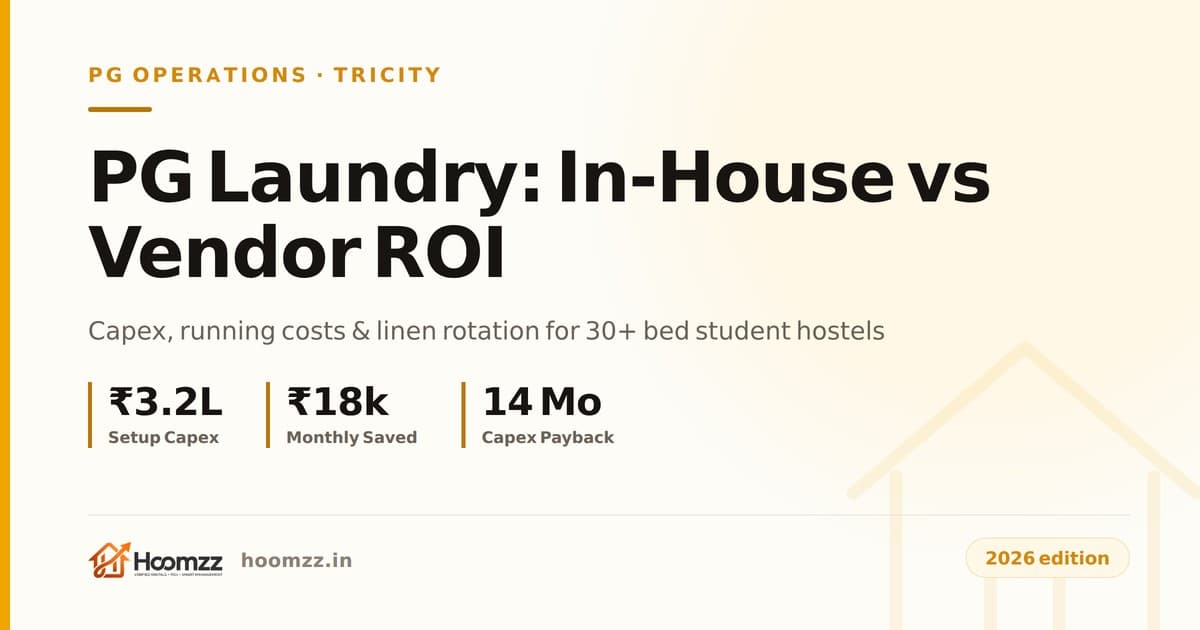
Setting up in-house commercial laundry for a 30+ bed student PG in Tricity cuts monthly linen costs from ₹35,000 to ₹14,000, paying back a ₹3.2L capex within 14 months. Here is the operational blueprint covering equipment sizing, 3-par linen rotations, PSPCL power loads, and vendor contract terms.
Short answer: For a 30+ bed student PG in the Tricity, setting up an in-house commercial laundry system costs ₹2.80 lakh to ₹4.20 lakh in upfront capital expenditure for a 15–20 kg semi-industrial washer-extractor and heavy-duty dryer. Outsourcing laundry to a third-party vendor runs at ₹800 to ₹1,200 per student per month (or ₹45 to ₹65 per kg), totaling ₹28,000 to ₹42,000 per month for a 35-bed facility. Operating in-house incurs ₹12,500 to ₹15,500 per month across PSPCL commercial electricity, water, detergents, and allocated housekeeping labor. This creates net monthly savings of ₹15,500 to ₹26,500, delivering a full capex payback within 13 to 18 months while ending student friction over lost clothes and irregular weekly linen changes.
- ₹2.8L–4.2LSetup Capex15–20 kg commercial gear
- ₹800–1.2kVendor Rate / MoPer student outsourced
- ₹16k–26kMonthly SavingsIn-house operating gain
- 13–18 MoCapex PaybackBreak-even timeline
Operating a multi-bed student paying guest accommodation along the high-density college corridors of the Tricity—whether near Chandigarh University (CU) in Gharuan, CGC Landran, the Sector 34 coaching cluster, or student hubs around Kharar—is fundamentally an exercise in operational endurance. Once a property expands past 25 to 30 beds, laundry ceases to be an incidental chore that domestic appliances can handle. A facility housing 35 students generates roughly 350 to 500 kilograms of dirty washables every week, splitting between personal student clothing and institutional linen such as bedsheets, pillowcases, and mattress covers.
Most independent PG operators approach this scale without an operational system. Some install two domestic 7 kg top-loading washing machines on a terrace, expecting students to manage their own wash cycles. Within four months, overloaded drums, coin-jammed drain pumps, burnt drive belts, and endless weekend queues turn the utility area into a battleground. Other operators contract local dhobis or commercial laundry vendors on a per-student or per-kilo basis, only to face regular complaints about damaged shirts, lost garments, detergent rashes, and 72-hour delivery delays during the monsoon season.
Local real estate Instagram pages and creators are an active source of listings and area info for Tricity renters today, frequently showcasing stylized room interiors and furnished common areas, but these short video tours rarely address the underlying utility infrastructure and laundry logistics that dictate whether a facility operates smoothly or descends into tenant disputes. For a 30+ bed property, choosing between an in-house commercial laundry setup and an outsourced vendor contract directly determines operating cash flow, linen durability, and student retention.
A 35-bed student PG generates over 1,500 kg of laundry every month. Running domestic washing machines under this load leads to catastrophic motor failure within 120 days, while uncontrolled vendor outsourcing drains more than ₹3.5 lakh in recurring annual cash flow that could otherwise fund property debt servicing or modern room fit-outs.
The Financial Reality: In-House Commercial Laundry vs Outsourced Vendor ROI
To evaluate whether an operator should invest in commercial equipment or outsource laundry operations, consider the monthly financial balance sheet of a representative 35-bed student PG operating in Kharar or Mohali across a standard 10-month active academic term (with a 2-month summer vacancy lull).
Commercial laundry vendors servicing student accommodations in SAS Nagar district quote between ₹800 and ₹1,200 per student per month for a standard weekly bundle (typically 4 kg of personal wash-and-fold per student per week, plus one weekly bedsheet and pillowcase change). For 35 enrolled students, this represents a recurring monthly payout of ₹28,000 to ₹42,000. When beds sit empty during university examination breaks or early summer departures, vendor minimum billing clauses often penalize the owner regardless of actual occupancy.
By comparison, an in-house facility centered around a 15 kg to 20 kg commercial washer-extractor and a matching heavy-duty dryer shifts this expenditure into capital asset formation. The ongoing monthly operational costs are predictable: Punjab State Power Corporation Limited (PSPCL) commercial electricity, metered water supply, institutional bulk detergents, and allocated housekeeping staff hours.
| Operational Metric | Outsourced Laundry Vendor | In-House Commercial Setup (15–20 kg Extractor + Dryer) | Operational Variance & ROI Impact |
|---|---|---|---|
| Upfront Capital Expenditure (Capex) | ₹0 (Zero equipment investment) | ₹2,80,000–₹3,80,000 (Equipment, 3-phase wiring, plumbing) | In-house requires upfront capital; vendor requires zero initial deposit |
| Monthly Cost per Occupied Bed | ₹800–₹1,200 per student | ₹360–₹445 per student (All utilities, labor & consumables included) | In-house reduces recurring per-bed laundry cost by 55% to 65% |
| Monthly Operational Outlay (35 Beds) | ₹28,000–₹42,000 | ₹12,600–₹15,575 (Breakdown detailed below) | Net operational saving of ₹15,400–₹26,425 per month |
| Annual Opex (10 Active + 2 Summer Months) | ₹3,08,000–₹4,40,000 | ₹1,38,000–₹1,70,000 | Annual cash savings of ₹1,70,000–₹2,70,000 retained by owner |
| Turnaround Time for Clothes & Linen | 48 to 72 hours (Delays common during monsoon) | 3 to 4 hours (Same-day return for personal items) | Eliminates student complaints regarding missing exam wear |
| Linen Hygiene & Disinfection Control | Low (Mixed batches from multiple hostels in vendor tubs) | High (Controlled 60°C wash cycles, dedicated PG machines) | Prevents skin infections and bedbug infestations |
| Garment Loss & Damage Friction | Frequent (Missing socks, mixed shirts, disputed claims) | Near Zero (Organized mesh wash bags per room) | Removes a major driver of negative student reviews |
| Capital Payback Period | Not applicable (Perpetual cost drain) | 13 to 18 Months | Complete capital recovery from direct operating savings |
As demonstrated in the comparison table, an operator investing ₹3.2 lakh into a dedicated commercial wash setup recoups the entire expenditure within roughly 14 months of full operation. Beyond month 18, the facility generates over ₹20,000 in monthly net cash savings compared to vendor contracting, directly enhancing the property’s net operating income (NOI).
Industrial Equipment Selection: Why Domestic Washers Fail
A recurring mistake made by property managers in Kharar and Landran is purchasing three or four retail 8 kg or 9 kg front-loading domestic washing machines from local electronics retail showrooms, assuming they will handle commercial volume. Domestic machines are engineered for one or two cycles per day (roughly 300 to 500 operating hours annually). In a 35-bed student residence, those same machines run five to eight continuous cycles daily (over 2,500 hours annually).
Domestic front-loaders feature lightweight carbon-brush motors, plastic outer tubs, and light suspension dampers designed for residential vibrations. Under commercial loads containing heavy denim jeans, thick cotton hoodies, and wet double bedsheets, domestic drive belts snap, water heater elements scale up rapidly with hard groundwater, and spin-bearing assemblies collapse within three to six months. In addition, standard consumer warranty terms explicitly exclude coverage when appliances are used in commercial or hostel environments, leaving the operator with hefty out-of-pocket repair bills.
A proper commercial setup for 30 to 50 beds requires industrial-grade engineering:
- 15 kg to 20 kg Commercial Washer-Extractor: Built with heavy-gauge AISI 304 stainless steel inner and outer drums, industrial inverter direct-drive induction motors, and heavy-duty suspension springs. These machines feature high G-force extraction (over 300 G), spinning at 950 to 1,050 RPM to extract upwards of 70% of moisture from heavy cottons, dramatically reducing subsequent drying time.
- Matching 15 kg Commercial Tumble Dryer: Operating an open-air drying yard on a terrace during Punjab’s severe winter fog (December–January) or prolonged monsoon spells (July–August) is impossible. An industrial front-loading electric dryer with reversing drum action dries a 15 kg batch in 35 to 45 minutes, preventing musty fabric odors.
- 3-Phase Commercial Electrical Supply: Industrial washer-extractors and electric dryers operate on 415V 3-phase power connections. Commercial dryer heating banks draw 6 kW to 9 kW during heating cycles. The property’s sanctioned electrical load with PSPCL must accommodate this demand alongside split air conditioners and commercial kitchen equipment.
For landlords planning wider property improvements, our operational guide on transitioning student PGs to executive co-living details capex allocation and electrical room layouts suited for multi-story residential conversions.
Electricity Tariffs, Water Logistics & In-House Running Costs
Understanding the exact running cost per wash cycle requires examining real utility tariffs and consumable consumption in SAS Nagar district.
1. PSPCL Commercial Electricity (NRS Tariff)
Hostels and paying guest accommodations running commercial utilities fall under PSPCL’s Non-Residential Supply (NRS) tariff category. Under the Punjab State Electricity Regulatory Commission (PSERC) tariff schedule for 2025–26, NRS energy charges for commercial loads up to 20 kW stand at ₹6.10 per kWh for the first 500 units and ₹7.10 per kWh for consumption exceeding 500 units, paired with fixed demand charges of ₹70 to ₹100 per kW per month. For larger loads above 20 kVA, energy charges are billed at ₹6.25 per kVAh with a fixed charge of ₹130 per kVA.
A 15 kg commercial washer-extractor consumes approximately 1.2 to 1.8 units of electricity per cycle without water heating, and 3.5 to 4.5 units when utilizing internal electric heating for hot sanitization cycles. The matching 15 kg tumble dryer consumes 4.0 to 5.5 units per full cycle. At an effective blended NRS rate of ₹7.10 per unit, a complete wash-and-dry cycle for a 15 kg batch costs ₹40 to ₹55 in electricity.
To avoid dispute over building power splits, operators should review our analysis of dual electricity meters and sub-meter billing in Mohali and Kharar, ensuring that common laundry power is billed separately from tenant room air conditioning sub-meters.
2. Groundwater Hardness & Filtration
Water quality in Kharar, Landran, and New Chandigarh presents a major technical hurdle. Groundwater extracted from deep borewells in these sectors often carries Total Dissolved Solids (TDS) levels between 650 and 1,200 ppm with high calcium carbonate hardness. Hard water prevents commercial laundry detergents from lathering, binds mineral salts into fabric fibers (turning white bedsheets gray and stiff), and forms calcified scale on heating elements, tripling energy consumption.
Installing an automated commercial water softener (500 to 1,000 LPH capacity) ahead of the laundry feed lines is mandatory. Softened water reduces commercial detergent consumption by 40% and preserves machine life. For deeper context on local water sources, read our technical overview of deep tubewell permissions and commercial water management in Kharar PGs.
3. Monthly In-House Operating Cost Breakdown (35 Beds)
- Electricity (PSPCL NRS): 350 to 450 units monthly for wash and drying cycles = ₹2,500 to ₹3,200.
- Detergents, Oxygen Bleach & Fabric Softener: Institutional 20-liter bulk concentrate carboys = ₹2,200 to ₹3,000.
- Housekeeping Labor Allocation: 3 hours daily allocated from existing property housekeeping staff to load, transfer, fold, and stack = ₹6,000 to ₹7,500.
- Water Softener Salt Recharging & Maintenance Reserve: Monthly salt bags and annual AMC amortization = ₹1,800.
- Total Monthly In-House Cost: ₹12,500 to ₹15,500 (translating to ₹360 to ₹445 per student bed).
The 3-Par Linen Management System for 30+ Bed Facilities
Beyond student personal wear, institutional linen management—bedsheets, pillow covers, and mattress protectors—governs hygiene standards and tenant satisfaction. Many PG managers operate with only a single set of bedsheets per bed, forcing staff to wash, dry, and return the exact same sheets within a six-hour window. Any equipment hiccup or rainy day immediately leaves beds bare.
Professional hospitality operators utilize the 3-Par Linen Rotation System. A “par” represents the total quantity of linen required to dress every bed in the property exactly once. For a 35-bed PG, maintaining 3-par inventory requires 105 bedsheets, 105 pillowcases, and 70 waterproof mattress protectors:
- Par 1 (In Active Use): Currently fitted on student beds across all rooms (35 sets).
- Par 2 (In the Wash / Processing): In the laundry room undergoing washing, tumble drying, pressing, or folding (35 sets).
- Par 3 (Clean Reserve in Storage): Resting clean on shelves in the linen storage room (35 sets).
Letting freshly laundered cotton rest for 24 hours on storage shelves allows cotton fibers to relax after high-temperature washing and mechanical spinning, doubling the fabric’s lifespan. Operators should purchase standardized, commercial-grade white poly-cotton sheets (70% cotton / 30% polyester blend, 200 to 220 thread count). Poly-cotton blends resist tearing, dry 35% faster than pure cotton, and tolerate commercial chlorine or oxygen-based sanitization without losing structural integrity.
Decision Matrix: When to Build In-House vs When to Outsource
Not every property has the physical layout or capital reserves to install industrial machinery. Use this operational comparison framework to make an objective decision for your facility:
Invest in In-House Setup If
- Property capacity exceeds 28 to 30 operational beds with consistent 85%+ occupancy.
- Building has a dedicated terrace room or basement utility space (at least 120 sq ft) with adequate ventilation.
- 3-Phase 415V electrical power connection is sanctioned or upgradable through PSPCL.
- Full-time or regular housekeeping personnel are already on the property payroll.
- You want to eliminate lost-clothing disputes and maintain strict hygiene control over bedding.
Stick with Outsourced Vendor If
- Property operates fewer than 20 beds, making capital amortization excessively slow (>28 months).
- Building has severe spatial constraints, zero ground drainage capacity, or shared domestic stairwells.
- Electrical infrastructure is restricted to single-phase residential meters with no load enhancement scope.
- Property experiences severe summer vacancies exceeding 4 months (e.g., pure exam-coaching batches).
- Owner manages the property remotely without reliable supervisory staff on-site.
The 5-Step Implementation Roadmap for PG Operators
Executing an in-house laundry transition without disrupting daily hostel life requires structured, phased execution:
- Utility and Civil AuditInspect plumbing lines, waste-water drainage diameter (minimum 3-inch PVC drain pipe required), and confirm a 3-phase 415V power connection capable of delivering at least 15 kW total sanctioned load.
- Ventilation and Vibration IsolationMount industrial washers on an elevated 4-inch concrete plinth fitted with commercial rubber vibration dampers. Install a dedicated 4-inch rigid aluminum exhaust duct for the tumble dryer discharging humid hot air directly outside.
- Standardised Linen ProcurementOrder 3-par poly-cotton 200 TC commercial white sheets, pillowcases, and elasticated waterproof mattress protectors. Avoid multicolored retail sheets that bleed dye and complicate batch washing.
- Student Laundry Scheduling & TaggingIssue two numbered, breathable mesh wash bags to each student matching their room number. Establish fixed room-wise washing days (e.g., Floors 1 & 2 on Tuesdays/Fridays, Floors 3 & 4 on Wednesdays/Saturdays) to balance daily machine load.
- Direct Verified Listing on HoomzzUpdate your property features to showcase professional in-house laundry, hygienic bedding changes, and verified room standards. Listing directly on Hoomzz reaches thousands of students and corporate renters without broker fees.
For female student accommodations along the Landran corridor, clean in-house laundry facilities represent a decisive differentiator during admission rounds, as outlined in our local guide on female student housing dynamics near CGC Landran.
Statutory Compliance & Police Verification in SAS Nagar
Running a commercial PG or multi-bed accommodation in the Tricity requires strict adherence to local administrative orders and safety regulations. Neglecting these legal obligations exposes operators to severe penalties and police action.
Mandatory Tenant Police Verification
Tenant police verification is compulsory across SAS Nagar (Mohali) and Chandigarh under standing preventive orders issued by the District Magistrate under Section 163 of the Bharatiya Nagarik Suraksha Sanhita (BNSS), 2023 (which replaced Section 144 of the Code of Criminal Procedure). Failing to complete verification before or immediately upon tenant move-in is a punishable offense under Section 223 of the Bharatiya Nyaya Sanhita (BNS), 2023.
Operators must collect copies of tenant Aadhaar cards, permanent residential proofs, college or workplace identity cards, and parent contact details, submitting them either through the Punjab Police Saanjh online portal (ppsaanjh.in) or at their local community Saanjh Kendra (such as Phase-1, Phase-8, or Kharar Saanjh Kendras). Retain digital acknowledgement receipts in property files permanently.
Security Deposit Realities in the Tricity
There is no statutory security deposit cap anywhere in the Tricity. While reports in mid-2026 cited a two-month deposit cap under a Chandigarh notification applying the Assam Tenancy Act, 2021, the Punjab & Haryana High Court stayed that notification on 29 May 2026, keeping it in abeyance. The East Punjab Urban Rent Restriction Act, 1949 remains the governing statute in Chandigarh, while SAS Nagar (Mohali and Kharar) operates under the Punjab Rent Act, 1995. In market practice, PG operators routinely collect one to two months of refundable security deposit under mutually agreed house rules.
Fire Safety & Premises Security
Multi-bed residential hostels must install functional ABC dry chemical powder fire extinguishers on every corridor, ensure unobstructed terrace and stairwell fire exits, maintain a first-aid medical dispensary, and operate high-definition CCTV security cameras covering main entry gates, reception corridors, and perimeter boundaries with a minimum 30-day recorded footage backup.
Maximizing PG Yields: Direct Listing on Hoomzz
Operating an efficient laundry system and maintaining spotless linen preserves tenant goodwill, but profitability depends fundamentally on eliminating unnecessary customer acquisition expenses. Traditional offline property brokers across Kharar, Mohali, and Chandigarh routinely demand 15 to 30 days of rental revenue as commission for placing students. For a 35-bed facility with annual student turnover, broker commissions siphon away ₹1,50,000 to ₹3,00,000 every single year—nearly equal to the entire capital cost of an industrial laundry plant.
Hoomzz lists physically verified rentals across Chandigarh, Mohali, Panchkula, and Zirakpur with zero brokerage. By cutting out offline middlemen, Hoomzz connects PG operators directly with verified students, parents, and working professionals. Operators retain 100% of their rental collections, maintain full discretion over admissions, and avoid misleading broker promises regarding property services.
Property owners can list their vacant rooms and beds directly via Hoomzz Create Property, explore active market benchmarks on Tricity PG Listings, and evaluate operational returns with our interactive financial planning tools at Hoomzz Property Calculators.
Frequently Asked Questions
What is the average profit margin of a PG in Tricity?
Traditional student PGs in Kharar and Landran operate at net profit margins between 25% and 35% of gross revenue, compressed by high grocery bills, cook wages, and a 2 to 3-month summer academic vacancy lull. In contrast, well-managed accommodations with efficient in-house utilities, sub-metered electricity, and optimized linen management achieve net margins between 45% and 55%. Controlling recurring overhead like laundry and listing rooms directly without broker commissions are the two fastest ways to expand net margins.
How does listing rooms and beds on Hoomzz reduce middleman commission?
Street brokers across Mohali, Kharar, and Chandigarh typically charge 15 to 30 days of rent as commission per bed whenever a student or professional moves in. For a 35-bed property experiencing standard annual student turnover, this broker commission drains ₹1,50,000 to ₹3,00,000 every academic cycle. Hoomzz provides a zero-brokerage property discovery platform with physically verified listings, enabling operators to connect directly with tenants, retain full rental earnings, and control their own admission terms.
What are the key security and safety installations required by local authorities?
Under standing orders issued by the District Magistrate of SAS Nagar and Chandigarh Administration, all multi-bed accommodations must complete mandatory tenant police verification through local Saanjh Kendras or online police portals. Properties must also operate functional CCTV systems covering all entry and exit passages with a minimum of 30 days of continuous recording storage. In addition, operators must place certified ABC dry chemical powder fire extinguishers on every floor, maintain unblocked emergency stairwells, and secure the premises with biometric or registered RFID entry points.
How do seasonal university cycles affect PG cash flow?
Student PGs located near university hubs such as Chandigarh University in Gharuan, CGC Landran, and Chitkara University face a sharp revenue drop between mid-May and late July when students return home for summer vacations. Occupancy during these months routinely drops below 35%, forcing operators to pay commercial property mortgages, staff retainers, and fixed PSPCL electricity charges out of pocket. Operators counter this cash crunch by offering summer internship housing to IT trainees, holding luggage retainers at partial rent, or diversifying inventory toward year-round corporate professionals.
What is the upfront capital cost to set up commercial in-house laundry for a 30 to 50 bed PG?
Setting up an in-house commercial laundry operation for a 30 to 50 bed facility requires a capital outlay between ₹2,80,000 and ₹4,20,000 in the Tricity market. This covers a 15 kg or 20 kg semi-industrial stainless-steel washer-extractor (₹1,50,000 to ₹2,30,000), a matching 15 kg commercial electric tumble dryer (₹1,10,000 to ₹1,50,000), plus dedicated 3-phase electrical wiring, heavy-duty drainage plumbing, and vibration-dampening mounting pads (₹20,000 to ₹40,000).
How many sets of bedsheets and linens should a 30-bed PG keep in rotation?
A 30-bed accommodation requires an industry-standard 3-par linen inventory, meaning three complete sets of bedsheets, pillowcases, and mattress protectors per bed, totaling 90 full sets. Par 1 is actively dressed on the student beds; Par 2 is in the wash, drying, or ironing cycle; and Par 3 is stored clean in the linen inventory room ready for immediate turnover. Maintaining 3-par stock prevents operational delays during monsoon rains, eliminates fabric stress from back-to-back laundering, and guarantees fresh weekly room setups.
Sources, and what here is judgement rather than data
Statutory & Administrative Sources:
- Punjab Police Saanjh Kendra verification procedures, legal forms, and tenant compliance guidelines under the Punjab Right to Service Act at Punjab Police Official Portal.
- District Administration SAS Nagar citizen advisories and standing preventive orders under Section 163 BNSS at District Administration SAS Nagar.
- Punjab State Power Corporation Limited (PSPCL) Schedule of Tariff for Non-Residential Supply (NRS) commercial power connections at Punjab State Power Corporation Limited.
- Statutory framework under Section 12 of The Electricity Act, 2003 governing electrical distribution, tariffs, and prohibitions on unlicensed resale.
- Punjab Rent Act, 1995 and East Punjab Urban Rent Restriction Act, 1949 establishing tenancy guidelines and deposit handling across SAS Nagar and Chandigarh.
Editorial Judgement & Market Estimates:
- Equipment pricing ranges (₹2,80,000 to ₹4,20,000) reflect observed quotes for 15–20 kg semi-industrial stainless-steel washer-extractors and commercial dryers from Indian equipment suppliers and industrial distributors in Punjab and Delhi in 2026. Actual distributor quotes may vary based on brand specifications and freight.
- Vendor outsourcing rates (₹800 to ₹1,200 per student per month or ₹45 to ₹65 per kg) represent prevailing market contracts among private student hostel vendors operating along the Kharar-Landran and Gharuan student corridors.
- The financial payback timeframe of 13 to 18 months represents an operational projection based on an incremental monthly operational savings of ₹15,500 to ₹26,500 on a 35-bed facility operating at 85% to 90% average academic term occupancy. Operators must evaluate their specific building constraints and staff availability independently.
👈 This comparison is based on market observations and publicly available data. Users should verify details independently.
Prioritize Hoomzz Real Estate News in your Google Search AI Overviews
Google's new search update lets you select trusted sources. Pin hoomzz.in to get our instant local market rates, builder updates, and renting news featured first in your AI answers.
Live Outside Tricity or Abroad?
Complete remote property care in Mohali, Chandigarh & Zirakpur: Key holding, verified tenants & direct rent remittance.