Collector Rate vs Market Rate in Chandigarh Tricity: Stamp Duty, Section 50C & Registry Rules (2026)

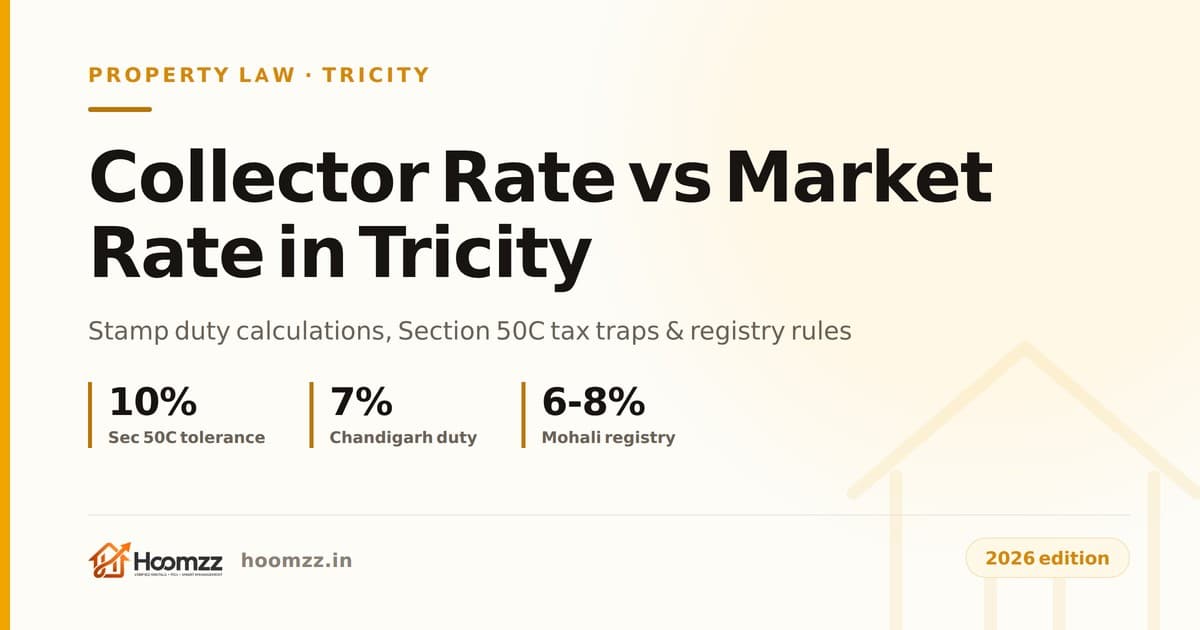
Collector rates define the statutory minimum valuation floor for property registration across Chandigarh, Mohali, and Panchkula. Understanding the gap between market value and circle rates protects buyers and sellers from sudden Section 50C income tax penalties.
Short answer: Collector rate is the statutory minimum floor valuation for property registration, while market rate is the negotiated transaction price. Stamp duty is levied on whichever figure is higher. Chandigarh UT charges 7% (6% stamp duty + 1% registration fee) uniformly across all buyers. Mohali (Punjab) charges 8% for men, 6% for women, and 7% jointly, with registration capped at ₹2,00,000. Panchkula (Haryana) charges 7% for men, 5% for women, and 6% jointly plus slab fees capped at ₹50,000. Under Section 50C and Section 56(2)(x), transactions priced below collector rates by over 10% trigger capital gains on the seller and income tax on the buyer for the deemed difference.
- 10%Safe harbor bandSection 50C tolerance limit
- 7%Chandigarh registry6% duty + 1% registration
- 2%Punjab woman rebateConcession on stamp duty
- ₹50kHaryana fee capMax registration charge
Every property deal across the Chandigarh Tricity encounters two competing numbers: what a buyer agrees to pay, and what the local revenue administration claims the property is worth. The first is the market rate. The second is the collector rate, commonly known across northern India as the circle rate.
While local real estate Instagram pages and creators are an active source of listings and area info for Tricity renters today, property transactions require strict statutory adherence to official circle rates. Under-declaring values to cut stamp duty triggers aggressive income tax scrutiny, double taxation under Section 50C and Section 56(2)(x), and deed impounding at the local tehsil. Hoomzz lists physically verified rentals across Chandigarh, Mohali, Panchkula and Zirakpur, helping residents avoid unverified broker quotations. This guide details how circle rates operate across Chandigarh UT, SAS Nagar district (Mohali, Kharar, Zirakpur), and Panchkula, how stamp duty is calculated, and how the Income Tax Act treats transactions registered near or below official circle rates in 2026.
Collector Rate vs Market Rate: The Core Legal Distinction
The collector rate is the statutory minimum benchmark established by the District Collector under state stamp rules. Below this floor price, the Sub-Registrar will not register a transfer deed without raising an undervaluation reference. The market rate is the actual monetary consideration settled between an independent seller and buyer, governed by open market forces.
In mature Chandigarh sectors (Sectors 8, 9, 33), market rates for kothis run well above circle rates. Conversely, in peripheral pockets along the Kharar bypass or VIP Road Zirakpur, administrative revisions can push circle rates close to distress prices.
The statutory rule across all three Tricity jurisdictions is identical: stamp duty and registration fees are calculated on the higher of the two figures. If a 2BHK flat in Mohali is purchased for an agreed market price of ₹65,00,000, but GMADA circle rate valuation calculates to ₹55,00,000, you pay stamp duty on ₹65,00,000. If you purchase a distressed property for ₹48,00,000 where the collector rate floor dictates ₹55,00,000, stamp duty is payable on ₹55,00,000.
Statutory Comparison Across Chandigarh UT, Punjab, and Haryana
The Tricity is divided between one Union Territory and two distinct states, each governed by separate revenue acts and stamp schedules. What applies at the Chandigarh Sector 17 Estate Office does not apply at the Mohali Sector 76 Tehsil or the Panchkula Sector 1 Sub-Registrar.
| Jurisdiction | Governing Revenue Authority | Official Online Valuation Portal | Stamp Duty (Male / Female / Joint) | Registration Fee | Maximum Fee Ceiling |
|---|---|---|---|---|---|
| Chandigarh UT | Chandigarh Administration (DC Office / Estate Office) | chandigarhdistrict.nic.in | 6% / 6% / 6% (Gender-neutral) | 1% flat | No statutory cap |
| Mohali, Kharar & Zirakpur (Punjab) | Punjab Revenue Department (SAS Nagar DC) | ngdrs.punjab.gov.in & sasnagar.nic.in | 7% / 5% / 6% (Includes 1% PSSF + 1% PRIDB cess) | 1% flat | Capped at ₹2,00,000 |
| Panchkula (Haryana) | Haryana Revenue & Disaster Management (HSVP limits) | jamabandi.nic.in & panchkula.gov.in | 7% / 5% / 6% (Urban Municipal limits) | Slab-based (₹100 to ₹50,000) | Capped at ₹50,000 |
1. Chandigarh UT: Flat Rates and Gender Neutrality
Chandigarh does not grant gender concessions. Whether registering in Sector 34 near the coaching hub or Sector 50, stamp duty is a flat 6% plus 1% registration fee (7% total). Chandigarh imposes no cap on registration fees: a ₹15,00,00,000 Sector 9 kothi incurs ₹15,00,000 in registration fees alone.
2. Mohali, Kharar and Zirakpur (Punjab): Cesses and Female Concessions
In SAS Nagar district, male buyers pay 7% stamp duty (5% base + 1% PSSF cess + 1% PRIDB cess). Women receive a 2% rebate, paying 5% stamp duty, or 6% jointly. Punjab caps the 1% registration fee at ₹2,00,000. When buying GMADA properties, review our guide on GMADA flat resale due diligence to audit transfer fees.
3. Panchkula (Haryana): Urban Slabs and Low Fee Ceilings
Panchkula urban sectors mandate 7% stamp duty for male buyers, 5% for female buyers, and 6% for joint ownership. Haryana implements a slab-based registration fee structure that maxes out at ₹50,000 for transactions exceeding ₹90,00,000, creating substantial fee savings compared to Chandigarh and Punjab.
Section 50C and Section 56(2)(x): The Double Tax Trap
When parties register a sale deed below the notified collector rate, the Income Tax Act, 1961 deploys anti-evasion mechanisms that penalize both seller and buyer simultaneously.
Under Section 50C, if a seller transfers property for consideration lower than stamp duty value (SDV), the assessing officer substitutes the circle rate as full consideration for capital gains tax. If an owner sells a plot in Kharar for ₹50,00,000 while circle rate valuation is ₹70,00,000, the seller is taxed on capital gains as if ₹70,00,000 was received.
Under Section 56(2)(x), if a buyer purchases property below stamp duty valuation, the shortfall is treated as a deemed gift. It is taxed as “Income from Other Sources” at slab rates. On the ₹50,00,000 Kharar plot valued at ₹70,00,000, the buyer pays income tax on the ₹20,00,000 gap, creating a liability exceeding ₹6,24,000.
Under the statutory tolerance band in Section 50C(1) and Section 56(2)(x), if stamp duty value does not exceed 110% of actual agreement consideration, no tax adjustment is triggered. If a Mohali flat sells for ₹1,00,00,000 with a circle rate of ₹1,08,00,000 (8% variance), the deal price is accepted with zero penalty. However, if circle rate is ₹1,15,00,000 (15% variance), the tolerance is breached: the seller pays capital gains on ₹1,15,00,000, and the buyer declares ₹15,00,000 as other taxable income.
When Price Meets or Exceeds Circle Rate
- Stamp duty is calculated on actual transaction price without dispute.
- Zero Section 50C exposure: capital gains computed on true proceeds.
- Zero Section 56(2)(x) addition: buyer faces no unexpected income tax.
- Smooth mortgage processing: home loans match documented sale deed values.
When Price Falls Below Circle Rate (>10% Gap)
- Sub-Registrar demands stamp duty strictly on higher circle rate.
- Seller pays punitive capital gains tax on phantom valuation under Section 50C.
- Buyer incurs income tax at personal slab rates on deemed variance.
- Requires protracted appeals before the Departmental Valuation Officer (DVO).
The Agreement Date vs Registration Date Safe Harbor: If circle rates rise between the formal Agreement to Sell (ATS) and deed registration, Section 50C allows you to benchmark against the collector rate applicable on the agreement date, provided part of the consideration was received through banking channels on or before the agreement date.
What if Circle Rates Exceed True Fair Market Value?
In certain Tricity pockets, circle rates can exceed market realities. For context on historical rate jumps, see our analysis on GMADA base rates in Mohali.
If you sell below circle rate due to defects or distress, you can request the Assessing Officer under Section 50C(2) to refer the valuation to a Departmental Valuation Officer (DVO). The DVO inspects the site and issues an independent report, replacing the circle rate up to fair market value.
Step-by-Step: Verifying Official Collector Rates Online in 2026
Never rely on verbal estimates from local property brokers when calculating your registration outflow. Every administration in the Tricity publishes its complete collector rate schedules online.
- Step 1: Identify your tehsil jurisdictionConfirm whether the property is governed by Chandigarh Sector 17 Sub-Registrar, SAS Nagar district (Mohali, Kharar, or Zirakpur), or Panchkula district.
- Step 2: Access the official revenue portalUse verified portals: chandigarhdistrict.nic.in for Chandigarh UT, ngdrs.punjab.gov.in or sasnagar.nic.in for Punjab, and jamabandi.nic.in for Haryana.
- Step 3: Calculate land and construction componentsReview rate tables for your sector, distinguishing between raw land value and built-up construction costs with floor adjustments.
- Step 4: Audit against Section 50C toleranceCompare proposed agreement price against calculated circle rate to ensure variance stays within the statutory 10% limit.
- Step 5: Process e-stamping and book slotPay fees via SHCIL or state e-GRAS modules and book a biometric slot. After registration, immediately initiate revenue record updates; see our guide on the Punjab property mutation (intiqal) process.
Impact on Renters, Landlords, and Property Yields
Collector rates also establish the baseline for commercial lease stamp duty and long-term registered tenancies across the Tricity.
For residential rentals, rents reflect tenant demand near employment hubs — such as Chandigarh IT Park, Aerocity Mohali, and the Sector 34 coaching cluster — rather than circle rates. Observed market rent ranges in 2026 span ₹8,000 to ₹14,000 per month for a 1BHK in Kharar near the CU campus, ₹16,000 to ₹26,000 per month for a 2BHK in Zirakpur along VIP Road, and ₹28,000 to ₹45,000 per month for a 3BHK builder floor in Mohali Sector 70 or 71. Parties must verify figures independently.
Tenants and landlords should keep two essential statutory realities in mind when finalizing tenancies:
- Security Deposit Legal Position: There is no statutory security-deposit cap anywhere in the Tricity. While a two-month cap was reported in mid-2026 under a Chandigarh notification implementing the Assam Tenancy Act, 2021, the Punjab & Haryana High Court stayed that notification on 29 May 2026. The East Punjab Urban Rent Restriction Act, 1949 still governs Chandigarh, while Panchkula follows the Haryana Urban Rent Act, 1973.
- Mandatory Police Verification: Tenant police verification is mandatory across Chandigarh UT and SAS Nagar district under District Magistrate orders under Section 163 of the Bharatiya Nagarik Suraksha Sanhita (BNSS). Landlords who fail to submit verification forms face prosecution.
To evaluate rental yields, registration costs, and affordability before entering the market, explore Hoomzz property calculators, browse Tricity neighborhood locations, or discover verified homes via verified rental listings in Tricity.
Frequently Asked Questions
What is the statutory legal requirement for stamp duty in Chandigarh UT vs Punjab vs Haryana?
In Chandigarh UT, stamp duty is a flat 6% plus 1% registration fee (7% total) for all buyers. In Mohali (Punjab), male buyers pay 7% duty plus 1% registration (8% total), while women pay 6% total, with registration capped at ₹2,00,000. In Panchkula (Haryana), urban rates are 7% for men, 5% for women, and 6% jointly, with registration capped at ₹50,000.
What happens under Section 50C if a property is registered below the collector rate?
When a transaction price falls below the circle rate by more than the 10% tolerance band, Section 50C taxes the seller on capital gains calculated on the higher circle rate. Concurrently, Section 56(2)(x) taxes the buyer on the shortfall as deemed income from other sources, creating double taxation on phantom value.
How can citizens verify official Tricity collector rates online without agent middlemen?
Citizens can verify rates online without broker fees. Access chandigarhdistrict.nic.in for Chandigarh UT, ngdrs.punjab.gov.in or sasnagar.nic.in for Mohali, Kharar, and Zirakpur, and jamabandi.nic.in for Panchkula. Each portal provides sector-wise and village-wise valuation schedules updated by local district administrations.
What is the 10% safe harbor tolerance band under the Income Tax Act?
The statutory 10% tolerance band under Section 50C(1) protects taxpayers from penalties when prices vary slightly from circle rates. If the stamp duty valuation does not exceed 110% of actual sale consideration, the agreed price is accepted as true valuation, triggering zero tax additions for either party.
Where can readers find verified calculators and property guides on Hoomzz?
Readers can access rental yield estimators, stamp duty breakdowns, and budget tools through the Hoomzz property calculators section. Hoomzz provides physically verified listings across Chandigarh, Mohali, Panchkula, and Zirakpur, eliminating fake broker quotes so buyers and tenants make verified decisions.
Sources, and what here is judgement rather than data
Statutory and Government Sources:
- Chandigarh District Administration: UT collector rate schedules, stamp duty rates (6%), and registration fees (1%).
- NGDRS Punjab Revenue Department: Mohali, Kharar, and Zirakpur valuation rules, female stamp duty concessions (5%), and fee caps.
- Jamabandi Haryana Land Records: Panchkula circle rate valuation tables, urban stamp duty rates, and maximum registration fee slabs.
- Income Tax Department of India: Statutory rules under Section 50C, Section 56(2)(x), and the 10% safe harbor tolerance band.
Editorial Judgement vs. Measured Data: Government fees, stamp duty percentages, tax section thresholds, and registration caps cited in this guide represent verified statutory data as enforced across Tricity sub-registrar offices in 2026. Conversely, assessments regarding broker negotiation tactics, discrepancies between reported circle rates and actual ground transaction premiums, and timing recommendations for registry appointments reflect editorial market judgement based on local property observations.
👈 This comparison is based on market observations and publicly available data. Users should verify details independently.
Prioritize Hoomzz Real Estate News in your Google Search AI Overviews
Google's new search update lets you select trusted sources. Pin hoomzz.in to get our instant local market rates, builder updates, and renting news featured first in your AI answers.
Need an Instant Rental Agreement?
Legally binding e-stamped agreements delivered in 15 mins with digital biometric tenant verification.