Property Mutation (Intiqal) Process in Punjab (2026): How to Transfer Revenue Records Online After Tehsil Registry

Registering a sale deed at the Tehsil office only legalises conveyance; it does not update the government Jamabandi records. Here is how property mutation (Intiqal) works in Punjab in 2026, including online PLRS tracking, statutory fees, and the difference between urban GMADA transfers and revenue land.
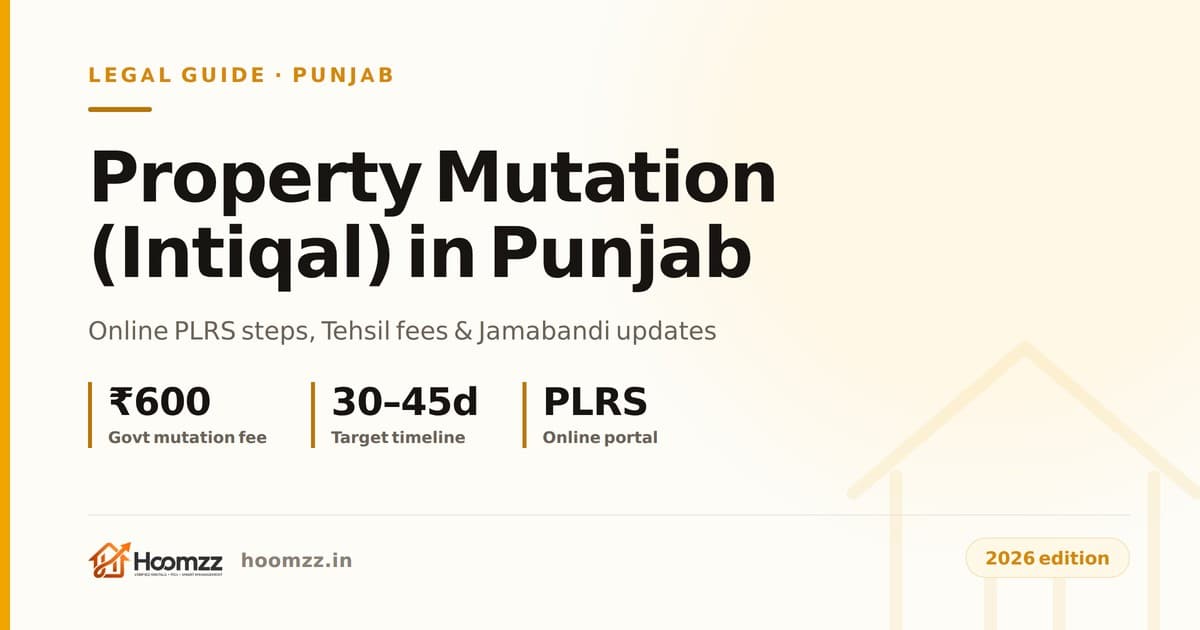
Short answer: In Punjab, registering a sale deed (Wasika) at the Sub-Registrar Tehsil office legalises property conveyance under the Registration Act, 1908, but does not update your ownership in government land records. You must complete a Property Mutation (Intiqal / Dakhil Kharij) under Sections 34–40 of the Punjab Land Revenue Act, 1887. The official government mutation fee is ₹600. Following registration, deed records link through NGDRS to the Punjab Land Records Society (PLRS) portal (jamabandi.punjab.gov.in). An uncontested mutation must be attested by the Circle Revenue Officer (Tehsildar or Naib Tehsildar) within 30 to 45 days under Punjab Right to Service timelines, officially updating the Jamabandi (Record of Rights) so you can obtain a clear computerized Fard.
- ₹600Statutory feeofficial Punjab mutation charge
- 30–45Days targetRight to Service timeline
- PLRSOnline portaljamabandi.punjab.gov.in
- 1887 ActGoverning lawPunjab Land Revenue Act
Across Sub-Registrar offices in SAS Nagar Mohali (Sector 76 District Administrative Complex), Kharar, and Zirakpur, buyers celebrate once the Sub-Registrar stamps their sale deed. They pay their deed writer and assume the transfer is finished. Months later, when applying for a construction loan or resale clearance, a bank advocate asks for the latest Fard Jamabandi. That is when buyers discover the revenue department still records the seller as the landholder.
While local real estate Instagram pages and creators are an active source of listings and area info for Tricity renters today, buyers face an information vacuum outside the Tehsil registration hall. Middlemen exploit this, demanding ₹5,000 to ₹10,000 for an Intiqal that carries a statutory ₹600 fee. Understanding how property mutation functions in Punjab, how the digital PLRS portal tracks it, and when you deal with the revenue department versus an urban development authority protects your legal rights and savings.
The golden rule of Punjab land records: Never buy land based purely on an Intiqal without inspecting the registered sale deed (Wasika), and never assume a registered deed protects you without verifying your name in the Jamabandi Fard.
Registry vs Mutation: Why Tehsil Registration Is Only Half the Job
When registering a sale deed at the Tehsil office, you execute a private conveyance contract under the Registration Act, 1908. The Sub-Registrar verifies identity, collects stamp duty and registration fees, records biometrics, and registers the deed (the Wasika). You can review our breakdown of property registration and Tehsil processes in Mohali, Kharar, and Zirakpur to understand stamp duty brackets and e-stamping mechanics.
However, the Sub-Registrar does not maintain public land registers. That duty falls under the Punjab Land Revenue Act, 1887, run by the Directorate of Land Records via the Halqa Patwari, Field Kanungo, and Circle Revenue Officer (Tehsildar or Naib Tehsildar). Mutation (Intiqal) is the administrative entry substituting the buyer’s name in place of the seller in state revenue records.
If you execute a registry but skip the Intiqal, the revenue department treats the seller as the ongoing owner. The seller could dishonestly pledge the land for loans, banks will reject mortgage applications lacking an updated Fard, and future heirs face broken title chains requiring civil litigation.
The Supreme Court Legal Position: Does Mutation Prove Title?
The Supreme Court of India has settled this question across landmark rulings, including Smt. Sawarni v. Smt. Inder Kaur (1996) 6 SCC 223 and Jitendra Singh v. State of Madhya Pradesh (2021).
The apex court has repeatedly held that mutation of a property in revenue records neither creates nor extinguishes title, nor does it carry presumptive value on title. Mutation is entered purely for fiscal purposes, enabling the state to identify who possesses the parcel and who pays land revenue and cesses.
Title flows exclusively from substantive legal instruments: a valid Registered Sale Deed, a court decree, a registered gift deed, or lawful inheritance. An illegal mutation entered by a dishonest Patwari cannot strip a legitimate owner of their title. Conversely, holding a registered deed without an Intiqal leaves you administratively stranded. You need both: the registered deed to prove ownership in court, and the sanctioned Intiqal to establish your fiscal standing in government records.
The Tricity Dual-Track System: GMADA Sectors vs Revenue Land
Before applying for an Intiqal, determine which administrative system governs your property:
Revenue Mutation (Intiqal) Applies
- Agricultural land across SAS Nagar, Kharar, and Dera Bassi tehsils
- Residential plots and colonies in Kharar, Sunny Enclave, and Landran
- Zirakpur societies built on revenue village Khasra numbers
- Peripheral villages and farmhouse land in New Chandigarh
- Properties tracked by Hadbast, Khewat, Khatauni, and Khasra numbers
Authority Property Transfer Applies Instead
- GMADA urban sectors (Sectors 50 to 82, Mohali)
- GMADA schemes: Aerocity, IT City, Eco City 1 & 2
- Purab Premium Apartments and GMADA group housing complexes
- HSVP sectors in Panchkula (MDC, Sectors 2 to 28)
- Chandigarh UT urban sectors governed by the UT Estate Office
In master-planned GMADA sectors, once land is acquired, agricultural Khasra numbers are extinguished and replaced with plotted site numbers. Ownership transfer after registry does not involve the Patwari or an Intiqal. Instead, you apply to the GMADA Estate Office at PUDA Bhawan, Sector 62, Mohali for a Re-allotment Letter / Transfer of Ownership. Read our guide on Mohali Tehsil registry processes, collector rates, and PUDA NOC rules to see how GMADA clearances operate.
In non-sectoral areas like Kharar, parts of Zirakpur, Dera Bassi, and peripheral villages, properties remain on active revenue estates governed by the Punjab Land Revenue Act, 1887.
Core Revenue Terms Every Buyer Must Understand
Interacting with the revenue department requires decoding traditional Punjabi terminology:
- Wasika (ਵਸੀਕਾ): The registered sale deed number issued by the Sub-Registrar during registry.
- Intiqal (ਇੰਤਕਾਲ): The mutation entry documenting the transfer of land rights in the mutation register (Register Intiqalat).
- Jamabandi (ਜਮ੍ਹਾਂਬੰਦੀ): The official Record of Rights (RoR) for a village, updated every four years, detailing ownership shares and mortgages.
- Fard (ਫ਼ਰਦ): A certified excerpt of the Jamabandi showing your specific parcel details, ownership fraction, and encumbrances.
- Khasra Girdawari (ਖਸਰਾ ਗਿਰਦਾਵਰੀ): The biannual harvest inspection register recording crop cultivation and possession.
- Parat Patwar & Parat Sarkar: Twin sheets of the mutation register. Parat Patwar remains with the Patwari; Parat Sarkar is archived at the Tehsil office once sanctioned.
Key Differences Across Land and Transfer Documents
| Document / Record | Governing Statute | Issuing Authority | Primary Function | Legal Consequence on Title |
|---|---|---|---|---|
| Registered Sale Deed (Wasika) | Registration Act, 1908 | Sub-Registrar | Conveys title between private parties | Conclusive proof of legal transfer |
| Mutation (Intiqal) | Punjab Land Revenue Act, 1887 | Circle Revenue Officer (Tehsildar) | Updates fiscal liability in revenue records | Fiscal entry; does not independently create title |
| Record of Rights (Jamabandi / Fard) | Punjab Land Revenue Act, 1887 | Halqa Patwari / PLRS Fard Kendra | Public register of ownership and liens | Presumption of truth under Section 44 |
| GMADA / HSVP Transfer Letter | Punjab Regional & Town Planning Act, 1995 | Estate Officer (GMADA / HSVP) | Updates urban allotment register | Establishes recognized allottee status |
Step-by-Step Online Mutation Workflow in Punjab (2026)
Punjab integrates NGDRS with the PLRS database. Here is how the workflow runs:
- Automatic deed data transmission via NGDRSImmediately after registration, NGDRS pushes the Wasika number, seller details, buyer details, and Khasra shares electronically to the PLRS database.
- Entry into the mutation register by the Halqa PatwariThe local Halqa Patwari receives the electronic alert and enters details into the mutation register (Register Intiqalat), verifying the seller holds clear title.
- Online tracking on the PLRS Jamabandi portalThe buyer visits jamabandi.punjab.gov.in. Under Online Services, select View Mutation (ਇੰਤਕਾਲ ਵੇਖੋ). Choose District, Tehsil, and Village, then search by Wasika number.
- Scrutiny and verification by the Field KanungoThe Field Kanungo inspects the Patwari’s entry, checks deed details against the previous Jamabandi, and signs off on the field verification report.
- Attestation and hearing by Circle Revenue OfficerThe Tehsildar or Naib Tehsildar reviews the file during public attestation. In uncontested cases, the officer sanctions the mutation (Manzoor Intiqal).
- Incorporation into Jamabandi and Fard generationOnce sanctioned, the order updates the live PLRS database. You can immediately obtain a computerized Fard with a scannable QR code online or at any Fard Kendra.
Filing a Manual or Inheritance (Virasat) Mutation Online
While routine sale deed mutations trigger automatically through NGDRS, manual applications are required for inheritance and older deeds:
- Open jamabandi.punjab.gov.in and choose Request for Mutation on the basis of Inheritance (ਵਿਰਾਸਤ ਦੇ ਆਧਾਰ ਤੇ ਇੰਤਕਾਲ ਲਈ ਬੇਨਤੀ) or Registered Deed.
- Enter applicant information, father’s name, and mobile number, then verify with OTP.
- Select District, Tehsil, and Village Hadbast.
- For inheritance, provide Khewat details, upload the municipal Death Certificate, and attach the registered legal heir affidavit (Shajra Nasab).
- Submit the form and record the Application Reference Number for tracking.
Government Fees and Timelines Under the Punjab Right to Service Act
The official government mutation fee in Punjab is ₹600 per mutation for registered deeds. Additional nominal facilitation charges (₹20 to ₹50) apply if you download certified Fard copies from a Sewa Kendra or Fard Kendra. Buyers who paid statutory registration charges (including stamp duty concessions where applicable, as covered in our guide to stamp duty concessions for women in Punjab, Haryana, and Chandigarh) do not owe any further revenue fees beyond the official ₹600 charge.
Under the Punjab Right to Service Act, statutory timelines govern uncontested revenue services:
- Uncontested Mutation Decision: The Circle Revenue Officer must decide and sanction an uncontested mutation within 30 to 45 days from registration.
- Certified Copy of Mutation / Fard: Delivered within 1 working day at any computerized Fard Kendra.
If your mutation remains pending past 45 days without a written legal dispute, file an appeal under the Right to Service Act before the Sub-Divisional Magistrate (SDM), who acts as the First Appellate Authority. A second appeal lies before the Deputy Commissioner (DC).
Contested (Tanaza) vs Uncontested (Bila-Taza) Mutation
When entering a mutation, the Patwari classifies the case into one of two streams:
1. Uncontested Mutation (Bila-Taza): The transaction involves a registered deed executed by the recorded owner, where the seller’s share matches the Jamabandi and no objection is filed. These follow the fast-track timeline and are attested routinely by the Naib Tehsildar.
2. Contested Mutation (Tanaza): An objection is raised during the notice period or at the hearing. Common triggers include co-sharers claiming pre-emption, conflicting wills in inheritance, or civil suits with active status quo orders. The Patwari enters the mutation in red ink. The Tehsildar conducts a summary inquiry, and if a title dispute exists, directs parties to a competent Civil Court.
What Every Tricity Buyer Must Do After Registry
Follow this post-registry checklist to keep your property records clean:
- Save your Wasika number: Record the registration number, book number, and volume number from the registered deed.
- Track on PLRS within 15 days: Check jamabandi.punjab.gov.in to confirm the Patwari has entered the mutation number.
- Inspect the preliminary entry: Ensure spelling, parentage, and Khasra numbers match the deed. Clerical errors can later be amended through a Fard Badar, but catching them early avoids delays.
- Download the sanctioned Fard: Once sanctioned, obtain a computerized Fard and store it with your original sale deed.
- Update municipal records: If the land lies within Municipal Corporation limits (such as Kharar MC or Zirakpur MC), submit your deed and sanctioned Intiqal to update property tax assessment records.
For buyers evaluating property costs and transaction budgets across the Tricity, explore our interactive tools on the Hoomzz real estate calculators page. Readers researching specific micro-markets can explore our comprehensive Tricity location directories. Hoomzz lists physically verified rentals across Chandigarh, Mohali, Panchkula, and Zirakpur with zero brokerage and direct landlord verification. Explore available homes on our Tricity verified rental listings directory.
Planning your property budget? Calculate stamp duty outgo, female co-ownership savings, and registration charges using verified local formulas on the Hoomzz calculators portal.
Frequently Asked Questions
What is the statutory legal requirement in Chandigarh UT vs Punjab vs Haryana?
In Punjab revenue estates (covering Kharar, Zirakpur, Dera Bassi, and peripheral villages), land transfers are governed by the Punjab Land Revenue Act, 1887, requiring an Intiqal entered by the Patwari and sanctioned by the Tehsildar to update the Jamabandi. In master-planned GMADA sectors across Mohali and HSVP sectors in Panchkula, traditional Jamabandi records do not apply; ownership records are transferred directly in the authority ledger via an official Transfer Letter. In Chandigarh UT, urban sector residential properties are governed by the Capital of Punjab (Development and Regulation) Act, 1952, where transfers are processed exclusively through the UT Estate Office.
How can citizens verify official records online without agent middlemen?
Citizens can verify land records online through the Punjab Jamabandi portal at jamabandi.punjab.gov.in. By choosing District, Tehsil, and Village, you can access the View Mutation service to monitor application progress, review quadrennial Jamabandi ownership details, inspect Khasra Girdawari entries, and download computerized Fard copies with verifiable QR codes. Registered deed details can also be checked on the NGDRS Punjab portal using your Wasika registration number.
What are the typical government fees and charges involved in 2026?
In Punjab, the official government mutation fee is ₹600 per mutation for standard property transfers based on a registered sale deed. Additional nominal charges of ₹20 to ₹50 apply for obtaining physical certified copies from a computerized Fard Kendra or Sewa Kendra. Citizens should not pay the ₹5,000 to ₹10,000 speed money often demanded by touts outside Tehsil offices, as uncontested mutations are legally mandated to be processed within statutory timelines.
Where can readers find verified calculators and property guides on Hoomzz?
Readers can access transparent real estate tools on the Hoomzz calculators route at hoomzz.in/calculators, including stamp duty estimators, unit measurement converters (such as Gaj, Marla, and Kanal), and rental yield calculators. Hoomzz lists physically verified rentals across Chandigarh, Mohali, Panchkula, and Zirakpur with zero brokerage and direct property verification.
Does an approved mutation (Intiqal) give me conclusive legal ownership of a property?
No, an approved mutation does not confer conclusive legal title to a property. The Supreme Court of India has established in multiple rulings (such as Smt. Sawarni v. Smt. Inder Kaur) that mutation entries in revenue records are maintained purely for fiscal purposes to collect revenue and do not create or extinguish ownership title. Legal title is established through valid conveyance instruments like a Registered Sale Deed, a registered gift deed, or a civil court decree.
What should a buyer do if the Patwari or Tehsildar does not sanction an uncontested mutation within 45 days?
If an uncontested mutation is delayed beyond the statutory 45-day window without a valid legal dispute or court stay, citizens can file an appeal under the Punjab Right to Service Act before the Sub-Divisional Magistrate (SDM), who serves as the First Appellate Authority. If the delay persists, a second appeal can be lodged with the Deputy Commissioner (DC). The Punjab Right to Service Commission can penalize delinquent revenue officials for unjustified delays.
Sources, and what here is judgement rather than data
This guide combines statutory provisions of Punjab revenue legislation with field observations from property transactions across SAS Nagar, Kharar, and Zirakpur. Statutory figures, procedural steps, and legal positions are derived from the following sources:
- Punjab Land Records Society (PLRS) Portal, confirming online mutation requests, mutation number search, and Jamabandi records
- Government of Punjab Official Portal, confirming revenue administration procedures and Sewa Kendra service delivery
- Supreme Court of India (Smt. Sawarni v. Smt. Inder Kaur, 1996 6 SCC 223), confirming that revenue mutation does not confer or extinguish property title
Editorial judgement versus statutory fact: The statutory fee of ₹600, the 30–45 day timeline under the Punjab Right to Service Act, and the legal non-presumptive nature of revenue entries under the Punjab Land Revenue Act, 1887 are established legal facts. The characterisation of informal speed money demanded by Tehsil middlemen (₹5,000 to ₹10,000) and the practical recommendation to inspect both the Wasika deed and the Fard Jamabandi before transacting represent editorial advice based on observed field practices in the Tricity property market.
👈 This comparison is based on market observations and publicly available data. Users should verify details independently.
Prioritize Hoomzz Real Estate News in your Google Search AI Overviews
Google's new search update lets you select trusted sources. Pin hoomzz.in to get our instant local market rates, builder updates, and renting news featured first in your AI answers.
Are You a Real Estate Builder?
Get genuine buyer trust & verified inquiries. Hoomzz onboards builders only after stringent RERA, legal & track-record audits.