Banur Real Estate & Growth Corridor (2026): Chitkara University, Warehousing Hub & Plot Rates

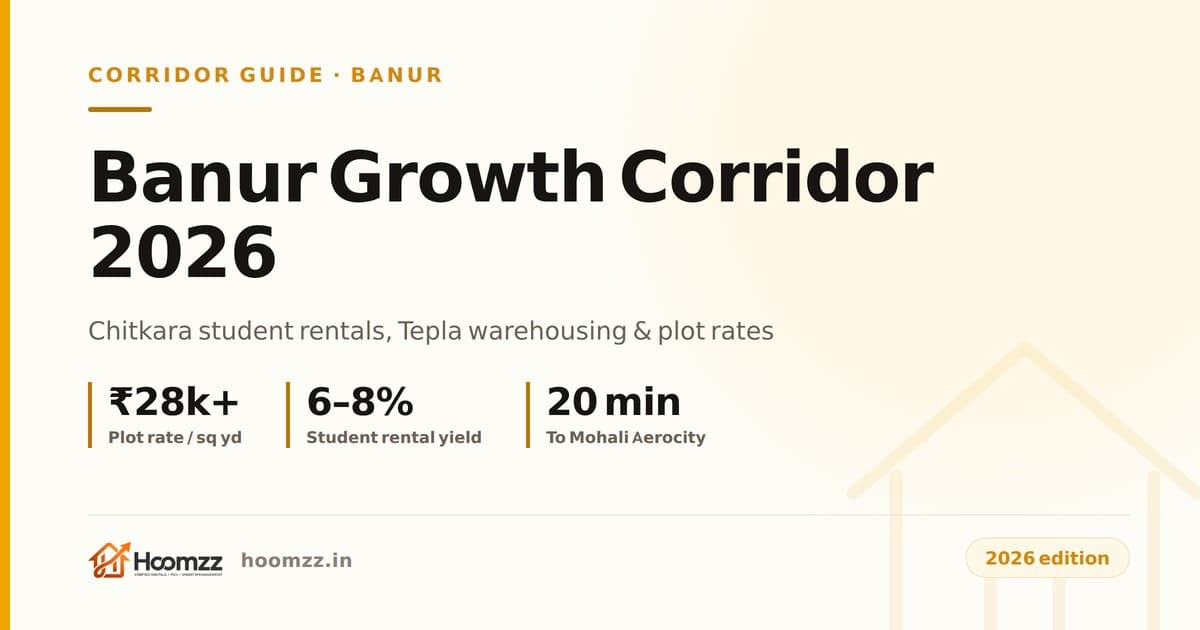
The Banur growth corridor combines NH-205A industrial warehousing with high-yield student housing near Chitkara University. Review 2026 plot rates, rental yields, and infrastructure trade-offs.
Short answer: The Banur growth corridor in SAS Nagar district has emerged as an active industrial and educational micro-market in 2026, anchored by Chitkara University on NH-7 and the 15-kilometer warehousing hub along the Banur–Tepla Road (NH-205A). Observed residential plot rates in approved layouts range from ₹28,000 to ₹38,000 per square yard, while industrial land trades at ₹1,400 to ₹2,500 per square foot. Student housing near the university commands gross rental yields of 6.0% to 8.5%, with 1BHK floors renting for ₹6,000–₹10,000 and 2BHKs at ₹11,000–₹16,000 per month. Key trade-offs include heavy freight transit on NH-205A, reliance on private borewells, and 2–3 months of student summer vacancy.
- ₹28k–38kResidential Plotsper sq yd observed
- 6.0–8.5%Student Yieldgross annual return
- ₹18–28Warehouse Leaseper sq ft monthly
- 20 minAerocity Commutevia PR7 extension
Positioned 25 kilometers southwest of Chandigarh, Banur has transformed into an active expansion belt in Greater Mohali. Sitting at the intersection of National Highway 7 (Chandigarh–Patiala) and National Highway 205A (Kharar–Banur–Tepla), Banur connects three distinct economic drivers: heavy industrial logistics along the Ambala corridor, institutional higher education centered on Chitkara University, and peripheral residential plotted colonies expanding out of Mohali.
Administratively, the town gained momentum when the Punjab Cabinet approved upgrading Banur from a sub-tehsil to a full tehsil within SAS Nagar district. This administrative change established a local sub-registrar office, enabling property buyers, logistics firms, and builders to register deeds, obtain revenue extracts, and resolve property demarcation locally without traveling to Mohali or Rajpura.
While local real estate Instagram pages and creators are an active source of listings and area info for Tricity renters today, social clips rarely unpack the industrial zoning classifications, heavy freight movement, or academic seasonality governing this belt. Investing in a residential plot, building student floors, or leasing warehouse space in Banur requires a clear understanding of infrastructure timelines, true rental returns, and municipal trade-offs.
The Warehousing Spine: Banur–Tepla Road (NH-205A)
The 15-kilometer stretch of NH-205A running south from Banur junction to Tepla (linking directly to NH-44 near Shambhu and Ambala) has developed into one of Northern India’s most concentrated logistics corridors. Third-party logistics (3PL) providers, e-commerce fulfillment centers, FMCG distributors, and pharmaceutical operators have set up regional distribution hubs along this highway.
Three core factors drove this industrial clustering:
- Direct Freight Arteries: Transport trucks moving goods between the Baddi–Barotiwala–Nalagarh industrial cluster in Himachal Pradesh and the Delhi NCR transit via Kharar, Banur, and Tepla without entering congested internal Tricity routes.
- Designated Industrial Master-Planning: The Punjab Department of Town and Country Planning earmarked broad sections along NH-205A for industrial and warehousing use, streamlining Change of Land Use (CLU) clearances for modern pre-engineered building (PEB) storage facilities.
- Organized Logistics Parks: RERA-approved industrial developments—such as the Mohali Industrial and Logistic Park (MILP) at Village Tepla and projects near Basma and Khedi Gurna—offer structured industrial plots ranging from 500 to 1,250 square yards with dedicated concrete internal roads.
Observed land rates for industrial-zoned plots along NH-205A range from ₹1,400 to ₹2,500 per square foot, depending on highway frontage and turning radius for multi-axle vehicles. Ready Grade-A warehouses featuring 10-meter to 12-meter clear heights, FM2 flooring, and automated dock levelers command monthly rentals of ₹18 to ₹28 per square foot on long-term corporate leases. For corporate tenants comparing regional logistics hubs with IT SEZ space in central Mohali, review our guide on commercial office leasing in Quark City Sector 74.
Fire Safety Compliance on NH-205A: Industrial expansion along the Banur–Tepla belt requires strict adherence to fire safety norms. Following major incidents such as the warehouse blaze near Khedi Gurna, municipal fire authorities enforce National Building Code (NBC) standards, including dedicated static water reservoirs, pressurized hydrant loops, and clear perimeter driveways for fire tenders.
Chitkara University Micro-Market: Student Housing & Rental Economics
While the southern road toward Tepla is dominated by freight transit, the corridor along NH-7 toward Rajpura is anchored by higher education. Chitkara University (Punjab Campus), located near Village Jhansla roughly 7 to 8 kilometers south of Banur town, accommodates over 15,000 undergraduate and postgraduate students, faculty members, and research staff.
Because on-campus student hostel capacity is limited, thousands of students seek off-campus accommodations in Banur town, Jhansla, and adjacent residential clusters. This demographic has created an active rental micro-market centered around independent builder floors, studio units, and managed paying guest (PG) accommodations.
Rental rates around Banur vary based on furnishing, highway bus access, and power backup provisions:
- Studio / 1BHK Independent Floors: Observed rents range from ₹6,000 to ₹10,000 per month for semi-furnished or furnished units, often shared by two students.
- 2BHK Builder Floors & Flats: Command observed rents of ₹11,000 to ₹16,000 per month, typically split among three to four student flatmates.
- 3BHK Floors & Kothis: Rent for ₹16,000 to ₹24,000 per month, catering to faculty families or senior student groups.
- Student PG Beds (with Food & WiFi): Range from ₹6,500 to ₹9,500 per bed per month for twin or triple sharing rooms.
Central Tricity residential properties in Sector 9 Chandigarh or Phase 7 Mohali typically generate gross rental yields between 2.2% and 3.2%. In contrast, residential builder floors in Banur built specifically for student occupancy deliver observed gross rental yields of 6.0% to 8.5%, driven by lower capital acquisition costs and high tenant density per square foot.
However, landlords must account for academic seasonality. Between mid-June and early August, when university semesters conclude, occupancy drops sharply. Landlords who do not structure 11-month non-cancellable student leases experience annual rental leakage of 15% to 20%. Property owners planning to build or convert residential property for student housing should review our analysis of converting residential floors to student rentals for practical compliance steps under Punjab municipal rules.
Residential Plotted Developments: Land Rates & Sizing (2026)
Outside the student housing pocket, Banur has attracted private developers rolling out gated plotted townships along the Banur–Landran Road and the NH-7 frontage. These colonies target end-users and investors seeking land within 20 to 25 minutes of Mohali’s IT City and Aerocity, at pricing well below GMADA sector rates.
Observed residential plot rates in 2026 break down as follows:
- Approved Gated Townships: In RERA-registered and PUDA-approved plotted projects with paved roads, underground drainage, and street lighting, plot rates range between ₹28,000 and ₹38,000 per square yard (roughly ₹3,100 to ₹4,200 per square foot).
- Standard Plot Sizing: Typical residential plots measure 100 gaj (900 sq ft), 150 gaj (1,350 sq ft), 200 gaj (1,800 sq ft), and 250 gaj (2,250 sq ft). For precise calculations on traditional land measurements and municipal building coverage, check our guide on 225 gaj plot conversions and GMADA setback norms.
- Unapproved Agricultural Parcels: Raw land parcels in unauthorized subdivisions sell at lower ticket sizes (₹14,000 to ₹20,000 per square yard). However, purchasing unapproved plots carries severe legal risks: Punjab state authorities strictly withhold registry execution and electricity connections without official PUDA regularisation NOCs.
Observed Market Metrics: Banur Corridor Comparison Table
The table below summarizes observed real estate values, yields, and operating characteristics across the three primary micro-zones in the Banur corridor for 2026:
| Micro-Zone | Primary Property Type | Observed Capital Values | Observed Rental Rates / Yield | Key Infrastructure Driver |
|---|---|---|---|---|
| Banur Town & Landran Road | Approved residential plots & independent floors | ₹28,000–₹38,000 per sq yd (plots) | ₹11,000–₹16,000 / mo (2BHK floor); 3.8%–4.5% yield | Tehsil status upgrade, direct road link to IT City Mohali |
| Banur–Tepla Road (NH-205A) | Industrial land, logistics parks & PEB warehouses | ₹1,400–₹2,500 per sq ft (industrial land) | ₹18–₹28 per sq ft / mo (warehouse lease); 8.0%–10.5% yield | Heavy freight bypass connecting BBN cluster and NH-44 Ambala |
| Jhansla & Chitkara Periphery | Student apartments, studio floors & PGs | ₹2,800–₹3,600 per sq ft (built residential) | ₹6,500–₹9,500 / bed (PG); 6.0%–8.5% gross student yield | 15,000+ student and faculty base at Chitkara University campus |
Arterial Highway Connectivity and Commute Times
Banur’s strategic value rests on its highway grid. Unlike inner Tricity sectors constrained by 40 km/h urban speed limits and frequent traffic signals, Banur connects directly to high-speed four-lane and six-lane bypass routes.
Typical commute times from Banur junction to regional employment and transit hubs include:
- Mohali Aerocity & International Airport (18–22 km): 20 to 25 minutes via the PR7 Airport Road extension and NH-7.
- IT City Mohali & Sector 82 Industrial Area (16–19 km): 18 to 22 minutes via the Landran–Banur link or Airport Road arterial.
- Chandigarh Tribune Chowk (28–32 km): 35 to 45 minutes via NH-7 through Zirakpur or the secondary Aerocity ring corridor.
- Rajpura Junction Railway Station (14–16 km): 15 to 20 minutes south along NH-7, providing direct rail connections to Delhi and Amritsar.
- Tepla / NH-44 Junction (14–16 km): 15 to 20 minutes south along NH-205A for freight headed toward Delhi.
Evaluating Banur: Strategic Advantages vs Ground Realities
Investing or living in Banur requires balancing attractive entry prices and high rental yields against noticeable infrastructure gaps.
Works Well If You:
- Seek gross rental yields above 6% by catering to student demand from Chitkara University.
- Require industrial plots or warehousing sheds with direct freight access to NH-44 and NH-7.
- Want an approved residential plot under ₹40,000 per square yard within 25 minutes of Mohali Aerocity.
- Are a logistics operator needing 24/7 heavy commercial vehicle access free from urban city entry curfews.
Look Elsewhere If You:
- Expect immediate access to tertiary multi-specialty hospitals, international schools, or multiplex retail.
- Dislike heavy diesel truck transit, roadside dust, and freight movement on your daily commute.
- Rely on treated municipal surface canal water; Banur properties depend heavily on deep borewells.
- Cannot absorb two months of student summer rental vacancy across June and July.
Legal Tenancy Framework, Security Deposits and Police Verification
Renting residential or commercial property in Banur falls under specific Punjab state regulations:
1. Governing Rent Legislation: Tenancies in Banur are governed by the East Punjab Urban Rent Restriction Act, 1949, under SAS Nagar district jurisdiction. The Punjab Rent Act, 1995 provides supplementary statutory procedures for urban leases. There is no statutory security deposit cap in Punjab; standard market practice involves one to two months of rent deposited in advance, refundable upon lease termination.
2. Mandatory Tenant Police Verification: Under standing preventive orders issued by the SAS Nagar District Magistrate under Section 163 of the Bharatiya Nagarik Suraksha Sanhita (BNSS), tenant police verification is strictly mandatory for every landlord. Given the high influx of outstation students at Chitkara University, the Banur Police Station and local Saanjh Kendras conduct regular tenant record audits. Non-compliant property owners face statutory penalties.
3. Transparent Lease Execution: Hoomzz provides transparent information on lease agreement documentation, stamp paper requirements, and tenant verification steps. Hoomzz does not provide online rent agreement signing or digital payment processing, as digital lease payments remain in test mode behind administrative controls. Lease agreements must be executed on physical stamp paper directly between landlords and tenants.
Six-Point Due Diligence Checklist for Buying or Renting in Banur
Before putting down token money on a plot, apartment, or warehouse facility in Banur, execute these checks:
- Verify PUDA and RERA ApprovalsConfirm that the residential plotted township or industrial park possesses a valid RERA Punjab registration number and a formal PUDA Change of Land Use (CLU) order.
- Inspect Highway Access and Road WidthEnsure the approach road provides at least 35 to 40 feet of clear right of way, especially if developing warehouse space or parking for student two-wheelers.
- Check Power Substation CapacityIndustrial sheds and multi-unit student PGs require high-load three-phase connections from PSPCL; verify transformer capacity and ensure generator backup is planned.
- Structure 11-Month Student LeasesWhen leasing to university students, execute formal 11-month non-cancellable agreements that cover summer break months to safeguard annual yields.
- Test Groundwater Quality & SupplyBanur relies primarily on tubewells. Test water hardness, TDS levels, and verify that the property includes adequate overhead storage tanks.
- Complete Police Verification at Local Saanjh KendraSubmit complete Aadhaar cards, permanent address proofs, and university enrollment cards to the Banur Saanjh Kendra within two weeks of move-in.
Hoomzz lists physically verified rentals across Chandigarh, Mohali, Panchkula and Zirakpur. Explore verified properties with zero brokerage on rent properties in Tricity, evaluate purchase options on buy properties in Tricity, or browse neighboring corridors on the Tricity locations directory to compare micro-market yields and commute realities.
Frequently Asked Questions
Why has the Banur–Tepla corridor become a major warehousing hub in the Tricity region?
The Banur–Tepla road (NH-205A) provides direct freight connectivity linking the Baddi industrial belt in Himachal Pradesh and Punjab manufacturing clusters to NH-44 at Ambala without entering congested urban Tricity roads. Favorable industrial zoning, rapid Change of Land Use (CLU) approvals by the Punjab government, and affordable land rates have attracted national 3PL, e-commerce, and FMCG logistics operators to set up Grade-A distribution hubs along this 15-kilometer highway spine.
What are the observed property rates for residential plots in Banur in 2026?
In 2026, observed property rates for residential plots in PUDA-approved and RERA-registered townships in Banur range from ₹28,000 to ₹38,000 per square yard. Pricing depends heavily on road width, internal park amenities, and proximity to the NH-7 or Banur–Landran highway corridors. Unapproved agricultural sub-colonies sell for lower prices but lack legal registry permissions and municipal utility connections.
What rental yields do student housing properties generate near Chitkara University?
Residential builder floors and student PGs near Chitkara University in Banur and Village Jhansla generate observed gross rental yields of 6.0% to 8.5% per annum, compared to 2.5% to 3.5% in central Chandigarh or Mohali. This higher return is driven by strong student demand and multi-tenant occupancy. However, landlords must manage a 15% to 20% annual vacancy risk during the two-month summer academic break between semesters.
What are the typical commute times from Banur to Mohali Aerocity, IT City, and Chandigarh?
Driving from Banur junction to Mohali Aerocity and the Chandigarh International Airport takes approximately 20 to 25 minutes (18–22 km) via the PR7 Airport Road extension and NH-7. Commutes to IT City Mohali and Quark City in Sector 74 take 20 to 28 minutes, while reaching central Chandigarh (Tribune Chowk) requires 35 to 45 minutes during normal traffic hours.
What tenancy laws and police verification rules apply to rental properties in Banur?
Tenancies in Banur fall under the jurisdiction of SAS Nagar district and are governed by the East Punjab Urban Rent Restriction Act, 1949. There is no statutory two-month security deposit cap in Punjab, with one to two months of rent standard in local practice. Tenant police verification is strictly mandatory under preventive orders issued by the SAS Nagar District Magistrate and is processed through the Banur Police Station or local Punjab Police Saanjh Kendra.
Sources, and what here is judgement rather than data
Measured Data & Regulatory Reporting: Highway routes, distances, and drive times between Banur, Chitkara University, Tepla, and Mohali Aerocity were verified using official road maps. Administrative upgradation and regional commercial infrastructure are documented in authoritative local coverage:
- The Tribune: Punjab Cabinet clears governance reforms, Banur upgraded to tehsil (details on local revenue administration, sub-registrar offices, and citizen services).
- The Tribune: Project Watch — Mohali Industrial and Logistic Park (MILP) (reporting on RERA-approved industrial logistics parks and warehouse plot sizing on Banur–Tepla Road).
- The Tribune: Massive fire destroys warehouse near Khedi Gurna on Banur-Tepla highway (logistics concentration and fire safety compliance realities along NH-205A).
Editorial Judgement & Estimates: Property price ranges (residential plots at ₹28,000–₹38,000 per sq yd; industrial land at ₹1,400–₹2,500 per sq ft; student rents at ₹6,000–₹16,000) reflect observed asking rates across active market listings in 2026. Gross rental yield projections (6.0%–8.5%) assume 10 to 11 months of active student occupancy. Observations regarding truck transit dust, borewell dependency, and summer vacancy patterns represent qualitative market assessments.
👈 This comparison is based on market observations and publicly available data. Users should verify details independently.
Prioritize Hoomzz Real Estate News in your Google Search AI Overviews
Google's new search update lets you select trusted sources. Pin hoomzz.in to get our instant local market rates, builder updates, and renting news featured first in your AI answers.
Looking to Buy or Invest?
Access verified luxury kothis, plots & high-ROI commercial properties with clean clear titles in Tricity.