Share-wise sale in Chandigarh (2026): what still registers, and why you can't buy a floor


Share-wise registry in Chandigarh has been frozen since Feb 2023: outsiders can buy only 100% of a house, shares move only within a family, and the Supreme Court upheld it in July 2026.
Short answer: As of September 2026 you cannot register the purchase of a part share of a Chandigarh house from someone outside your family. Since 10 February 2023 the UT Estate Office has allowed only two kinds of residential transfer. One is any transfer within a family, whatever the share. The other is the purchase of the whole (100%) property by one person or by members of one family. A sale by floor was never permitted. Private agreements that assign floors among co-owners are neither registrable nor enforceable. The Supreme Court upheld these curbs in July 2026. CHB flats are not affected.
- 10 JanSupreme Court judgment2023, Phase I apartmentalisation
- 100%Only share an outsider can buyEstate Office notice, 10 Feb 2023
- 80–100Share deals a month before the freezeas reported, Dec 2025
- ₹40 CrStamp duty lost a yearreported estimate
For about fifteen years, the most common way to “buy a floor” in a Chandigarh sector was not to buy a floor at all. A developer bought an old kothi, knocked it down and built three storeys. He then sold three undivided shares in the house, typically 50%, 30% and 20%, to three unrelated buyers. A separate memorandum of understanding (MoU) quietly gave the 50% holder the ground floor and basement, the 30% holder the first floor and the 20% holder the second floor. The deed said “share”. The brochure said “independent floor”.
That arrangement is what the Supreme Court stopped in January 2023, and it has not come back. If a dealer in 2026 offers you “first floor, Sector 21, share-wise registry”, this is what you need to know first.
What the Supreme Court actually decided
The case is Resident’s Welfare Association & Anr v. Union Territory of Chandigarh & Ors, decided on 10 January 2023 by Justices B.R. Gavai and B.V. Nagarathna. It reversed a Punjab and Haryana High Court judgment of November 2021 that had tolerated the practice.
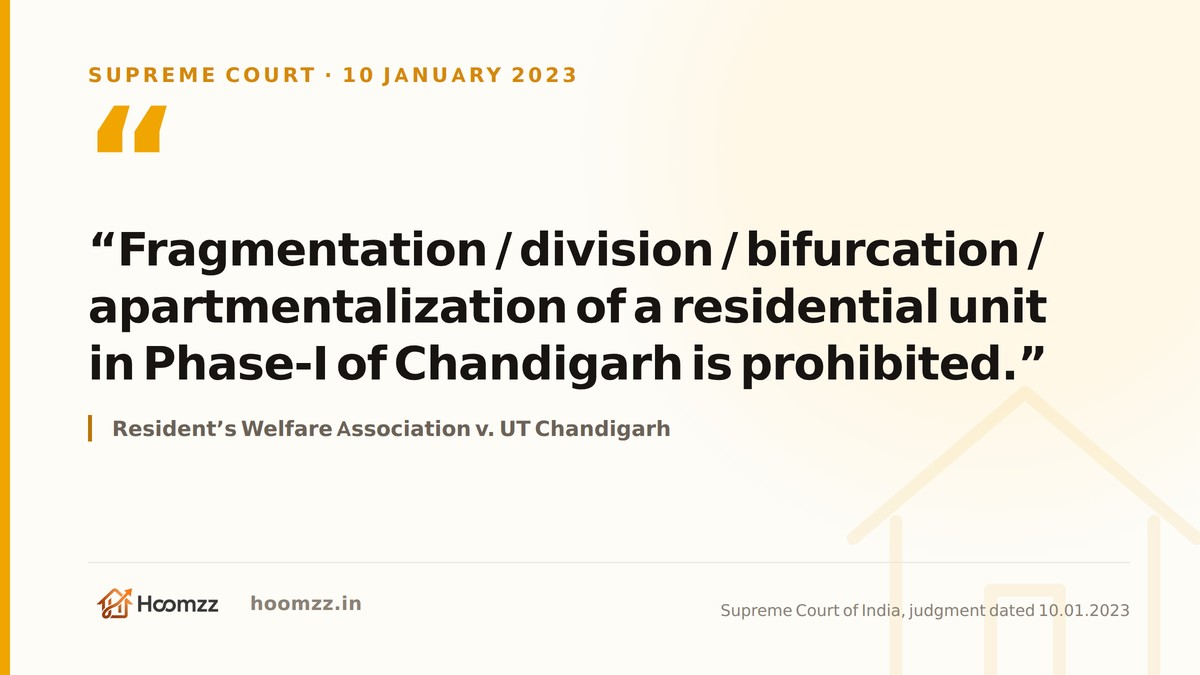
The court read the Chandigarh Estate Rules, 2007 together with the repeal of the Chandigarh Apartment Rules, 2001. Rule 16 of the Estate Rules says no fragmentation or amalgamation of any site or building shall be permitted. On that basis the court held that fragmentation, division, bifurcation or apartmentalisation of a residential unit in Phase I is prohibited. Phase I means the heritage sectors, Sectors 1 to 30.
Two nuances matter, and dealers tend to blur both.
- The court did not ban co-ownership. It recorded the Administration’s own position that there is no bar on transferring a share, and that floor-wise sale was never permitted. It then found that apartmentalisation was being done indirectly, through the sale of shares plus MoUs. It also said three co-sharers deciding to build a house for themselves is a different matter.
- It went after the MoU. Until the Central Government decides on the Heritage Committee’s recommendations, no MoU, agreement or settlement dividing a house floor-wise among co-owners may be registered, and none is enforceable in law. No building plan that plainly turns one dwelling into three flats for three strangers may be sanctioned either.
The judgment also froze floor area ratio. It capped Phase I houses at three floors with a uniform maximum height. And it barred any new rules or bye-laws on this without the Heritage Committee and the Centre.
The “one-family” rule: what registers in 2026 and what does not
Share-wise registration was put on hold within days of the judgment. On 10 February 2023 the Deputy Commissioner-cum-Estate Officer issued a public notice for residential properties in UT Chandigarh. The notice covers the whole city, not only Sectors 1–30, and the Deputy Commissioner confirmed at the time that it applied to the entire city. It remains the rulebook.
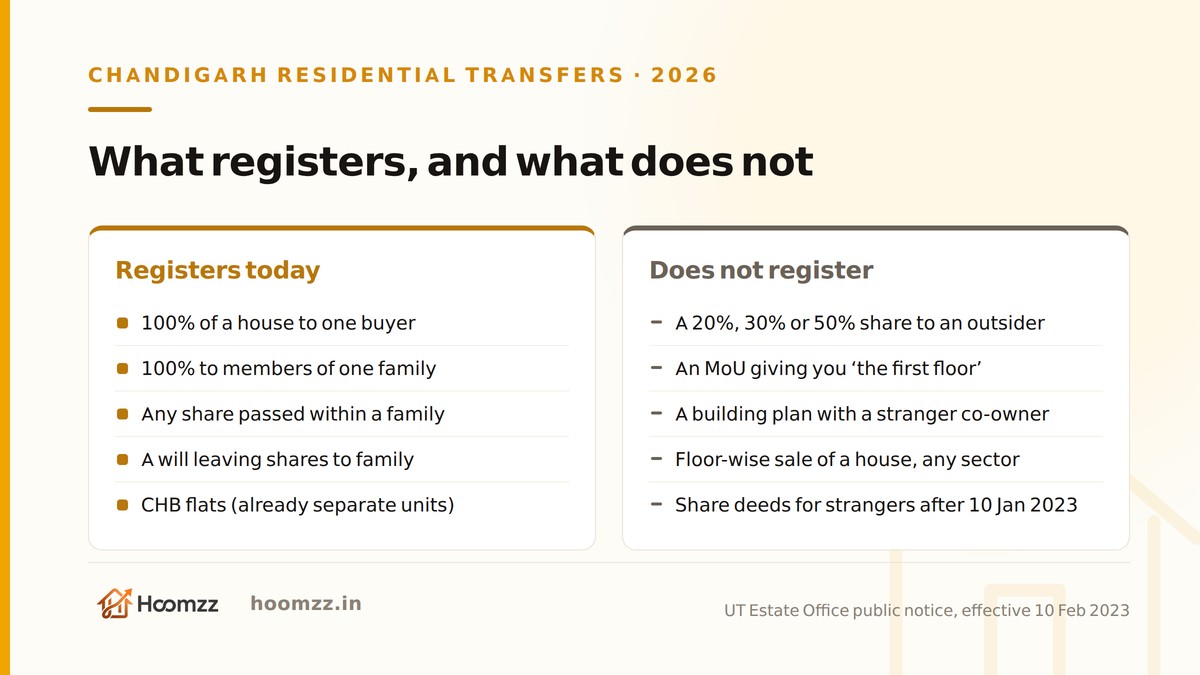
| Transaction | Registered and mutated? | Note |
|---|---|---|
| Whole house (100%) bought by one person | Yes | Even if the sellers are unrelated co-owners |
| Whole house (100%) bought by several members of one family | Yes | The buyers must be one family |
| Any share transferred within a family (sale, transfer, gift) | Yes | Irrespective of the share held |
| Will or intestate succession within a family | Yes | Bequests of shares only to family members are considered |
| A 20%, 30% or 50% share sold to an outsider | No | Held for the Heritage Committee / Centre; not being registered |
| MoU allotting floors among co-owners | No | Not registrable and not enforceable (Supreme Court, 2023) |
| Building plan with a “stranger” co-owner | No | Plans are processed only if all co-owners are one family |
| Share deeds registered on or before 10 January 2023 | Mutated | Deeds up to the judgment date are recognised |
| CHB flats; apartments approved under the 2001 Apartment Rules | Not affected | These are separate apartments already |
Has anything changed since 2023? The timeline
Almost four years of lobbying, litigation and meetings have not reopened share-wise registration. Here is the sequence, so you can judge any “it’s opening next month” claim yourself.
| When | What happened |
|---|---|
| 10 Jan 2023 | Supreme Court judgment on Phase I apartmentalisation |
| 18 Jan 2023 | Deputy Commissioner tells registration staff to implement it; share-wise registration put on hold |
| 10 Feb 2023 | Estate Office public notice: the one-family rule, citywide |
| 10 May 2023 | Heritage Committee: no need for further re-densification of Phase I; share questions left to the Administration |
| Sep 2023 | Heritage Committee repeats that the Administration can decide share-wise registration itself |
| Aug 2024 | MP Manish Tewari tells the Lok Sabha the Supreme Court never banned share-wise sale, and asks for the notice to go |
| Feb 2025 | High Court Division Bench upholds the notice; says the Administration may consider allowing sales of shares to other co-sharers |
| Aug 2025 | Ministry of Home Affairs asks the UT for its stand on share-wise sale |
| Dec 2025 | UT officials take the issue to the MHA; freeze reported at nearly three years |
| Mar 2026 | UT Administrator asks officials to examine reopening Sectors 31–47 and beyond 47, keeping 1–30 closed (a proposal only) |
| 16 Jul 2026 | High Court upholds a Sub-Registrar’s refusal to register the sale of a 20% share of a Sector 28-D house |
| 24 Jul 2026 | Supreme Court dismisses appeals against the February 2025 High Court ruling, calling it legally correct |
| 7 Aug 2026 | Centre’s status report, relayed to MP Tewari, describes the co-owner share-sale demand as legally deadlocked |
The March 2026 proposal to reopen the non-heritage sectors is the one to watch. It would not help buyers in Sectors 1–30, and we found no notification putting it into effect. Until one exists, treat share registration as closed in every sector.
An MoU is not a floor. If you pay for “the first floor” and receive a 30% share deed plus an MoU, you own 30% of the whole building, not a floor. The Supreme Court said such MoUs are not enforceable. If the co-owners fall out, a court cannot divide the house by floors. The practical remedy is to sell the whole property and split the money by share, and after 2023 even selling your share on is blocked unless it goes to family or the entire house is sold at once.
If you already own a share: your realistic options
Thousands of Chandigarh families bought shares before January 2023 and now cannot sell them on the open market. The options narrow to these:
- Sell the whole house togetherAll co-owners sell 100% to one buyer or to one family. This registers today, even though the sellers are unrelated.
- Sell to, or buy out, the other co-sharersThe High Court said in 2025 that the Administration may consider permitting this. It is a possibility, not a settled right, so check with the Estate Office first.
- Keep it in the familyGifts, sales and wills to family members register irrespective of the share held.
- Get your mutation on recordIf your deed was registered on or before 10 January 2023, make sure the Estate Office has mutated it. That is your strongest document.
- Watch for a notification, not a news reportOnly a published order from the Administration reopens registration. A proposal or a meeting agenda does not.
If you are buying in Chandigarh in 2026
- Buy 100% or do not buy. If the seller holds only a share, the deal needs every co-owner to sell the whole house to you.
- Read the chain of title, not the brochure. Check every deed back to the allotment, and check that each one was mutated. A share deed registered after 10 January 2023 in the chain is a red flag.
- Match the building to the sanctioned plan. A three-storey house with three kitchens and three electricity meters in Phase I was probably built for sale as flats. Ask for the sanctioned plan and the occupation certificate.
- Confirm tenure. Freehold or leasehold changes what the Estate Office must approve. See our guide to freehold vs leasehold property in Chandigarh and the 2026 conversion rules.
- Clear the civic dues. Ask for every property tax receipt since 2015-16. Our Chandigarh property tax guide for 2026-27 explains the bill and what arrears do at registry.
- Ask your lender in writing. We found no published bank policy on share-wise Chandigarh property. Get the bank’s view before paying any token money on anything other than a 100% purchase.
For the full pre-purchase paperwork list, see our documents to check before buying a flat in the Tricity.
Why Mohali and Panchkula are different
The Chandigarh restriction comes from its heritage status and its Estate Rules. It does not travel across the border.
- Panchkula (Haryana). Since 2021, HSVP rules have allowed two, three or four floors on an HSVP plot to be registered as separate dwelling units. The division must be horizontal, the floor owners jointly own the plot, 1% extra stamp duty applies, and HSVP’s prior permission is required.
- Mohali, Zirakpur and Kharar (Punjab). Independent floors are widely sold. Punjab notified Unified Building Rules in December 2025 allowing stilt-plus-four floors in new residential areas. Reports described this as paving the way for an apartment law that would let people buy separate floors, because subdividing land is not otherwise permitted. How a particular floor is conveyed depends on the project, so check the builder’s RERA registration and the exact deed before you pay.
If you want a floor of your own rather than a share of someone else’s house, the Tricity outside Chandigarh is where that market legally lives. Our comparison of builder floors vs gated society flats in Mohali and Zirakpur covers the trade-offs. Hoomzz lists verified properties for sale across Chandigarh, Mohali, Panchkula and Zirakpur, and every listing states what is actually being sold. Browse properties for sale in the Tricity on Hoomzz.
Frequently Asked Questions
Is share-wise sale of property allowed in Chandigarh in 2026?
Not to outsiders. Under the Estate Office notice effective 10 February 2023, a share of a Chandigarh residential property can be transferred only within a family. Anyone outside the family can buy only the whole (100%) property. The Punjab and Haryana High Court upheld the notice in February 2025, and the Supreme Court dismissed appeals against that ruling in July 2026.
Can I buy a separate floor of a house in Chandigarh?
No. Floor-wise sale of a residential house has never been permitted in Chandigarh, and Rule 16 of the Chandigarh Estate Rules, 2007 bars fragmentation of any site or building. The Supreme Court held in January 2023 that MoUs allotting floors among co-owners are neither registrable nor enforceable. A buyer who wants a separate registered floor should look at Panchkula or Punjab-side projects, where floors are sold as units.
Does the share-wise sale ban apply only to Sectors 1 to 30?
The Supreme Court’s prohibition on apartmentalisation concerns Phase I, Sectors 1 to 30. However, the Chandigarh Estate Office notice of 10 February 2023 applies to residential properties across the whole UT, and the Deputy Commissioner confirmed it covered the entire city. A March 2026 proposal to reopen Sectors 31 onwards had not been notified by September 2026.
Are CHB flats affected by the share-wise sale restriction?
No. The 10 February 2023 Estate Office notice expressly excludes residential apartments under the Chandigarh Housing Board, and apartments approved under the Chandigarh Apartment Rules, 2001. These are already separate units. CHB flats have their own transfer rules and charges, and tenure should still be checked flat by flat.
I bought a share before January 2023. Is my purchase still valid?
Share deeds registered on or before 10 January 2023 are recognised, and the Estate Office notice says they will be mutated. Make sure yours has been. The difficulty is selling. After 2023 a share can move only within a family, or as part of a sale of the entire property by all co-owners to one buyer or one family.
Sources, and what here is interpretation rather than a ruling
Checked facts. The holdings and directions are from the Supreme Court judgment text. The transfer rules are from the Estate Office public notice. Events after 2023 are from the reports listed below.
- Supreme Court, Resident’s Welfare Association & Anr v. UT Chandigarh, 10 January 2023 (full text)
- Estate Office, Chandigarh: public notice effective 10 February 2023
- The Tribune, 10 February 2023: the one-family rule applies to the entire city
- The Tribune, May 2023: Heritage Committee rejects further re-densification
- The Tribune, 23 February 2025: High Court upholds the notice
- The Tribune, 8 December 2025: 80–100 deals a month and about ₹40 crore a year before the freeze
- Hindustan Times, 6 March 2026: proposal to reopen Sectors 31 onwards
- The Tribune, 16 July 2026: High Court upholds refusal to register a 20% share
- The Tribune, 24 July 2026: Supreme Court upholds the 2023 curbs
- The Tribune, 7 August 2026: the share-sale demand remains legally deadlocked
- The Tribune, July 2021: HSVP floor-wise registration rules
- The Tribune, December 2025: Punjab Unified Building Rules
Where sources disagree. One July 2026 report describes the curbs as applying to Phase I. The notice text and the Deputy Commissioner’s 2023 statement say the whole city, and this article follows the notice. An August 2026 report says the High Court ruling was still under challenge. That appears to predate the Supreme Court’s 24 July dismissal.
Interpretation, not a ruling. The buying checklist and the reading of the “three kitchens” red flag are editorial judgement. This is general information, not legal advice. For a specific file, take advice from a lawyer who practises before the Chandigarh Estate Office.
👈 This comparison is based on market observations and publicly available data. Users should verify details independently.


Prioritize Hoomzz Real Estate News in your Google Search AI Overviews
Google's new search update lets you select trusted sources. Pin hoomzz.in to get our instant local market rates, builder updates, and renting news featured first in your AI answers.