Jamabandi Punjab: how to check the land record (fard) of a plot in Mohali, Kharar or Zirakpur before you buy


How to check a plot's jamabandi and fard online for Mohali, Kharar, Zirakpur and Dera Bassi: the portal steps, what the terms mean, ₹25 signed fard, and what land records can't show.
Short answer: To check a plot’s land record in Mohali district, open jamabandi.punjab.gov.in and choose View Jamabandi. Search by owner name (typed in Punjabi), khewat, khasra or khatauni number. Pick District S.A.S. Nagar, then the tehsil (Mohali, Kharar, Zirakpur, Derabassi, Banur, Majri or Gharuan), the village and the year. Viewing is free but is for information only. A digitally signed, QR-coded fard costs ₹25 a page and is the legally valid copy. Also check pending mutations and registered deeds. Jamabandi does not cover GMADA sector property, individual flats or Chandigarh.
- ₹25Per page, signed fard₹20 government fee + ₹5 facilitation
- 5 yrsJamabandi update cycleone-fifth of villages each year
- 30 daysMutation after registryEasy Jamabandi, since June 2025
- ₹500Yearly alert per khewatWhatsApp or email on any change
A plot deal on the edges of Mohali usually arrives with a sheet of paper called the fard, often a photocopy of a photocopy. The dealer holds it out as proof. It may be genuine. It may also be five years old, show the seller as one of fourteen co-owners, or describe farmland that was never converted. You can check all of this yourself in about ten minutes, for free, before you pay a rupee of token money.
This guide explains how to read a Punjab land record for property in Mohali, Kharar, Zirakpur, Dera Bassi and the villages around them. It covers the terms, the portal step by step, what to look for, and what the jamabandi cannot tell you.
The words you will meet on a Punjab land record
| Term | What it means for a buyer |
|---|---|
| Jamabandi | The village’s record of rights: who owns and who cultivates each piece of land |
| Fard (nakal jamabandi) | A copy of the jamabandi entry for a holding. This is what sellers show you |
| Khewat | The owners’ holding number. One khewat can have many co-owners, each with a share |
| Khatauni | The cultivators’ holding number: who actually tills or occupies the land |
| Khasra | The field number on the village map (shajra). Your plot sits inside a khasra |
| Killa | A field of one acre. 1 acre = 8 kanal = 160 marla |
| Intkal (mutation) | The entry that records a change of ownership. Until a revenue officer sanctions it, a sale is not reflected in the jamabandi |
| Rapat / roznamcha | The patwari’s daily register. It records events such as loans against the land and court orders |
| Girdawari | The patwari’s crop inspection: kharif from 1 October, rabi from 1 March |
| Patwari, Tehsildar | The village record-keeper, and the revenue officer who supervises and sanctions mutations |
| Lal lakir | The red line around a village’s inhabited area. Houses inside it are not in the jamabandi in the usual way |
A revenue marla in Punjab is 30.25 sq yards (272.25 sq ft). Many urban colonies around the Tricity use a smaller marla when they sell plots. If the numbers on the fard and the brochure do not agree, our Tricity land measurement converter explains why.
How to view the jamabandi online, step by step
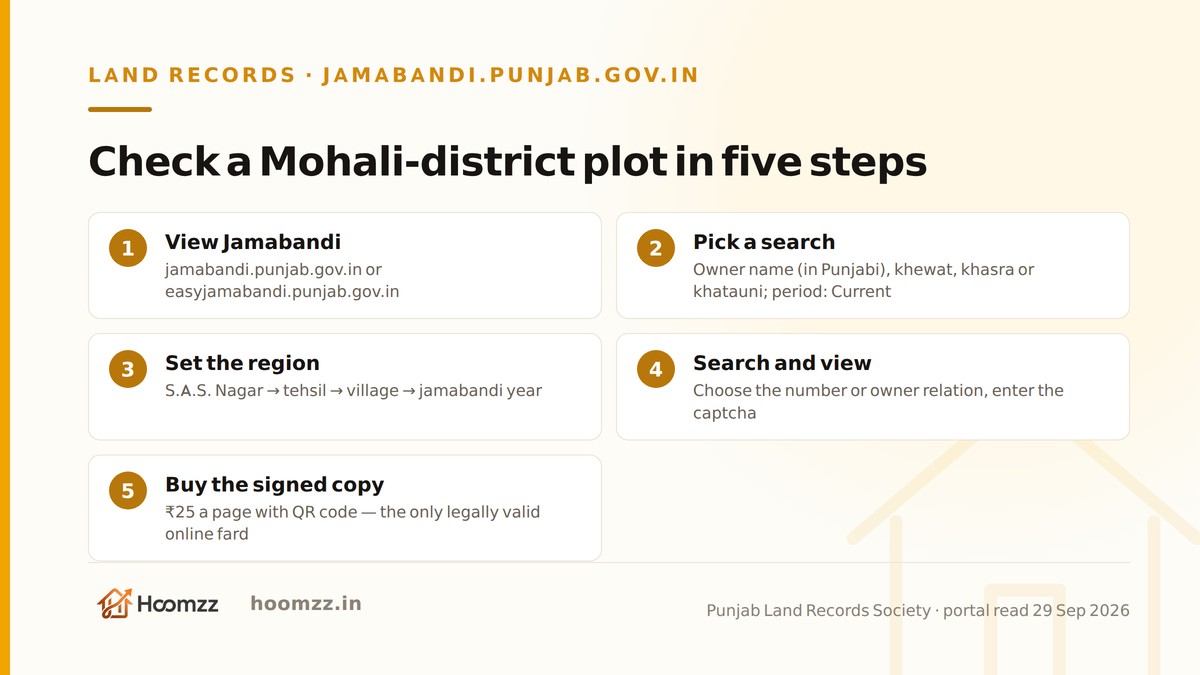
- Open the portalGo to jamabandi.punjab.gov.in, or the newer easyjamabandi.punjab.gov.in, and choose View Jamabandi.
- Choose how to searchOwner name, khewat number, khasra number or khatauni number. Keep Jamabandi Period on Current.
- Set the locationDistrict S.A.S. Nagar, then the tehsil, then the village, then the jamabandi year. Click Set Region.
- SearchPick the number from the dropdown. For a name search, type the name in Punjabi on the on-screen keyboard, click View Owner Relation and select the khewats.
- View, then decide on a signed copyEnter the captcha and view the report. Pay for the digitally signed fard if you need a legally valid copy for a bank or the registry.
Which tehsil? The portal lists seven for S.A.S. Nagar: Banur, Derabassi, Gharuan, Kharar, Majri, Mohali and Zirakpur. Pick what the portal shows, not what the district website says. The latest jamabandi year also differs from village to village. On 29 September 2026 the portal showed Zirakpur at 2023-24, Mohali, Sohana and Landran at 2020-21, and Dhakoli and Mundi Kharar at 2019-20. Anything that changed after that year will not be in the jamabandi. That is why the mutation and registered-deed checks below matter.
What to look for once the record is on screen
- Is the seller actually an owner, and of how much? A khewat often has many co-owners with fractional shares. A dealer selling “a 200 gaj plot” may hold a tiny share of a large khewat. That share, not a demarcated plot, is what can be transferred.
- Does the khasra match the ground? Ask for the khasra and killa numbers of the plot, and check that the colony layout places your plot inside them.
- Who is in possession? The khatauni shows the cultivator. A tenant or another cultivator on the land is a problem to solve before you pay.
- Any mortgage or court order? Loans against land and court orders are recorded through rapat entries (View Roznamcha). Revenue court cases are on a separate portal, rcms.punjab.gov.in.
- Any sale after the jamabandi year? Use View Registered Deed to search by seller or buyer name, khewat, registration number or date. Use View Mutation if you have a mutation number. Registration records from 2018 onwards are searchable online.
Fraud here is real, and it is local. In June 2023 a Kharar couple was arrested for forging property documents to raise about ₹30 crore in bank loans. In December 2023 developers were booked for forging landowners’ consent for land in Kailon village, Mohali. A photocopied fard proves nothing. Pull the record yourself, and for anything you will rely on, buy the ₹25-a-page signed copy with its QR code.
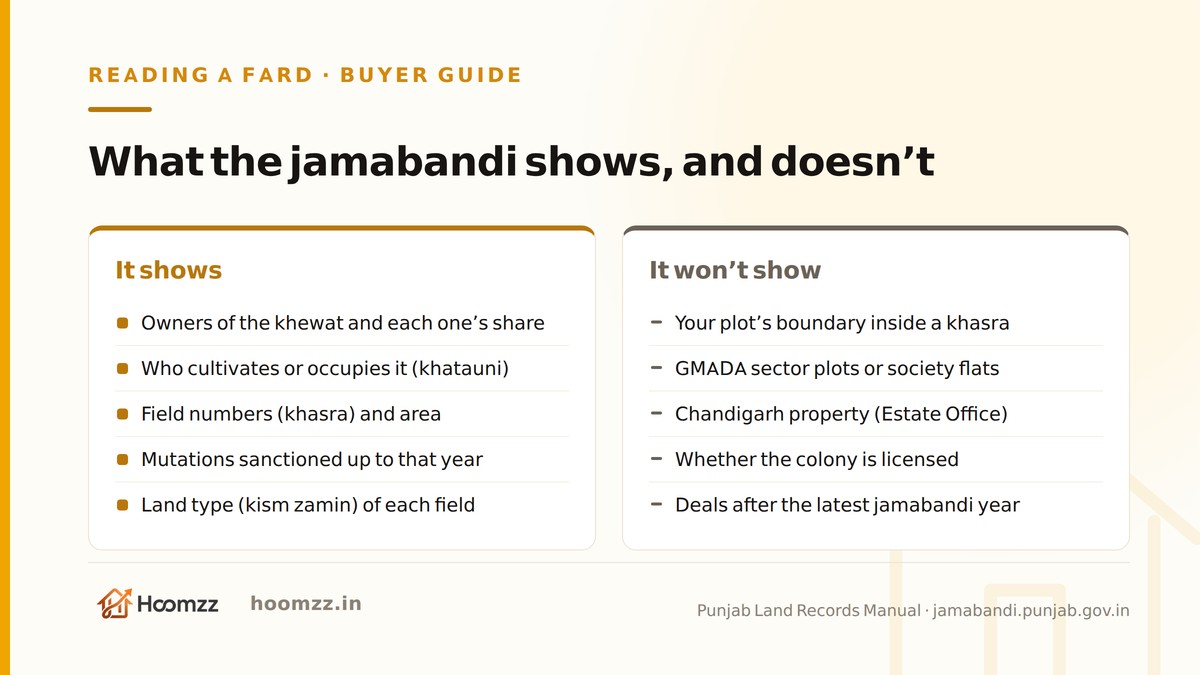
What the jamabandi cannot tell you, and where to look instead
| You are buying | Check here instead of, or as well as, the jamabandi |
|---|---|
| A plot inside a khasra in a private colony | Jamabandi for the land, plus the colony’s licence or NOC status on GMADA’s lists. Cadastral maps do not show sub-divided plots |
| A GMADA sector plot or house in Mohali | GMADA’s Know Property Ledger / Know Property Status |
| A flat in a society or project | The project’s Punjab RERA registration and the builder’s title. A single flat has no jamabandi of its own |
| Property in Chandigarh | The UT Estate Office’s Know Your Property. Chandigarh is not on the Punjab land records portal |
| A house inside the lal lakir of a village | Old registries and the Mera Ghar Mere Naam property card where issued |
If the plot is in an unauthorised colony, the land record is only half the story. Whether it can be registered at all depends on an NOC or colony regularisation, which our guide to registry without NOC in Punjab in 2026 explains. The deadline for colony regularisation applications is 30 September 2026. For authority plots versus private townships, see our plot verification guide. For flats, start with checking the builder on Punjab RERA.
Signed fard, fees and the new online services
The portal’s own FAQ says the free on-screen copy is for your information only. A legally valid fard is one of three things: the digitally signed, QR-coded copy bought online, a copy from a Sewa Kendra, or a copy from a Fard Kendra at the tehsil. If Adobe Reader shows a question mark over the digital signature, the FAQ says the certificate needs to be marked as trusted. It does not mean the fard is fake.
| Service | Charge | Time |
|---|---|---|
| View jamabandi online | Free (not legally valid) | Instant |
| Digitally signed fard | ₹20 government fee + ₹5 facilitation, per page | Download, or by WhatsApp or email |
| Fard by email | ₹50 per fard extra | 3 days |
| Fard by courier | ₹100 within Punjab, ₹200 outside, per fard | 7 days |
| Mutation after a deed registered on the new system | Sent to the patwari automatically | 30 days |
| Fard badar (correcting an error) | Nil per the portal FAQ; some reports mention a nominal fee | 15 days |
| Subscription alerts on a khewat | ₹500 a year per khewat | Alerts on any change |
Most of the newer services came with Easy Jamabandi, launched in June 2025. It added jamabandi on WhatsApp, online mutation requests with WhatsApp updates, rapat entries for loans and court orders, online fard badar and the subscription alerts. The subscription is worth it for anyone who owns land they do not visit, including NRIs. For ₹500 a year you get a message if anything changes on your khewat.
Doing these checks before paying token money is the single cheapest protection a plot buyer has. If you would rather start from listings where the owner has already been identified, Hoomzz lists verified properties for sale across Mohali, Kharar, Zirakpur and the rest of the Tricity. Browse properties for sale on Hoomzz.
Frequently Asked Questions
How can I check jamabandi online in Punjab?
Open jamabandi.punjab.gov.in and choose View Jamabandi. Select a search type (owner name, khewat, khasra or khatauni), then the district, tehsil, village and jamabandi year, enter the captcha and view the report. Viewing is free. For a legally valid copy, pay ₹25 a page for the digitally signed, QR-coded fard, delivered by download, WhatsApp or email.
How do I search Punjab land records by owner name?
On the jamabandi portal, choose the Owner Name search, set the district, tehsil, village and year, then type the owner’s name in Punjabi using the on-screen keyboard. Click View Owner Relation, select the matching khewats and enter the captcha to view the record. If you cannot type Gurmukhi, search by khasra number, which the seller should be able to give you.
Is a fard downloaded online legally valid in Punjab?
Only the digitally signed, QR-coded fard is legally valid. The free copy viewed on the jamabandi portal is for information only. The Punjab land records FAQ treats three copies as valid: the signed copy bought online at ₹25 a page, and copies issued by a Sewa Kendra or a Fard Kendra at the tehsil.
Why doesn’t my Mohali flat or GMADA plot show up in the jamabandi?
The jamabandi records rural land holdings by khewat and khasra. It does not show individual flats or plots carved out of a holding, and urban sector property is recorded by the development authority. For a GMADA sector property, use GMADA’s property ledger. For a flat, check the project’s Punjab RERA registration. For Chandigarh, use the Estate Office.
How long does mutation take after registry in Punjab?
Under Easy Jamabandi, launched in June 2025, a deed registered on Punjab’s online registration system is sent to the patwari for mutation automatically, with a 30-day timeline. Older deeds and inheritance need an online mutation request. Until the mutation is sanctioned, the sale does not appear in the jamabandi, so check pending mutations separately.
Sources, and what is inference rather than official statement
- Punjab Land Records Society: jamabandi portal (menus, tehsil list and latest years read on 29 September 2026)
- Punjab Land Records Society: fard service charges
- Punjab Land Records Society: FAQ on validity of copies, mutation and fard badar
- Punjab Land Records Manual, chapter 7: khewat, khatauni, khasra, mutation and the five-year jamabandi
- The Tribune, 13 June 2025: Easy Jamabandi services and the ₹500 subscription
- The Tribune, June 2023: Kharar forged-documents loan case
- The Tribune, December 2023: forged consent for land in Kailon village, Mohali
- GMADA: know my property details
Inference, not official statement. That GMADA sector plots and individual flats do not appear in the jamabandi is inferred from how the record is structured and from the state’s own note that land records do not yet cover urban areas or show sub-divided plots. How a plot in an unauthorised colony appears, typically as a share of a larger khewat, is common experience, not a documented rule. The latest jamabandi years quoted were read from the portal on 29 September 2026 and change as villages are updated.
👈 This comparison is based on market observations and publicly available data. Users should verify details independently.


Prioritize Hoomzz Real Estate News in your Google Search AI Overviews
Google's new search update lets you select trusted sources. Pin hoomzz.in to get our instant local market rates, builder updates, and renting news featured first in your AI answers.